


- Blog
- >
- Mobile App Development Cost
- >
- Mobile App Development Cost...
Mobile App Development Cost in 2026: Full Budget Guide
A professionally developed mobile app can cost roughly $15,000 to $500,000+ in 2026.
That range is wide because “mobile app” can describe anything from a focused product with a few workflows to a platform handling payments, live communication, regulated data, multiple user roles, enterprise integrations, or advanced AI.
GoodFirms’ 2026 app development cost study, based on input from 267 mobile app development companies across North America, Europe, and Asia, places overall app development costs at approximately $15,000 to $500,000+, with development timelines ranging from about three months to 18 months or longer depending on complexity.
Clutch provides a useful second perspective. Mobile app projects reviewed on its platform most commonly fall between $10,000 and $49,999, while its current average reviewed project cost is approximately $90,780, with an average timeline of about 11 months.
Those numbers are not directly interchangeable. GoodFirms organizes surveyed market estimates by project complexity, while Clutch reports costs from reviewed engagements on its platform. That difference in methodology helps explain why Clutch’s commonly observed project bands can sit below GoodFirms’ mid-level tier without the two sources being contradictory.
The more useful budgeting question is therefore not simply “How much does an app cost?”
But —
What must be designed, engineered, integrated, tested, secured, and supported for this particular product to work?
Mobile App Development Cost by Complexity
The following figures are best treated as market planning ranges rather than fixed quotations.
| App complexity | Estimated development cost | Typical timeline | Representative scope |
|---|---|---|---|
| Basic App / MVP | $15,000–$40,000 | 3–6 months | Simple UI, authentication, profiles, static or limited dynamic content, basic notifications, limited backend |
| Mid-Level App | $40,000–$120,000 | 6–9 months | Custom UX, payments, API integrations, real-time data, analytics, search, filtering |
| Advanced / Complex App | $100,000–$250,000+ | 9–12 months | Real-time communication, multi-role access, sophisticated integrations, offline sync, subscriptions, deeper analytics |
| Enterprise-Level App | $250,000–$500,000+ | 12–18+ months | Scalable cloud architecture, enterprise integrations, advanced security, compliance, permissions, DevOps, complex data processing |
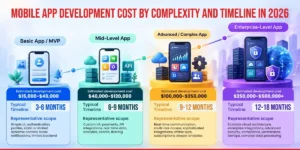
These figures match GoodFirms’ current 2026 complexity framework. The boundaries are not rigid. A consumer application can exceed $250,000 if it requires demanding real-time systems, several platforms, large-scale infrastructure, advanced media, or sophisticated data processing.
The label attached to the app matters much less than what has to happen behind the interface.
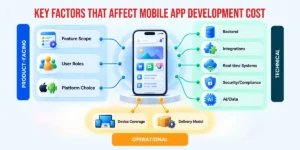
What Factors Affect Mobile App Development Cost?
Two products can contain a similar number of screens and require very different budgets.
The differences usually sit in the workflows, architecture, integrations, performance requirements, security model, and amount of ongoing infrastructure behind those screens.
Feature Scope and User Workflows
Counting features gives only a rough indication of complexity.
Consider a basic account profile. At one end, it may allow someone to update a name, email address, and profile picture. At the other, that same profile could interact with identity verification, subscriptions, permissions, medical records, payment history, recommendations, document storage, or several account types.
The second version is not just “one profile feature.”
Every additional rule, state, dependency, permission, and workflow adds engineering and testing work.
This is why estimating solely from the number of screens can produce misleading budgets.
How Does Platform Choice Affect App Development Cost?
Platform strategy deserves separate consideration because the decision can change both initial development effort and long-term maintenance.
Building one native iOS application is not inherently more expensive than every cross-platform project. The major cost difference appears when the alternative is developing and maintaining separate native implementations for both iOS and Android.
GoodFirms’ current market research provides the following platform-specific ranges:
| Platform approach | Simple app | Mid-level to advanced | Highly complex |
|---|---|---|---|
| Native iOS | $25K–$60K | $60K–$150K | $150K–$350K |
| Native Android | $28K–$70K | $65K–$150K | $160K–$380K |
| Separate native iOS + Android | $50K–$120K | $120K–$300K | $300K–$700K+ |
| React Native | $35K–$85K | $72K–$185K | $170K–$420K |
| Flutter | $33K–$80K | $40K–$100K | $165K–$410K |
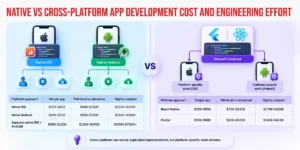
These are wider-market estimates, not Red Apple Technologies-specific prices.
They also answer a different question from the general complexity table above. The first table asks, “What can an app of this complexity cost overall?” This table asks, “How can platform and framework choice change that cost?”
GoodFirms estimates that cross-platform development can reduce initial development cost by roughly 20-40% compared with maintaining separate native iOS and Android implementations. That does not mean every line of code can be shared or that cross-platform is always the better architectural choice.
Flutter and React Native projects can still require platform-specific work around device capabilities, permissions, native SDKs, background processes, store requirements, testing, and specialist integrations.
Platform choice should therefore follow the product’s performance requirements, target devices, technical dependencies, UX expectations, and roadmap rather than cost alone.
Backend Architecture Can Cost as Much as the App Interface
A mobile app is often only the visible layer of a larger system.
The backend may be responsible for authentication, databases, business logic, payments, admin tools, notifications, search, content management, file processing, analytics, synchronization, messaging, permissions, and communication with third-party platforms.
GoodFirms estimates that backend development can consume roughly 25-35% of the initial build budget, broadly comparable with frontend or mobile engineering.
That is why two apps with equally polished interfaces can carry very different budgets.
A product displaying mostly static information is architecturally different from one coordinating transactions, several user types, live data, secure records, and multiple external systems.
How Much Do Third-Party Integrations Affect Cost?
Using an external platform can reduce the amount of software that must be built internally, but integration still requires engineering.
Payment gateways, CRM systems, mapping platforms, analytics tools, identity providers, communication APIs, healthcare systems, ERPs, and cloud services can all introduce authentication requirements, API limitations, version dependencies, usage fees, error handling, synchronization logic, and testing.
An existing API therefore does not mean “no development cost.”
It changes the work from building that functionality yourself to integrating and operating another system reliably.
How Much Does UI/UX Design Add?
Design cost depends more on the product experience than on whether the interface looks visually elaborate.
A straightforward application based on an established design system can reuse patterns and components. A product requiring several user journeys, complex interaction states, custom animations, accessibility work, responsive behavior, extensive prototyping, or brand-specific components needs substantially more design effort.
GoodFirms places UI/UX design at roughly 10-20% of the initial project budget in its current phase breakdown.
Existing components can reduce production effort, but they may still require licensing, customization, accessibility review, brand adaptation, and development work.
Security and Compliance Can Change the Architecture
Apps that process sensitive or regulated information usually require more than ordinary authentication.
Depending on the product, the architecture may need stronger identity controls, encryption, role-based permissions, secure storage, audit logs, consent management, security testing, data-retention policies, and compliance work.
Healthcare is a good illustration.
What This Looks Like in Practice: eSehati
Red Apple Technologies eSehati project had to support text, audio, and video consultations, searchable medical records, multilingual use, scheduling, 24/7 availability, and healthcare-data requirements including HIPAA or GDPR considerations.
The live case study reports more than 15,000 users within six months and over 3,000 virtual consultations per month.
The important point for cost planning is the engineering underneath those outcomes.
Secure health records, always-on availability, real-time communication, regulated data, and several connected workflows make this a fundamentally different build from a simple informational app.
Real-Time Features Add More Than a Screen
Chat, live location, collaborative activity, real-time dashboards, video, voice, live tracking, and synchronized device data can introduce persistent connections, latency requirements, data consistency, concurrency, fallback behavior, media infrastructure, and additional performance testing.
The visible feature may look simple.
The infrastructure behind it often is not.
What This Looks Like in Practice: Zippy
Red Apple Technologies Zippy fitness application combines IoT-device integration, real-time speed tracking, synchronized data, virtual running environments, AI-driven bots, and cross-platform functionality.
The case study reports 50K+ active users, a 70% increase in engagement within six months, and an 80% reduction in latency during extended runs.
Those results do not validate a particular pricing tier. They demonstrate why a product involving sensors, synchronization, latency constraints, real-time analytics, and cross-platform delivery carries a different engineering profile from a conventional content app.
How Much Can AI Add to App Development Cost?
There is no meaningful universal “AI surcharge.”
Adding one hosted model API to an existing workflow is very different from building retrieval over proprietary information, recommendation systems, evaluation pipelines, custom data processing, fine-tuning workflows, computer vision, or dedicated model infrastructure.
GoodFirms places AI-enabled app projects broadly around $50,000-$300,000+, but the range is too wide to use as a flat add-on.
AI should be estimated as its own technical workstream.
The estimate should specify what is being integrated, what data is required, how output quality will be evaluated, what infrastructure is involved, and which parts of the system depend on the AI component.
Device and OS Coverage Also Affects the Budget
Supporting one recent device is very different from supporting a broad matrix of hardware, screen sizes, OS versions, accessibility settings, network conditions, and device capabilities.
More coverage increases compatibility work, QA time, regression testing, debugging, and release validation.
The right device matrix should be based on the intended user base and product requirements rather than trying to support every possible configuration.
Does the Engagement Model Change App Development Cost?
It affects how cost is managed, but no engagement model is automatically the cheapest.
A fixed-price arrangement works best when the scope, acceptance criteria, dependencies, and deliverables are sufficiently clear. Fixed price does not necessarily mean paying the full amount upfront. Payments can still follow deposits, milestones, or acceptance stages.
Time-and-materials arrangements are generally better suited to evolving requirements. Cost follows actual effort and agreed roles rather than one predetermined total.
Dedicated-team models can suit longer roadmaps where the product needs stable capacity across multiple releases.
The right model depends on scope certainty, expected change, project duration, role mix, and how much product evolution is expected after the first release.
What Should a Mobile App Development Estimate Include?
The total number means very little if you do not know what is inside it.
| Area | What should be clarified |
|---|---|
| Discovery | Requirements, workflows, architecture, technical validation |
| UI/UX | Research, wireframes, prototypes, design system |
| Mobile engineering | Platforms, framework, native/shared code, device capabilities |
| Backend | APIs, databases, authentication, business logic, admin systems |
| Integrations | Payments, CRM, analytics, external platforms |
| Infrastructure | Environments, cloud configuration, deployment, monitoring |
| Security | Authentication, access control, data protection, compliance |
| QA | Functional, regression, device, performance and security testing |
| Release | Builds, store preparation, deployment support |
| Handover | Source code, documentation, credentials and deployment information |
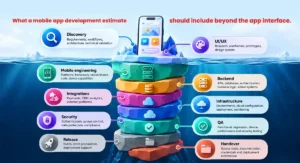
The estimate should also specify what it does not include.
Third-party software subscriptions, paid APIs, cloud consumption, marketing, content production, long-term support, or major post-launch features may sit outside the original build budget.
A $60,000 estimate and a $100,000 estimate cannot be compared properly until both describe the same responsibilities.
Where Does the Mobile App Development Budget Go?
GoodFirms’ current research provides the following indicative phase ranges.
| Development phase | Approximate share of budget |
|---|---|
| Planning and discovery | 5–10% |
| UI/UX design | 10–20% |
| Frontend/mobile engineering | 25–35% |
| Backend engineering | 25–35% |
| QA and testing | 10–15% |
| Deployment and launch preparation | 5–10% |
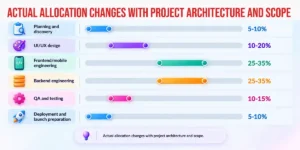
These percentages are broad ranges for individual phases. They are not fixed allocations that every project must add up to in exactly the same way.
A backend-heavy enterprise application may concentrate substantially more effort in architecture and integration. A simple consumer application may place relatively more emphasis on UX.
The useful point is that mobile development cost is distributed across much more than the screens users see.
Does Cross-Platform Development Cost Less Than Native Development?
Often, yes, when the alternative is building and maintaining separate native iOS and Android applications with substantially the same functionality.
The reason is straightforward: a suitable cross-platform framework can allow a meaningful portion of the product to share implementation.
That does not make cross-platform universally cheaper over the entire life of the product.
Applications that depend heavily on platform-specific capabilities, specialist hardware, advanced background processing, highly optimized graphics, or deep native integrations may require substantial native work regardless of framework.
GoodFirms’ 2026 data places React Native projects at approximately $35K-$85K for simpler builds, $72K-$185K for mid-level to advanced applications, and $170K-$420K for highly complex products.
Flutter sits at approximately $33K-$80K, $40K-$100K, and $165K-$410K respectively.
The wider strategic question remains:
How much of the product can genuinely share implementation without introducing performance, UX, or maintenance compromises later?
What Costs Continue After Launch?
The initial build is not the complete cost of owning a mobile product.
Ongoing expenditure may include infrastructure, databases, API consumption, monitoring, compatibility updates, bug fixes, security work, third-party services, analytics, support, and new releases.
GoodFirms uses approximately 15-25% of the initial development budget per year as a broad planning benchmark for maintenance and ongoing support.
For a $100,000 build, that would imply roughly $15,000-$25,000 per year as a starting maintenance allowance.
That estimate should not automatically include major feature development, unusually high infrastructure consumption, large-scale customer support, or marketing.
What App Store Costs Should You Budget For?
Store and developer-account charges are small compared with development cost, but they should still be included in launch planning.
Apple currently charges $99 per membership year for the Apple Developer Program.
Google Play requires a one-time $25 registration fee for a developer account.
Transaction and digital-goods fees should be budgeted separately. There is no single platform service-fee percentage that applies in every situation. Fees can vary by platform, region, program, transaction type, and billing route.
For that reason, a cost article should not hard-code one universal “store commission” percentage.
Check the current Apple and Google commercial terms when the product’s monetization model is being finalized.
How Can You Reduce Mobile App Development Cost Without Creating Rework?
Cutting the hourly rate is not necessarily the most effective way to reduce the total budget.
The larger savings usually come from reducing uncertainty, unnecessary scope, duplicated work, and expensive late changes.
Validate Technical Risks Before Full Production
A third-party integration, payment flow, AI dependency, hardware requirement, security constraint, real-time system, or compliance obligation can change the architecture.
Resolve the highest-risk assumptions before the entire product is built around them.
Define What the First Release Must Prove
An MVP should contain enough functionality to test the product’s central value without carrying every feature planned for the long-term roadmap.
That does not mean releasing a poor-quality product.
It means separating what is required now from what can wait.
The right validation metric depends on the product. Early evidence might involve activation, task completion, retention, conversion, workflow usage, or qualitative feedback rather than expecting every MVP to produce mature LTV or ARPU data immediately.
Reuse Components When They Actually Fit
Existing authentication systems, design systems, payment services, cloud platforms, SDKs, or proven libraries can reduce custom development.
Reuse stops saving money when a dependency requires extensive workarounds or cannot support the roadmap.
Compatibility, licensing, security, documentation, and long-term support still matter.
Choose the Initial Platform Deliberately
If the product does not require both iOS and Android for the first release, starting with the platform that best matches the initial audience can reduce scope.
If both platforms are required and much of the experience can be shared, Flutter or React Native may reduce duplicated implementation.
The decision should follow the product rather than a blanket rule that one technology is always cheaper.
Test Throughout Development
Testing should happen throughout production, not after development is supposedly complete.
Functional QA, integration testing, device validation, regression testing, performance checks, and security review help identify problems before they become expensive release blockers.
GoodFirms’ phase framework allocates roughly 10-15% of the initial budget to QA and testing, which reflects how substantial this work can be.
How Should You Compare Two Mobile App Development Quotes?
A lower number is not automatically the better offer.
| Compare | What to check |
|---|---|
| Scope | Are both estimates covering the same functionality? |
| Platforms | iOS, Android, both, web, or another interface? |
| Backend | Included, partially included, or assumed to exist? |
| UX/UI | How much design work is included? |
| Integrations | Which systems are actually covered? |
| QA | What testing and device coverage are included? |
| Infrastructure | Who sets up deployment, environments, and monitoring? |
| Security | Which security requirements are included? |
| Project management | Is delivery coordination part of the price? |
| Handover | What code, documentation, and access are transferred? |
| Post-launch support | Is a warranty or support period included? |
| Change process | How are new requirements estimated and approved? |
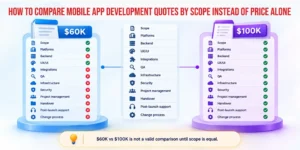
The $60,000 quote may simply exclude work contained in the $100,000 quote.
Compare total scope, ownership, assumptions, and delivery risk before comparing headline prices.
Ready to Move From a Market Range to a Project Estimate?
Industry benchmarks help establish whether a project is likely to cost tens of thousands or several hundred thousand dollars.
They cannot determine the final budget for your product.
Platforms, workflows, integrations, backend requirements, security, compliance, design depth, infrastructure, and delivery model still need to be scoped.
If you already have an initial concept or feature set, RAT’s project calculator can provide a more specific starting point based on those requirements.
Use the Red Apple Technologies project cost calculator
Treat calculator output as an initial planning estimate. The delivery range should still be confirmed after the technical requirements and dependencies have been reviewed.
Final Thoughts
A useful mobile app development cost estimate begins with scope, not with one average figure.
Current 2026 market research places professional app development broadly between $15,000 and $500,000+, but the amount that matters is the range appropriate to the product being built.
A focused MVP, a consumer marketplace, a telemedicine platform, an IoT fitness product, and an enterprise application all create different engineering obligations even though each could be described simply as a “mobile app.”
Define the first release, identify the systems behind it, make the platform decision deliberately, and compare estimates on equal scope.
For projects moving from planning into delivery, Red Apple Technologies supports product discovery, UX/UI, mobile and backend engineering, integrations, QA, deployment, and post-launch development.
Explore App Development at Red Apple Technologies
The Author

Related Blogs
Discover more stories & insights that inspire
A mobile app may be the part of a digital product users see first, but much of the real work happens behind the screen. Modern apps often depend on cloud...

Mobile applications have become an essential part of modern business strategies, transforming how companies interact with customers, deliver services, and drive innovation. However, with the rapid adoption of mobile technology...
From general people to business establishments, digital wallet apps are emerging as a popular, faster, and more efficient medium of financial transactions worldwide. With a staggering market value of $9.55...

The online education industry is substantially evolving with cutting-edge technological innovation. Now with the introduction of Mobile Learning (mLearning) apps, prospects in the e-learning industry are also witnessing a steady...
Despite experiencing the hassle-free purchasing benefits of online shopping, people have not stopped visiting physical retail outlets. As of now, 82 percent of customers across the world prefer visiting physical...
Women’s healthcare is gaining prominence with rapid technological advancement. Right now, plenty of women health tracking applications are available in the Google Play store and iOS App store. It is...

Every business is prioritizing the utilization of Virtual Reality (VR) over time. VR has the outstanding potential to upgrade your business to the next best level. Entrepreneurs also have the...

The use of IoT (Internet of Things) in the fitness segment is gaining momentum with time. It is assisting fitness freaks, health instructors, and others to achieve distinct objectives with...
Our previous post was centered on mobile app development ideas and strategies. It also mentioned the mobile app development stages that are observed to achieve the desired outcome. You should...
Mobile apps are altering businesses to the next level. This is very much evident with the massive audience engagement and revenue generation. Now, every industry is seeking mobile app development...


 Book An Appointment
 WhatsApp