


- Blog
- >
- agency or freelancer for...
- >
- game development company
- >
- 2D vs 3D Game...
2D vs 3D Game Development Companies: Which Should You Choose?
The decision between a 2D and a 3D game development company is rarely just about visuals. For businesses, startups, and studios, it’s a strategic choice that affects cost, timelines, player experience, and long-term scalability. This 2D vs 3D game development comparison helps clarify how each approach differs in practice and what to consider when choosing between 2D and 3D studios for your next project.
Rethinking the Difference Between 2D and 3D Game Development
At a surface level, the difference between 2D and 3D games appears straightforward. One operates in a flat visual plane, while the other introduces depth and spatial movement. In reality, this distinction represents two fundamentally different production approaches followed by any game development company.
2D game development emphasizes clarity, speed, and controlled complexity. Assets are typically sprite-based, perspectives are fixed, and gameplay systems are easier to prototype and refine. Many companies specializing in 2D development focus on rapid iteration and accessibility.
3D game development adds an additional dimension, literally and operationally. Characters, environments, and interactions exist in three-dimensional space, requiring coordination across modeling, animation, lighting, physics, and camera systems. A 3D/2D game development company offering such services must manage significantly higher technical complexity.
Understanding this difference early is critical when choosing between 2D and 3D studios.
How Development Complexity Shapes Real-World Delivery
The practical differences between 2D and 3D become most visible once development begins.
In 2D projects, teams tend to move faster. Asset creation is simpler, gameplay changes are easier to test, and performance optimization is more predictable. This allows a game development company focused on 2D titles to deliver quicker builds and adapt to feedback efficiently.
3D development introduces more dependencies. A change to a character or environment can affect animations, physics behavior, lighting, and performance. Because of this, companies that specialize in 3D projects rely on structured pipelines, specialized roles, and longer testing cycles.
This isn’t a disadvantage but the trade-off required to deliver immersive, spatial experiences.
Cost Isn’t Just About Budget; It’s About Commitment
Cost is often the first consideration in any 2D vs 3D game development comparison, but it shouldn’t be the only one.
2D projects usually require smaller teams and shorter timelines, making them attractive for startups and indie studios that want to control risk. Hiring a game development company for 2D work often means lower upfront investment and faster validation.
3D projects demand more resources. When you hire 2D/3D game developers for a 3D tile, you’re paying for specialized skills, longer production cycles, and extensive QA. For games aiming at premium positioning or long-term content expansion, this investment can make sense.
The real question is not which option is cheaper but which level of commitment aligns with your goals.
Player Experience: Simplicity Versus Immersion
From the player’s perspective, the difference between 2D and 3D is immediately noticeable.
2D games prioritize readability and precision. Players can quickly understand mechanics, controls feel tight, and visual distractions are minimal. This makes 2D ideal for strategy, puzzle, platformer, and casual genres.
3D games focus on immersion. Players explore environments, navigate space, and experience depth through camera movement and environmental interaction. Genres like RPGs, simulations, and shooters benefit significantly from this approach.
A capable game development company evaluates which experience best serves your audience, not which format is trending.
Platform Reach and Performance Considerations
Platform strategy plays a major role when choosing between 2D and 3D studios.
2D games generally perform well across a wide range of devices, including lower-end smartphones and older hardware. This broader compatibility helps with distribution and ongoing maintenance.
3D games require more processing power and careful optimization, especially on mobile platforms. A 3D/2D game development company must account for hardware constraints early to avoid performance issues later.
Choosing the wrong approach for your target platforms can increase costs or limit reach.
Tools, Technology, and Production Pipelines
Many companies use the same engines, such as Unity or Unreal, but the pipelines differ based on dimensional focus.
2D pipelines emphasize sprite systems, tilemaps, UI workflows, and lightweight physics. The goal is fast iteration and gameplay balance.
3D pipelines involve modeling, rigging, animation systems, shaders, lighting, and performance optimization. When you hire 2D/3D game developers for such projects, you’re also investing in deeper technical coordination.
These differences directly impact timelines, budgets, and team structure.
Team Structure: What You’re Really Hiring
Understanding who you’re hiring matters as much as what you’re building. A 2D-focused game development company typically works with designers, 2D artists, animators, and gameplay programmers. Communication tends to be simpler, and iteration cycles are shorter.
A 3D-focused company requires a broader mix of specialists (environment artists, animators, technical artists, and engine programmers), adding coordination overhead but enabling more complex results.
This distinction is critical when choosing between 2D and 3D studios.
Which Option Makes Sense for Startups and Indie Studios?
For many startups, 2D development offers a practical entry point. Faster delivery, smaller teams, and lower costs help validate ideas before scaling.
However, 3D development can be the right choice if immersion, differentiation, or premium positioning is central to the vision. The key is aligning ambition with resources and choosing the right game development company to execute it.
Can One Company Handle Both 2D and 3D?
Some 3D/2D game development companies offer both services under one roof. This can be useful if your project may evolve over time or if you want a single long-term partner. What matters most is depth of experience, not just service labels.
How to Choose Between a 2D or 3D Game Development Company
Before deciding, ask:
- Which platforms are we targeting?
- What experience does our audience expect?
- What is our realistic budget and timeline?
- Do we need fast iteration or long-term scalability?
- Does the company have proven experience in our chosen format?
Strong partners guide clients through these questions instead of pushing one approach.
Why Some Teams Consider Red Apple Technologies
When businesses compare 2D vs 2D game development companies, they often look for partners that can advise on which approach makes sense, not just execute a predefined scope. Red Apple Technologies is sometimes considered in this context because of its experience working across both 2D and 3D production pipelines.
The company typically supports startups, indie studios, and growing teams that need structured guidance alongside execution. Rather than treating 2D or 3D as a default choice, projects are usually evaluated based on gameplay goals, target platforms, and long-term scalability.
Another factor that draws attention is flexibility in engagement models. Teams that hire 2D/3D game developers through Red Apple Technologies often do so with the intention of starting small and scaling development as the product evolves, including post-launch support where needed.
This approach tends to resonate with teams that value predictability, continuity, and technical clarity when choosing between 2D and 3D studios.
Conclusion
The choice between a 2D or 3D game development company isn’t about trends; it’s about alignment. Both approaches can succeed when matched with the right goals, audience, and execution strategy.
Choosing wisely means understanding the trade-offs, setting realistic expectations, and partnering with a company that can deliver from concept to launch—and beyond.
To Have A Better Understanding On This Let us Answer The Following Questions
Answer: Start by defining your core objectives: target platform, audience expectations, budget, and timeline. If rapid iteration, lower cost, and broad device compatibility matter most, a 2D game development company may be the better fit. If immersion, realism, and spatial interaction are central to your project vision, a 3D-focused team is more appropriate.
Answer: Not always, but it usually is for comparable scope. A complex 2D game with deep mechanics and live features can cost more than a simple 3D prototype. Cost depends on asset volume, feature depth, polish level, and post-launch support; not just dimensionality.
Answer: Both can work, but 2D games generally offer better performance across a wider range of devices. 3D mobile games require careful optimization and are better suited for mid-to-high-end hardware. The right choice depends on your audience and retention strategy.
Answer: Some 3D/2D game development companies do offer both services. However, you should validate the depth of experience in each area. Review portfolio examples, ask about team specialization, and confirm whether dedicated 2D or 3D pipelines exist.
Answer: Not necessarily. Specialists often deliver higher quality within their focus area. Risk arises only if your project’s requirements evolve beyond that specialization without proper planning or transition support.
Answer: 2D projects typically move faster due to simpler asset creation and fewer technical dependencies. 3D projects take longer because of modeling, animation, physics, and performance optimization. Timelines should reflect these realities when planning milestones.
Answer: It’s possible but rarely straightforward. Core systems, assets, and mechanics often need to be rebuilt. If future 3D expansion is likely, it’s best to plan for it early or work with a game development company experienced in both formats.
Answer: Startups often benefit from 2D development because it reduces cost and accelerates market validation. However, if the value proposition depends heavily on immersion or realism, 3D development may be justified even at an early stage.
Answer: Key questions include: What similar projects have you delivered? How do you manage scope changes? What post-launch support do you offer? How do you optimize performance for target platforms? Clear answers indicate process maturity and reliability.
Answer: No. Engagement depends on gameplay quality, progression systems, and player feedback loops. Many successful games remain 2D because they execute mechanics exceptionally well.
Answer: 2D games are generally easier to update with new content and balance changes. 3D games often require more testing and optimization for each update, increasing post-launch effort. This should be factored into long-term planning.
Answer: Experiences should usually take priority. A lower-cost vendor without relevant expertise can lead to delays, rework, and higher overall spend. Look at total project value, not just initial pricing.
Answer: Choosing based on trends instead of strategy. A well-executed 2D game often outperforms an under-resourced 3D project. Alignment matters more than ambition.
Answer: Rushing increases risk. Shortlisting 3–5 companies, reviewing portfolios, and holding technical discussions usually leads to better outcomes than quick decisions.

Related Blogs
Discover more stories & insights that inspire
Two game studios can show equally polished portfolios and still create very different production risk. The difference often becomes visible only after you look beyond the showreel: who will actually...

A game can have a strong core loop and still run into trouble if two business decisions are left until the end: how it will make money and how it...
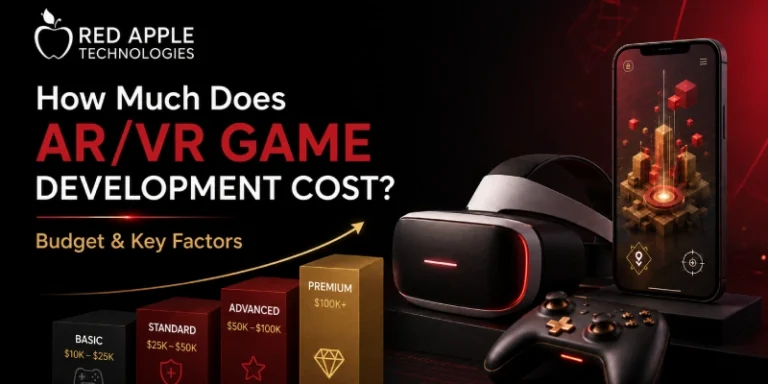
An AR prototype built around one core interaction and a multiplayer VR game designed for several headsets should not receive anything close to the same estimate. Both may fall under...

A quote tells you what a studio expects the project to cost. A portfolio shows what it has worked on. Neither tells you whether the team assigned to your game...
A good-looking game can still fail to hold a player’s attention if its mechanics are unclear, progression feels unrewarding, or levels become frustrating for the wrong reasons. Game design goes...
Despite occupying second position after China, the USA still manages to be a superpower in the global game industry. Whether game development or game publishing, the USA continues to shine...
Italy has quietly developed into one of Europe’s most creative mobile game development ecosystems. While the country may not match the scale of mobile gaming markets like the United States...

The UAE — particularly Dubai and Abu Dhabi — has rapidly evolved into one of the Middle East’s most ambitious gaming hubs. Backed by government-led initiatives, global investment, and major...
Turkey has become one of the fastest-growing mobile gaming ecosystems in Europe. Over the past decade, mobile game developers in Turkey have produced globally successful casual and hyper-casual titles, attracted...

Spain has established itself as one of Europe’s most active mobile game development markets. With internationally successful studios, experienced live-operations teams, and competitive production structures, the country continues to attract...


 Book An Appointment
 WhatsApp