


Why Hire Dedicated Unreal Developers for Game Development Projects?
There’s a moment in almost every Unreal project where progress starts to feel heavier. Not slower in an obvious way, but heavier. Features take longer to implement. Fixes don’t stay fixed. Systems that once worked independently begin interfering with each other.
At that point, most teams assume the problem is technical. It usually isn’t. It’s structural. More often than not, it leads to a realization that comes slightly too late: the project didn’t just need developers. It needed a smarter approach to how teams are built.
This is exactly where the decision to hire Unreal developers for game projects begins to shift from optional to essential.
The Industry Is Growing Faster Than Teams Can Adapt
The pressure isn’t just internal — it’s coming from the market itself. According to Grand View Research, the global game engine market was valued at over £3 million in 2024 and is projected to exceed $8.3 million by 2030, growing at a CAGR of more than 18%.
At the same time, Statista reports continuous growth in global gaming revenue and player engagement, driven by demand for richer graphics, real-time responsiveness, and cross-platform experiences. This combination is reshaping expectations. Games are no longer judged just on gameplay; they’re evaluated on performance, immersion, and scalability. And that raises the technical bar for every studio entering the space.
Unreal Engine Builds Complexity Faster Than You Expect
Working with Unreal Engine means working with a system designed for high-end output. But that power comes with a trade-off. You’re not just building features — you’re designing interconnected systems that must work together under pressure. Rendering, physics, AI, and networking all operate simultaneously, and even small inefficiencies can scale into larger problems. At the beginning, this complexity stays hidden. As the project grows, it becomes unavoidable.
When Projects Reach the Breaking Point
Early development phases are usually smooth. Teams move quickly, ideas come together, and progress feels steady. But over time, certain patterns begin to emerge. You might notice:
- Performance drops when multiple systems are active
- Features taking longer due to increasing dependencies
- Fixes creating unexpected issues elsewhere
These are not isolated challenges. They are indicators that your project has reached a level where general workflows are no longer enough. At this stage, many studios begin to seriously consider whether to hire Unreal developers for game projects who bring deeper specialization.
What Dedicated Unreal Engine Developers Actually Change
The real value of dedicated Unreal Engine developers isn’t just in execution — it’s in continuity. When developers stay consistently involved in a project, they begin to understand how different systems interact over time. They don’t just solve problems as they appear; they anticipate them.
This leads to a different development pattern. Instead of reacting to performance issues, systems are designed to avoid them. Instead of patching bugs, architecture becomes more stable from the outset. That shift from reactive to proactive development is what separates scalable projects from fragile ones.
Why More Developers Isn’t Always the Answer
When projects slow down, the instinct is often to expand the team. But Unreal development doesn’t always scale linearly with headcount. Adding more developers can introduce:
- Increased coordination overhead
- More context switching
- Greater inconsistency across systems
What actually improves outcomes is specialized expertise. This is why many studios choose to work with an experienced Unreal development company rather than building large in-house teams without the required depth.
The Cost Perspective Most Teams Overlook
Cost is often the biggest hesitation when deciding whether to bring in experts. But Unreal projects tend to shift how cost should be evaluated. The real expense doesn’t come from hiring specialists — it comes from fixing what wasn’t built correctly in the first place. This often includes:
- Rebuilding systems that don’t scale
- Fixing late-stage performance bottlenecks
- Delays caused by architectural limitations
This is where working with a reliable Unreal development partner becomes a strategic move rather than a financial one.
Momentum Is What Keeps Projects Alive
Game development is less about speed and more about momentum. You don’t need to move fast every day — you need to keep moving without friction. Dedicated teams help maintain that flow. They reduce fragmentation, improve communication, and ensure that different parts of the system evolve together.
Over time, this creates a development environment where fewer things break, and fewer things need to be revisited. That’s where Unreal game development services start to deliver real value — not just in output, but in stability.
When Teams Turn to an Unreal Development Partner
There’s usually a clear moment when teams begin looking outside. It might come after a missed milestone, or when performance issues persist longer than expected, or simply when progress becomes inconsistent. At that point, the focus shifts toward finding an Unreal development partner who can step in without disrupting the project’s direction.
Companies like Red Apple Technologies are often brought in during this phase — not just to contribute development resources, but to bring structure and predictability back into the process.
Timing Shapes the Outcome More Than Budget
Two projects can have similar budgets and similar teams, and still produce very different results. The difference often comes down to timing. Teams that hire Unreal developers for game projects early tend to:
- Avoid large-scale rework
- Maintain consistent performance
- Scale systems more efficiently
Teams that wait usually spend more time correcting issues that could have been prevented.
When Dedicated Developers Become Non-Negotiable
Not every project needs a dedicated Unreal team from the beginning. But once your game involves high-end visuals or cinematic environments, multiplayer or real-time interactions, or multi-platform deployment, the margin for error becomes extremely small. At this stage, relying solely on generalist development approaches can slow progress significantly. This is where dedicated Unreal Engine developers transition from being a strategic advantage to a core requirement.
Final Thought
The decision to hire Unreal developers for game projects is rarely about replacing a team. It’s about strengthening the foundation before complexity makes that foundation harder to adjust. Because Unreal Engine doesn’t just amplify what you build — it amplifies how you build it. And in projects where systems grow quickly, the difference between steady progress and constant rework often comes down to one factor: whether the right expertise was brought in at the right time.
To Have A Better Understanding On This Let us Answer The Following Questions
Answer: Because early architectural decisions affect long-term scalability and performance in Unreal projects.
Answer: They improve system stability, performance optimization, and long-term scalability.
Answer: Yes, especially when projects involve complex systems or high-quality visuals.
Answer: When development slows due to complexity or when scaling becomes difficult.
Answer: Look for proven experience, strong collaboration practices, and the ability to handle large-scale systems.
Get Started
- End-to-End Game & App Development Services
- Flexible Business Models – Project Based or Dedicated Hiring
- 13+ Years of Industry Experience with Global Clientele
- Globally Recognized by Clutch, GoodFirms & DesignRush
Related Blogs
Discover more stories & insights that inspire
Hiring for Unreal Engine isn’t as straightforward as it looks on paper. You can review portfolios, check years of experience, and still end up with a team that struggles once...
Most teams think they have a hiring problem. They don’t. They have a structure problem discussed as a hiring problem. Because when a project slows down, the instinct is predictable:...

There’s a pattern you start noticing if you talk to enough game studios in San Francisco. They don’t struggle with ideas. They don’t struggle with funding. They struggle with execution...
Stunning visuals. Console-level performance. And a development process that can either scale or collapse based on who you hire — that’s the reality of building games with Unreal Engine. It’s...

How to Choose a Game Outsourcing Partner in Washington: A Studio Head’s Perspective Game development has shifted. The days when a single in-house team could hand-craft every texture, line of...
Game development has evolved as the most flourishing industry worldwide. With a global market value of $300 billion, the gaming industry is rapidly capturing the attention of business owners with...
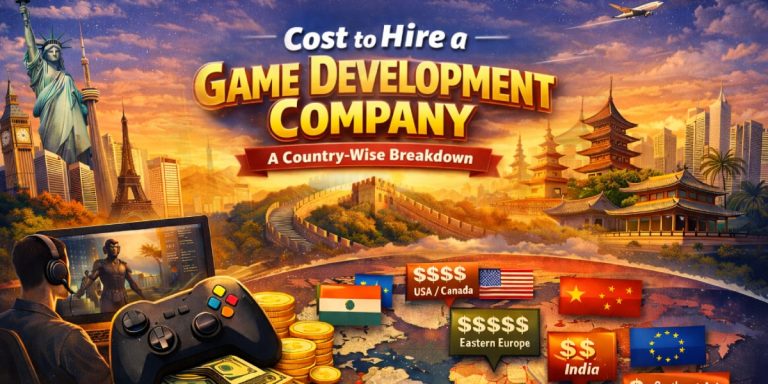
One of the first questions businesses ask when planning a game project is deceptively simple: How much does it cost to hire a game development company? The reality is that...
Whether it is making strategic decisions, providing employee training, or fulfilling other organizational goals, simulation has evolved as an indispensable tool in global businesses. From Healthcare to Education, Software Development,...
Visual realism is crucial in gaming. If you can provide immersive and realistic experiences, your games are likely to succeed. Gameplay mechanics and storyline, while part of the equation, are...
Video game development not only requires fresh ideas but also involves using the right game engine where consulting a professional game development company is essential. As of now, enterprises are...


 Book An Appointment
 WhatsApp