



GAME PROVIDER INTEGRATION SERVICES
Trusted By
Brands, Studios And Businesses Worldwide






FROM API TO GAME LAUNCH
CONNECT THE PROVIDER WITHOUT
BREAKING THE PLAYER FLOW
A casino API integration has to keep the provider, player session, wallet flow, and transaction state aligned from launch through the end of play. We engineer each connection around the provider's API contract and the platform conditions it has to work within.
FOUR CORE PROVIDER INTEGRATION AREAS
BUILT FOR THE REALITIES OF GAME PROVIDER INTEGRATION
Provider-Specific
API Contracts
Game providers do not all expose the same endpoints, authentication methods, payload structures, wallet models, or error behavior. Each integration has to work with the provider's technical contract.
Experience across 100+ provider protocols helps us account for those differences without treating every game provider API integration as though it follows one reusable pattern. game-provider-integration

Transaction Integrity
Under Failure
A timeout does not always mean a transaction failed. Retries, duplicate callbacks, delayed responses, cancellations, and rollbacks can all affect what the provider and platform believe happened during a game round.
We use idempotency, transaction references, recovery paths, and state handling to keep duplicate requests and interrupted transactions from creating inconsistent balance states. The integration architecture supports sub-100ms transaction processing for provider round flows.
Environment &
Release Control
Provider integrations usually move through credentials, sandbox environments, test accounts, configuration checks, transaction-flow validation, and production settings before real players can access the games.
We keep those environments explicit and validate launch, wallet, callback, rollback, and error flows before production configuration is introduced.


Logging &
Diagnostics
Once a provider goes live, failed launches or mismatched transactions need enough technical context to investigate. An integration that works but cannot be traced becomes difficult to operate.
Provider responses, transaction references, round IDs, error states, and relevant logs are accounted for so teams can follow what happened across the platform-provider boundary when an issue appears.
FROM PROVIDER CATALOG TO CASINO LOBBY
CONNECT EVERY GAME TO THE PLATFORM THAT HAS TO LAUNCH IT
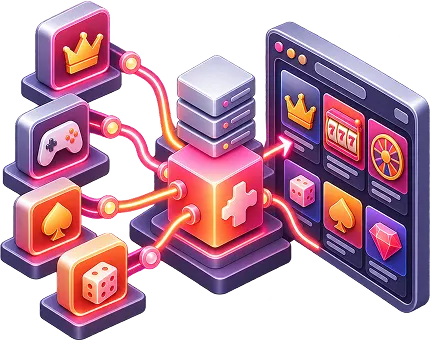
A casino game integration involves more than establishing API communication. Our integration experience covers provider catalogs totaling 10,000+ games, where IDs, titles, categories, currencies, languages, launch parameters, and supplied metadata have to map correctly into the casino platform and player-facing lobby. game-provider-integration
Those structures vary by provider. We account for catalog formats, availability data, configuration rules, assets, and launch requirements so the platform can identify and request each game correctly.
Where the provider API supports it, synchronization can keep game availability, categories, thumbnails, localized assets, and other supplied metadata aligned as provider-side content changes.
BEYOND THE BASIC CONNECTION
BRING PROVIDER-SIDE FEATURES
INTO THE SAME INTEGRATION
Game provider APIs can expose capabilities beyond game launch and wallet transactions. Where the selected provider supports them, we connect those features to the platform rules, player data, and operational flows they depend on.
BUILT FOR WHAT HAPPENS AFTER GO-LIVE
KEEP THE INTEGRATION WORKING AS THE PROVIDER CHANGES
A provider connection does not become static once it reaches production. APIs, game catalogs, configuration requirements, and platform dependencies can change over time, so the integration needs room for controlled updates without destabilizing the live environment.
Frequently Asked Questions
The cost of a casino game provider integration depends on the provider API, existing platform architecture, wallet model, authentication and launch requirements, supported currencies and markets, testing scope, and whether existing integration code needs to be modified. We scope the work after reviewing the provider documentation and the systems the connection has to work with.
The timeline varies with API complexity, documentation quality, sandbox access, wallet and transaction flows, platform readiness, testing requirements, and the provider's own review process. A contained integration into an established platform can move differently from one that also requires backend changes or migration from an existing connection.
Yes, where the platform exposes the technical access and integration points required by the provider. We first review the existing architecture, wallet and session flows, available APIs, and platform constraints to determine where the provider connection should sit and what surrounding changes may be required.
Usually, access to production games and provider systems depends on the commercial relationship between the operator or platform owner and the game provider. We handle the technical integration within the access and documentation made available for the project rather than representing the provider or arranging commercial game-content rights.
Yes. We support provider integrations using both seamless and transfer-wallet models. Each implementation follows the selected provider's balance, bet, win, cancellation, rollback, and settlement requirements rather than assuming one wallet flow applies to every provider.
Yes. Multiple game providers can be connected to the same casino platform, with each integration implemented around that provider's authentication, game-launch, wallet, transaction, callback, and configuration requirements. Integrations can also be phased as the game offering expands.
We can support technical integration testing, sandbox validation, transaction-flow testing, error handling, configuration checks, and fixes required during the provider's integration process. Final certification, acceptance, or production approval remains subject to the provider or other responsible third party where their approval is required.
Yes, where the existing code, provider documentation, credentials, and relevant platform access are available for review. We assess the current launch, wallet, transaction, callback, and configuration flows first, then define whether the integration should be repaired, completed, or partially reworked.
READY TO CONNECT A
GAME PROVIDER TO YOUR PLATFORM?
Get a reply within 24 hours
Tell us where the project stands today. We'll start there.


 Book An Appointment
 WhatsApp