


How Much Does It Cost to Make a Video Game in 2026? Full Pricing Breakdown
- Home
- /
- Blog
- /
- Game Development Services
- /
- How Much Does It...
A video game can cost anywhere from a few thousand dollars for a small prototype to well over $100 million for a large multiplayer, console, or AAA-style project. The final number depends on what the game needs to do, where it will run, how it looks, how many people build it, and how much support it needs after launch.
A simple 2D mobile game can be built on a lean budget. A mid-core mobile game with progression, live events, backend systems, and monetization needs significantly more planning and spend. A multiplayer shooter, open-world RPG, sports game, or console title gets expensive fast because of art production, optimization, servers, testing, platform requirements, and long-term content support.
That’s why the more useful question isn’t simply:
How much does it cost to make a video game?
It’s:
What kind of game are you building, and what does the budget actually need to cover?
This guide breaks down game development cost by game type, platform, production phase, engine, art requirements, multiplayer scope, team model, timeline, and hidden expenses, using current 2026 pricing where the numbers are tied to real platform and engine fees.
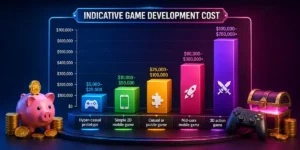
Quick Answer: How Much Does It Cost to Make a Video Game?
A video game typically costs $10,000–$50,000 for a simple mobile or 2D game, $80,000–$300,000+ for a mid-core mobile or multiplayer game, $100,000–$700,000+ for a polished 3D game, and $1 million–$100 million+ for AA or AAA production. The exact figure depends on genre, platform, art fidelity, multiplayer/backend needs, engine, team model, and timeline — the factors covered in detail below.
These ranges are indicative planning estimates. Actual costs may vary based on region, team seniority, production model, IP requirements, third-party tools, backend infrastructure, platform approvals, and post-launch support.
A game’s cost should always be estimated against its actual scope. A “simple mobile game” and a “mobile RPG” may both run on phones, but their budgets can be completely different.
What Does Game Development Cost Include?
A complete game development budget covers nine areas: discovery and planning, game design, prototyping, art and animation, core development, backend and multiplayer, QA and optimization, launch preparation, and post-launch support, not just programmer hours.
A budget that covers only “development hours” is incomplete. Art, QA, backend, project management, launch support, and updates can significantly change the final cost.
Main Video Game Development Cost Factors
1. Game Genre and Scope
Genre is one of the biggest drivers of game development cost, because it determines how many systems, assets, and content pipelines the game needs. A casual 2D game needs fewer systems and a shorter production cycle. An RPG needs characters, story, levels, combat, inventory systems, UI, and content pipelines. A battle royale or multiplayer shooter needs servers, matchmaking, network optimization, anti-cheat planning, and long-term LiveOps.
The larger the feature set, the more the budget grows. A small but polished game is usually easier to control than a large game with unclear systems.
Also Read: Best Game Genres to Invest in for 2026
2. Platform Choice
Platform affects cost because every device and storefront carries its own testing requirements, certification process, and technical constraints. A mobile game needs testing across many screen sizes, OS versions, and device tiers. A console game involves dev kits, platform certification, controller optimization, and stricter performance checks.
A mobile game development cost estimate should specify whether the game is for Android, iOS, or both. Cross-platform release can improve reach, but it also adds QA, release management, UX, and performance work.
3. Project Complexity
Complexity is driven by systems, not visuals alone; real-time multiplayer, AI, physics, and economy systems raise cost more than art fidelity does. A Ludo-style game with limited features and a small number of screens is easy to estimate. A real-time multiplayer game with chat, leaderboards, tournaments, wallet systems, matchmaking, and live events needs far more engineering and testing.
Complexity usually increases when the game includes:
Real-time multiplayer
AI-driven enemies or companions
Advanced physics
Large levels or open worlds
Player accounts
Inventory or progression systems
In-game economy
Custom analytics
Anti-cheat requirements
Social features
Cloud saves
LiveOps events
Cross-platform support
Complex features also create more edge cases, which means more QA, more bug fixing, and more time stabilizing the game before launch.
4. Art Style and Animation
Art and animation are typically the single largest cost category for 3D and story-driven games, sometimes exceeding core programming spend. A simple 2D casual game needs basic characters, UI, icons, backgrounds, and effects. A cinematic RPG or AAA-style title needs a full modeling, texturing, rigging, animation, and VFX pipeline.
Reusable assets can reduce cost. Fully custom characters, worlds, cutscenes, animations, and VFX increase the budget.
5. Game Engine Selection
Engine choice affects cost mainly through royalties, subscription tiers, and how fast your team can build in it, not through the sticker price, since Unity and Unreal are both free to start.
Unity cancelled its Runtime Fee effective September 12, 2024, and states that no Unity games (made with Unity 6 or any other version) will be subject to that fee. Under the updated Editor Software Terms, Unity Personal’s revenue ceiling rose to $200,000 (from $100,000), and new financial thresholds for Unity Pro ($200,001–$24,999,999) and Unity Enterprise ($25,000,000+) took effect January 1, 2025, alongside per-seat subscription price increases. Teams should still review current Unity plan eligibility, subscription pricing, and related service costs before budgeting. (Unity pricing updates)
For Unreal Engine, Epic charges a 5% royalty on lifetime gross revenue directly attributable to the engine once a product exceeds $1 million in lifetime gross revenue, with no royalty owed on the first $1 million. Revenue earned through the Epic Games Store is excluded from royalty calculations entirely. Since January 1, 2025, Epic’s “Launch Everywhere with Epic” program reduces the royalty to 3.5% for qualifying Windows, macOS, and Android titles released on the Epic Games Store at or before other storefronts. Non-game commercial users (VFX, virtual production, archviz) instead pay a $1,850/year seat-based subscription once their studio revenue exceeds $1 million/year. (Unreal Engine licensing)
Do not choose an engine only because it is popular. Choose it based on the game’s target platform, required visuals, team skill, asset pipeline, multiplayer needs, and long-term support plan.
6. Multiplayer and Backend Requirements
Multiplayer is one of the single biggest cost multipliers in game development, because it adds an entire backend layer on top of the game itself. A single-player game runs most systems locally. A multiplayer game needs servers, player authentication, matchmaking, real-time synchronization, cloud saves, leaderboards, chat, moderation, anti-cheat planning, and server monitoring.
Backend costs can include:
Player accounts
Matchmaking
Multiplayer servers
Cloud hosting
Database setup
Leaderboards
Social features
Analytics
Push notifications
LiveOps tools
Admin dashboards
Security monitoring
A small asynchronous multiplayer feature may be manageable. A real-time competitive game needs much more engineering, testing, and infrastructure planning.
7. Development Timeline
Timeline affects cost directly, since longer projects mean more team hours, more management overhead, and more QA cycles, and a rushed, fixed launch date can increase cost further by forcing a larger team and parallel workflows.
A realistic timeline should include discovery, prototyping, production, QA, optimization, release preparation, and post-launch support.
8. Team and Engagement Model
The engagement model changes cost predictability more than it changes the total spend; fixed cost suits well-defined small projects, while time-and-material or dedicated-team models suit evolving or long-running ones.
Red Apple Technologies game development services span full-cycle, co-development, and outstaffing models, including producers, designers, artists, engineers, QA specialists, and LiveOps support.
Cost by Development Phase
Art and design (20%–35%) and core development (25%–40%) together consume more than half of most game budgets, with QA, backend, and launch support splitting most of the remainder.
Not every game follows this exact split. A puzzle game may spend more on levels and balancing. A 3D action game may spend more on art and animation. A multiplayer game may spend more on backend and QA.
Hidden Costs in Game Development
The most commonly underestimated costs are platform registration fees, engine royalties, and post-launch LiveOps, all of which are easy to leave out of an initial budget because they don’t show up until closer to launch.
Common hidden or overlooked costs include:
Store registration fees
Engine subscriptions or royalties
Third-party plugins
Asset licenses
Cloud hosting
Multiplayer servers
Analytics tools
Crash reporting
Anti-cheat systems
Localization
Device testing
Console certification
Marketing assets
Trailer production
Community management
Post-launch updates
LiveOps content
Steam charges a $100 Steam Direct fee for each new app distributed on Steam. The fee is non-refundable but recoupable. Valve credits it back in the payment made after the product reaches at least $1,000 in Adjusted Gross Revenue from the Steam Store and in-app purchases. (Steam Direct fee, Steamworks docs)
Apple’s Developer Program membership costs $99/year (individual or organization; $299/year for the Enterprise track), and this is required to distribute on the App Store. Google Play instead charges a one-time $25 Play Console registration fee with no recurring renewal. (Apple Developer Program · Google Play Console registration)
These fees may be small compared with production, but they should still be included in the launch budget.
How to Reduce Game Development Cost Without Compromising Quality
Cost control should not mean cutting the parts that make the game work. The goal is to protect the core experience and reduce waste.
1. Start With a Clear Scope
A clear scope document is the single cheapest way to prevent expensive rework, and should define genre, target audience, target platforms, core gameplay loop, art style, feature list, monetization model, multiplayer requirements, level/content scope, technical integrations, and launch expectations.
A game design document doesn’t need to be perfect at the start, but it should be specific enough for the team to estimate the work responsibly.
2. Build a Prototype Before Full Production
A prototype tests whether the core idea is fun, feasible, and worth developing further, before you spend on full production. A good prototype can validate core mechanics, controls, camera behavior, combat feel, puzzle logic, multiplayer feasibility, performance assumptions, and user response.
Spending on a prototype can prevent larger losses later. It is better to discover a weak mechanic early than after months of full production.
3. Prioritize the Core Gameplay Loop
Many games become expensive because they try to do too much too early. Start with what the player does, why it’s enjoyable, and what keeps them coming back.
Secondary features should support the core loop. If a feature does not improve the main experience, it can wait.
4. Use Agile Milestones
Agile milestones control cost by dividing the project into short, reviewable stages: concept approval, prototype, vertical slice, alpha, beta, soft launch, release candidate, launch, and post-launch update, so problems surface early instead of after months of unreviewed work.
Each milestone should have clear acceptance criteria.
5. Reuse Where It Makes Sense
Reusable UI components, backend modules, animation libraries, save systems, and modular level assets can cut cost without making the game feel generic, as long as they don’t weaken the game’s identity.
The goal is to avoid rebuilding commodity systems unnecessarily, not to make the game generic.
6. Outsource Specialized Work
Outsourcing reduces cost when a project needs skills that are expensive to hire permanently, such as 2D art, 3D modeling, animation, VFX, UI/UX, porting, QA, backend development, LiveOps support, or optimization.
Outsourcing works best when ownership is clear. The internal or external producer should define what is being delivered, how quality will be reviewed, and how dependencies will be managed.
When Should You Hire Game Developers or Work With a Game Development Company?
Hire a dedicated team or studio when the project spans multiple platforms, 3D art, multiplayer systems, backend services, LiveOps, complex QA, ongoing updates, or a tight production schedule. A freelancer is usually enough only for a small prototype or an isolated task.
A game development company can also help during discovery by reviewing the scope, identifying cost drivers, recommending the right team model, and separating must-have features from later-phase additions.
Final Thoughts
The cost to make a video game depends on scope, not just the idea.
Genre, platform, engine, art style, multiplayer requirements, backend systems, team model, and timeline all influence the final budget. A small prototype may be affordable, while a production-ready cross-platform game with multiplayer, polished 3D visuals, and LiveOps support requires a much larger investment.
The safest approach is to start with discovery, define the core gameplay loop, build a prototype, estimate the production scope, and plan for QA, launch, and post-launch support from the beginning.
Red Apple Technologies provides game development services across full-cycle production, co-development, and outstaffing models. The team supports planning, game design, art, engineering, QA, backend, porting, and LiveOps for teams that want to build, scale, or extend a game project. Get in touch to scope your project.
The Author

Related Blogs
Discover more stories & insights that inspire
For startups, studios, and enterprises planning to work with a game development company, genre selection is one of the first major business decisions behind a new game. It shapes the...
The wrong partner doesn’t fail your project on day one. It fails itself slowly through delays, compliance gaps, and missed market windows. In the iGaming industry, your technology partner is...

A $100 billion market. Millions of bets placed every minute. And most new operators still get the cost wrong. Not because the opportunity isn’t real, but because they underestimate the...
A game aggregator is not just another software product. For investors, it is better understood as infrastructure: a platform that connects many game providers, delivers content through one system, and...
As the third-largest market in Europe, France is gradually making its presence felt in the global game industry. With over 500 million game studios and a vibrant gaming population of...
Singapore is fast evolving into the global gaming landscape. As a prominent game development destination, the country is attracting investors, startups, and businesses of all sizes. Already, this Asian country...
Italy has quietly developed into one of Europe’s most creative mobile game development ecosystems. While the country may not match the scale of mobile gaming markets like the United States...
South Korea is one of the most advanced gaming ecosystems in the world. With high-speed 5G infrastructure, strong government support for immersive technology, and a deeply rooted competitive gaming culture,...
Turkey has become one of the fastest-growing mobile gaming ecosystems in Europe. Over the past decade, mobile game developers in Turkey have produced globally successful casual and hyper-casual titles, attracted...
The United States is home to some of the world’s most technically advanced game development companies, particularly in Unity and Unreal Engine development. From indie successes to AAA franchises, the...


 Book An Appointment
 WhatsApp