


How to Choose an iGaming Development Partner: Scorecard
An iGaming vendor can demonstrate a polished casino platform without having built every system behind it. The game content may come from an aggregator, the wallet may be licensed from another supplier, and the developers involved in the demonstration may not be assigned to your project.
None of that necessarily makes the vendor unsuitable. It does, however, make the division of responsibility important.
Before signing a development agreement, you need to establish what the supplier has actually delivered, which systems it proposes to develop, which third-party dependencies your business will inherit, and how its team handles failures involving transactions, game sessions, or external services.
Choosing an iGaming software development partner requires particular care because the work may involve real-money gaming transactions, player accounts, sensitive information, and jurisdiction-specific technical requirements. A weakness in integration design or an unclear contractual responsibility can have consequences well beyond the initial development schedule.
This guide provides a practical framework for evaluating prospective partners. It covers the evidence to request, technical questions to raise, regulatory and contractual considerations, and a weighted scorecard for comparing qualified suppliers.
Establish What Your iGaming Project Actually Requires
A supplier cannot prepare a meaningful proposal without understanding what you intend to build.
An online casino, sportsbook, remote game server (RGS), and individual iGaming title involve different technical requirements.
A sportsbook may depend on event data, betting transactions, trading-service integrations, and settlement workflows. An online casino may require game aggregation, wallets, bonus systems, player account management, and administrative controls.
An RGS introduces requirements involving game sessions, transaction callbacks, round-state handling, outcome processing, and connections to operator platforms.
The starting point is a requirements document that prospective suppliers can use to evaluate the same project.
| Requirement | What to define |
|---|---|
| Product type | Casino, sportsbook, RGS, games, or a combination |
| Project scope | New development, modernization, or selected integrations |
| Target markets | Intended jurisdictions, license arrangements, and regulatory dependencies |
| Core systems | Wallet, ledger, accounts, responsible gaming controls, administration, and reporting |
| Third-party services | PSPs, KYC providers, risk tools, game aggregators, odds feeds |
| Data requirements | Personal-data handling, security, retention, and access responsibilities |
| Technology ownership | Components to be developed, owned, licensed, or operated internally |
| Delivery expectations | Launch priorities, testing, deployment, documentation, and acceptance |
| Operating responsibilities | Hosting, monitoring, maintenance, incident response, and support |
The document should separate essential launch requirements from capabilities planned for subsequent releases.
Compare the Same Scope, Not Just the Same Price
Consider two proposals for a casino platform.
One covers frontend development, backend services, wallet integration, testing, documentation, and deployment support. The other includes the frontend and API connections but excludes most backend engineering.
The second proposal might be substantially cheaper because it covers less work.
A meaningful comparison therefore needs a breakdown of deliverables, assumptions, exclusions, and external dependencies.
It should also establish which technical services will be developed from scratch, which will be licensed, and which will remain under the client’s management.
Otherwise, the initial quotation may conceal costs and responsibilities that only become apparent after development begins.
Identify the Type of Development Partner You Need
Not every iGaming technology company offers the same type of engagement.
Some develop custom software. Others provide existing platforms under licensing or operating arrangements. Specialist teams may handle only selected modules or integrations.
| Partner type | What it typically provides | Main evaluation concern |
|---|---|---|
| Custom development company | Bespoke software and engineering services | Technical capability, ownership, architecture, and delivery |
| Turnkey platform provider | Existing platform technology and defined supporting services | Customization, operating dependencies, and contractual control |
| White-label provider | Existing technology under a branding and operating arrangement | Restrictions, recurring terms, ownership boundaries, and operating responsibilities |
| Specialist engineering team | Specific development, modernization, or integration work | Scope boundaries, technical coordination, and handover |
These categories can overlap. A platform provider may offer custom development, while an engineering company may integrate existing third-party systems.
The important difference lies in what the buyer receives and controls.
For example, commissioning a custom wallet system is not the same arrangement as licensing a wallet supplied and maintained by another company.
Both may be suitable, but they create different expectations regarding modifications, source-code access, ongoing payments, and provider dependence.
Establish the proposed arrangement before comparing technical strengths.
Verify Regulatory Eligibility Before Scoring Vendors
A supplier may have strong technical capabilities but still be unsuitable for a particular project because of a licensing issue, contractual arrangement, or unmet regulatory requirement.
These matters should be assessed before the weighted scorecard is used.
Identify the Contracting Entity and Its Responsibilities
The company named in a proposal may not be the legal entity that signs the agreement or performs the work.
Determine who will contract with your business, who will develop the software, who controls the resulting product, and whether subcontractors are involved in activities subject to regulatory requirements.
The obligations depend on the jurisdiction and the actual work performed.
In Great Britain, the UK Gambling Commission distinguishes between businesses that manufacture, supply, install, or adapt gambling software and contractors providing technical expertise within another company’s development arrangement.
Its assessment considers where control of product development sits.
For example, a development company that controls the design and production of a gambling software product may require a gambling software license. A contractor supplying time or technical skills under another company’s control may fall into a different arrangement.
The Commission considers factors such as design authority, approval of changes, acceptance testing, quality assurance, intellectual property, and contractual responsibility. The requirements also extend beyond manufacturing to relevant supply, installation, and adaptation activities.
Describing a supplier as an outsourced development company does not automatically establish that it is exempt from gambling-software licensing.
The UK Gambling Commission’s guidance on what constitutes gambling software explains these distinctions.
Before proceeding, establish:
- The legal entity responsible for the contracted activities.
- Which licenses or authorizations may be required.
- Who controls product design, implementation, and approval of changes.
- Who owns or licenses the relevant intellectual property.
- Whether subcontractors perform activities requiring separate authorization.
- Who coordinates applicable testing and maintains the required evidence.
A supplier’s marketing description is not sufficient evidence of regulatory eligibility.
Separate Regulatory Approval From Technical Implementation
A development team may implement identity-verification workflows, transaction controls, reporting systems, security features, and responsible gaming functionality.
Those engineering activities should not be confused with gambling operations, the granting of licenses, or independent regulatory approval.
Contracts should distinguish the responsibilities of developers, operators, authorized service providers, independent test houses, and legal advisers.
A material regulatory eligibility problem cannot be offset by a high technical score.
Regulatory examples in this guide are provided for general evaluation purposes. Requirements differ by jurisdiction, activity, and contractual arrangement. Appropriate legal and compliance advice should be obtained before making decisions involving regulated activities.
The iGaming Development Partner Scorecard
Once mandatory eligibility requirements have been addressed, a weighted scorecard can help compare suppliers using consistent criteria.
The model below assigns 100 points across seven areas. It is a proposed vendor-evaluation framework, not an official industry standard or regulatory certification system.
The weights can be adjusted to reflect a project’s specific requirements.
Stage 1: Mandatory Eligibility Checks
Before scoring, establish that the supplier’s proposed arrangement satisfies the essential conditions applicable to the project.
These may include relevant legal authorization, acceptable contractual responsibility, permitted third-party services, and the ability to meet mandatory testing requirements.
Record each requirement as satisfied, outstanding, or unsuitable.
A material unresolved eligibility issue should prevent final approval until it is resolved.
Stage 2: Weighted Technical Evaluation
| Evaluation criterion | Weight | Evidence to request |
|---|---|---|
| Relevant iGaming experience | 20% | Comparable work, documented contributions, technical references |
| Regulatory implementation readiness | 20% | Requirements mapping, implementation plans, testing responsibilities |
| Architecture and integrations | 20% | System diagrams, API designs, transaction and failure handling |
| Security and QA | 15% | Security controls, test evidence, vulnerability remediation |
| Delivery capability | 10% | Team structure, leadership, milestones, dependencies |
| Contract and ownership clarity | 10% | IP terms, source access, third-party rights, exit provisions |
| Post-launch support | 5% | Maintenance scope, incident procedures, transition arrangements |
| Total | 100% |
The regulatory implementation category evaluates the supplier’s ability to build and document relevant technical controls. It does not replace the mandatory licensing and legal checks.
Rating Each Criterion
Assign each supplier a rating between 0 and 5, based on the evidence provided.
| Rating | Meaning |
|---|---|
| 0 | No relevant evidence |
| 1 | Capability claimed but not demonstrated |
| 2 | Partial evidence or significant unresolved questions |
| 3 | Credible evidence covering the principal requirements |
| 4 | Strong, relevant evidence reviewed against the proposed scope |
| 5 | Comprehensive evidence supported by additional verification |
Calculate the weighted contribution as follows:
Weighted points = (Rating ÷ 5) × Criterion weight
For example, a supplier receiving 4/5 for architecture earns 16 of the available 20 points.
Example: Evaluating a Development Company
The following hypothetical assessment illustrates the calculation.
| Criterion | Rating | Weighted score |
|---|---|---|
| Relevant iGaming experience | 4/5 | 16 |
| Regulatory implementation readiness | 3/5 | 12 |
| Architecture and integrations | 4/5 | 16 |
| Security and QA | 3/5 | 9 |
| Delivery capability | 4/5 | 8 |
| Contract and ownership clarity | 3/5 | 6 |
| Post-launch support | 2/5 | 2 |
| Total | 69/100 |
The supplier appears relatively strong in architecture and delivery, but its post-launch arrangements need closer examination.
That does not necessarily disqualify it. The buyer would need to establish whether its support limitations could be addressed through specific maintenance commitments, escalation procedures, and documented handover obligations.
A score should inform the decision, not determine it automatically.
Record missing evidence, unresolved contractual conditions, and mandatory requirements that still prevent approval. The total score is not a substitute for those findings.
Establish What the Vendor Has Actually Delivered
General software development experience does not automatically demonstrate expertise in real-money gaming systems.
A company may have developed mobile games, enterprise applications, or online marketplaces without building the transaction infrastructure used in an online casino.
Relevant experience should be evaluated against the specific components your project requires.
Relevant Casino Development Experience
Comparable work may include player accounts, game aggregation, wallet integrations, bonus systems, administrative tools, and reporting.
Determine which parts the supplier developed and which it connected through third-party systems.
Integrating a licensed wallet through an API demonstrates a different capability from engineering the transaction ledger itself.
Both are legitimate areas of work, but they should not be presented as equivalent.
Relevant Sportsbook Experience
Sportsbook projects can involve event feeds, trading-service integrations, betting transactions, settlement logic, and subsequent corrections.
The supplier’s contribution should be identifiable.
Developing a sports-themed game, for example, does not demonstrate experience building sportsbook transaction or settlement systems.
Relevant RGS and Game Integration Experience
For an RGS or game integration, relevant work may involve game-session handling, financial callbacks, outcome processing, round-state management, and preparation for applicable testing.
The vendor should explain whether it developed the game logic or server, integrated an existing RGS, or worked on another part of the system.
A project portfolio showing an established gaming platform does not necessarily establish that the supplier engineered its underlying infrastructure.
Evidence Worth Requesting
Depending on confidentiality obligations, useful evidence may include anonymized architecture diagrams, technical documentation, project records, authorized client references, test evidence, or a walkthrough with engineers involved in delivery.
Evidence should be directly related to the capability being evaluated.
The objective is not to identify the company with the longest portfolio. It is to establish whether its previous work supports confidence in the particular responsibilities it proposes to undertake.
Review Architecture and Integration Evidence
Technical evaluation should move beyond lists of programming languages, cloud platforms, and development frameworks.
The proposed architecture should explain how the system operates, which components depend on third-party services, and how responsibilities are divided.
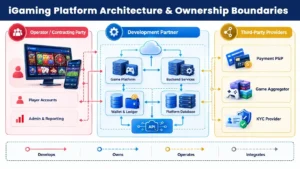
Architecture and Ownership Boundaries
Request a high-level architecture diagram identifying the major components and their dependencies.
For a casino platform, this may include player accounts, the gaming frontend, wallet and ledger services, payment providers, game aggregators, identity services, responsible gaming controls, administration, and reporting.
The diagram should distinguish:
- Components the supplier will develop.
- Technology the client will own or license.
- Services operated by external providers.
- Integrations that connect independently managed systems.
These are different responsibilities.
For example, a development partner may create an integration between an operator’s gaming wallet and a client-selected payment service provider. That does not mean the development partner processes the underlying payments.
The same principle applies to identity-verification services, game aggregators, hosting infrastructure, and other external dependencies.
The proposed architecture should make these boundaries understandable to both the technical team and the contractual decision-makers.
Transaction and Integration Design
A meaningful technical review should show how the proposed system handles transaction references, state changes, callbacks, timeouts, and reconciliation.
Provider-specific behaviors must be accounted for without allowing uncertain external responses to produce duplicate or incorrect internal financial entries.
The design should also address API authentication, version changes, monitoring, diagnostic logging, and recovery arrangements.
For player-account and responsible gaming functionality, determine how restrictions, limits, and verification outcomes are applied within the platform.
Performance and Recovery Evidence
Scalability claims should be accompanied by measurable assumptions.
Establish the workloads considered, the expected transaction volumes, the known dependencies, and the testing completed.
A system suitable for an initial launch may require additional work when the operator adds markets, providers, or products.
The supplier should explain which components can scale independently, which services remain shared dependencies, and how recovery is expected to work during interruptions.
These questions are particularly relevant to iGaming platform development, where wallet architecture, backend services, and third-party integrations must operate together.
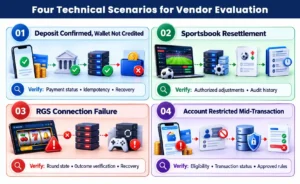
Four Technical Scenarios That Reveal Delivery Readiness
A technical proposal describes the planned architecture. Practical scenarios can reveal whether the team understands its operational consequences.
Use these situations during shortlisted vendor discussions.
1. A Deposit Succeeds, but the Player Wallet Is Not Credited
A payment provider confirms a $100 deposit. The wallet update fails because of a temporary service interruption.
Question: How would the platform recover the missing wallet credit without processing the deposit twice?
The answer should address payment-status verification, transaction references, idempotency, durable records, and controlled recovery.
Submitting another external payment request is not a satisfactory response to an unresolved internal wallet update.
2. A Sportsbook Event Requires Resettlement
An event correction requires certain bets to be voided or resettled under the applicable betting rules.
Question: How would the system identify affected transactions, authorize changes, and preserve the original settlement history?
Look for an explanation of authoritative results, settlement logic, ledger adjustments, approval controls, and reconciliation.
Overwriting the latest player balance would not preserve a reliable record of the correction.
3. An RGS Becomes Unavailable During an Active Session
A game session is interrupted when the operator platform loses communication with the RGS.
Question: How would the platform establish the game’s final round and transaction states once connectivity is restored?
The supplier should distinguish confirmed failures from unresolved outcomes and explain how those states are verified.
Recovery needs to prevent duplicate financial effects and retain records necessary for investigation.
4. A Player Account Is Restricted During a Transaction
An identity, risk, or compliance system changes the player’s account status while a financial transaction is underway.
Question: How would the platform apply the required restriction without incorrectly changing transactions already in progress?
A suitable response should distinguish account eligibility, transaction state, applicable operator rules, and authorized exception handling.
The correct treatment depends on the jurisdiction, the restriction, and the transaction’s status.
These scenarios are not a substitute for engineering review or formal testing. They provide a practical way to identify gaps that may not be apparent in a demonstration or proposal.
Evaluate Security and Quality Assurance Practices
Security should be supported by engineering practices and verifiable evidence.
A list of security products or an assurance that a platform is enterprise-grade does not establish how the software has been protected or tested.
Review authentication, authorization, API security, credential handling, access controls, sensitive-data protection, deployment permissions, vulnerability remediation, and relevant monitoring arrangements.
The OWASP Application Security Verification Standard (ASVS) provides a recognized framework of security requirements for web applications and services. It can help buyers specify security expectations and assess whether relevant controls have been considered.
The supplier should also explain which standards or requirements it proposes to use, which parts of the system they cover, and what evidence it can provide.
Quality Assurance Beyond Successful Test Cases
An API demonstration in which every request succeeds does not establish production readiness.
Test plans should also address delayed callbacks, duplicated events, interrupted sessions, invalid responses, dependency outages, transaction concurrency, and the recovery of unresolved states.
For each major deliverable, establish the acceptance criteria and the test evidence required before approval.
Internal QA and Independent Testing Are Different
Functional QA, application-security testing, and gambling-software testing serve different purposes.
An internal security review does not automatically satisfy jurisdiction-specific requirements for independent testing.
In Great Britain, the UK Gambling Commission’s Remote Gambling and Software Technical Standards and its testing strategy identify relevant technical obligations and circumstances in which independent assurance is required.
The testing requirements differ according to the product, activity, changes made, and applicable license.
Before delivery begins, establish which tests are needed, who may perform them, who will coordinate the process, and which party must retain or submit the results.
A supplier’s security certification, where one exists, should be evaluated according to its actual scope. It should not be treated as proof that every product developed by the supplier has received independent gambling-software approval.
Compare Delivery Models and Total Project Commitments
Development costs cannot be evaluated properly without understanding the engagement model behind each proposal.
Three arrangements are commonly considered.
| Model | Typical application | Main concern |
|---|---|---|
| Fixed-scope delivery | Requirements and deliverables are sufficiently defined | Exclusions, change requests, acceptance criteria |
| Dedicated development team | Product requirements are expected to evolve | Oversight, capacity, team continuity, billing |
| Co-development | Work is shared between internal and external engineering teams | Coordination, technical boundaries, responsibility |
A fixed-scope arrangement can improve cost predictability when the work is well defined.
A dedicated team offers greater flexibility in changing priorities, but requires effective product ownership and technical management.
Co-development may suit a business that retains responsibility for the main architecture while an external team handles particular components.
None of these models guarantees lower cost or better quality.
Compare What Each Proposal Includes
The complete commitment may extend beyond the initial development fee.
Compare discovery, engineering, integrations, testing, deployment preparation, documentation, stabilization, and the agreed support period.
External expenses should be identified separately. These may include hosting, third-party licenses, payment-processing charges, independent testing, and operational services.
If one proposal is considerably cheaper, establish whether it includes the same work, dependencies, and responsibilities before considering the difference a saving.
Examine Contract Terms and Long-Term Dependence
A development partner may become closely involved with systems your business relies on.
The contract needs to establish more than payment milestones and delivery dates.
Intellectual Property and Source-Code Rights
Determine who will own the project-specific deliverables and which components remain subject to preexisting or third-party intellectual property rights.
A custom development agreement may provide rights over newly developed software while excluding licensed frameworks, vendor tools, or external systems.
Clarify source-code access, repository arrangements, build configurations, documentation, and the licenses needed to maintain or operate the delivered system.
The phrase “full ownership” is not sufficiently precise if material components are excluded.
Deliverables and Acceptance
Milestones need measurable acceptance criteria.
For example, a payment integration deliverable might require documented transaction flows, status handling, error scenarios, sandbox testing, and reconciliation requirements.
A milestone described only as “integration completed” leaves room for disagreement about what constitutes an acceptable result.
Subcontractors and Access Responsibilities
Establish whether critical engineering work will be performed by the contracting supplier, an affiliated company, or a subcontractor.
The agreement should address confidentiality, relevant access rights, security obligations, responsibility for subcontracted work, and any required contractual approvals.
This is particularly important where the division of work may affect licensing or regulatory obligations.
Maintenance and Exit Planning
Consider what happens when the engagement ends.
Which repositories, configurations, documentation, provider integration details, and necessary access rights will be transferred?
Who will assist with technical handover?
What rights will the client retain to maintain and extend the delivered system?
A defined exit arrangement helps reduce dependence on a single supplier.
Material contractual, intellectual property, licensing, and regulatory terms should be reviewed by appropriately qualified advisers.
Warning Signs During iGaming Vendor Evaluation
Some proposal gaps can be resolved through clarification. Others may indicate that the supplier is unsuitable for the project.
Unclear delivery experience: The company cannot identify which systems it developed and which were provided by other parties.
Unsupported regulatory assurances: It promises licensing or certification outcomes without defining the responsible parties and required process.
Weak transaction handling: Its team cannot explain how uncertain financial transactions, duplicate events, or unresolved game rounds are investigated.
Unsubstantiated delivery commitments: A fixed launch date is offered without addressing material dependencies or testing requirements.
Undefined engineering ownership: Critical components have no clearly assigned development or operating responsibility.
Ambiguous contract terms: The proposal leaves important IP rights, source access, subcontracting, or termination arrangements unresolved.
Inadequate production support: The supplier cannot explain how serious incidents, integration failures, or release-blocking defects will be handled.
A vendor that cannot establish responsibility for wallet discrepancies, third-party integration incidents, or critical software defects is leaving important operational questions unanswered.
Those questions should be resolved before commitment.
Making the Final Selection
The objective is not to find the supplier with the most persuasive demonstration.
It is to identify a company whose documented capabilities, delivery arrangements, and contractual responsibilities fit your project.
Begin with the mandatory eligibility review. Then evaluate qualified suppliers using the same scorecard and evidence requirements.
Where uncertainty remains, a limited discovery engagement or targeted proof of concept may help.
For example, if wallet integrity is a material concern, a discovery exercise could produce a transaction-state model, architecture review, failure-handling demonstration, or documented integration-risk assessment.
Those outputs may be more useful than another general sales presentation.
When comparing final proposals, examine the overall result alongside unresolved conditions.
A supplier with a slightly lower score may still be suitable if its limitations can be addressed through specific commitments. A higher-scoring supplier should not be approved while an essential legal, technical, or contractual requirement remains unresolved.
Before signing, document the agreed scope, responsibilities, acceptance criteria, third-party dependencies, and outstanding conditions.
Looking for Custom iGaming Development Support?
Red Apple Technologies provides B2B iGaming game and platform engineering, backend development, and third-party integration services.
Our work concerns software delivery and technical implementation. Gambling operations, financial processing, licensing decisions, and regulatory approvals remain with the appropriate clients and authorized parties.
If you are planning a new gaming product or need engineering support for an existing platform, explore our iGaming Software Development Services to review the available capabilities and discuss your technical requirements.

Published by
Sameer VermaTable of Contents

Related Blogs
Discover more stories & insights that inspire
A player deposits $100 into an online casino. The payment provider confirms the transaction, but the player’s account balance remains unchanged. Assuming the payment failed, the player tries again. Now...

Online casino gaming has moved well beyond digital versions of slots, roulette, blackjack, and poker. Modern platforms combine real-time game delivery, mobile-first interfaces, live streaming, analytics, payments, identity verification, player-protection...

Online casinos look deceptively simple from the outside: a clean lobby, a few games, a deposit button, and maybe a big welcome bonus. Behind that interface, launching a real online...

A game aggregator is not just another software product. For investors, it is better understood as infrastructure: a platform that connects many game providers, delivers content through one system, and...

Launching an online casino or sportsbook requires choosing the right technology foundation. One of the most important decisions operators face is whether to use a white-label platform or build a...

Launching an online casino or sportsbook requires more than technology and game integrations. Operators must obtain a valid iGaming license from a recognized regulator before offering online gambling services. The...

Evolving into a profitable business worldwide, iGaming as a segment is not just restricted to casino games like slots, roulette, bingo, and poker. It also includes various virtual sports like...
The term iGaming is often used broadly, with many people, sometimes using it incorrectly, to describe a fast-growing segment of the digital entertainment economy. At its core, iGaming refers to...
KYC AML integration in iGaming is no longer a regulatory afterthought. It is the core infrastructure. For operators building or scaling regulated platforms, compliance architecture determines whether growth is smooth...

iGaming or internet gambling is evolving into a highly profitable business segment. Standing on a global revenue of $118 billion, investment in the industry is expected to maintain an impressive...


 Book An Appointment
 WhatsApp