


iGaming Payment Processing: Deposits & Payouts Explained
A player deposits $100 into an online casino. The payment provider confirms the transaction, but the player’s account balance remains unchanged. Assuming the payment failed, the player tries again.
Now the operator may have two successful payments, an incorrect wallet balance, and a financial discrepancy that a payment confirmation alone cannot resolve.
This is where iGaming payment processing becomes more complicated than connecting a payment gateway.
An online casino or sportsbook must coordinate external payment providers, internal player balances, transaction records, and compliance controls. Deposits need to be credited correctly, withdrawals must be tracked to their final status, and interrupted transactions require a safe recovery process.
Understanding how these systems work together helps operators choose suitable payment methods, define integration requirements, and establish where technical and operational responsibilities begin and end.
This guide examines those decisions, including how fiat and cryptocurrency payments differ, why reconciliation matters, and what to evaluate before integrating a payment provider.
What Is iGaming Payment Processing?
iGaming payment processing covers the arrangements and systems used to accept player deposits, facilitate withdrawals, and maintain accurate transaction records within an online gambling platform.
The external movement of money is only one part of this process.
A payment service provider (PSP), acquirer, bank, or other authorized financial provider may handle payment acceptance and payout services. The gaming platform must then recognize the transaction, update the relevant player balance, enforce applicable account controls, and preserve the information needed for financial reconciliation.
Different organizations may perform these functions.
Who Is Responsible for Each Part?
| Participant | Typical responsibility |
|---|---|
| Gambling operator | Player accounts, payment policies, financial oversight, and applicable gambling compliance |
| PSP, acquirer, or banking partner | Payment acceptance, supported payouts, settlement services, and related financial processing |
| KYC, AML, and risk providers | Verification, screening, monitoring, and other services within their authorized and contracted scope |
| Platform engineering team | Payment APIs, wallet and ledger software, transaction handling, integrations, and technical reporting |
| Operator’s finance and compliance teams | Reconciliation oversight, transaction investigations, financial reporting, and compliance decisions |
These are typical functional boundaries, not a universal allocation of legal responsibility. The actual arrangement depends on the jurisdiction, contracts, and services provided.
A payment gateway may confirm that a deposit succeeded without determining whether the player’s gaming wallet was credited correctly.
That second task belongs to the platform’s transaction infrastructure.
For an operator evaluating a payment setup, the first requirement is therefore to establish which party handles each financial, technical, and compliance responsibility.
How iGaming Deposits and Withdrawals Work
Deposits and withdrawals may appear within the same cashier interface, but their underlying transaction flows differ.
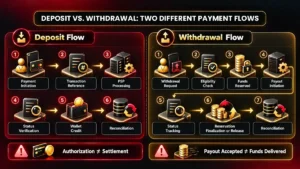
The Deposit Process
1. Payment initiation
The player selects an eligible payment method and enters an amount. The platform checks relevant account restrictions, deposit limits, and payment eligibility.
2. Internal transaction creation
The system generates a unique transaction record associated with the player, amount, currency, and payment method.
3. Payment processing
The request reaches the selected PSP or other financial provider. Authentication, authorization, bank processing, or other payment steps take place according to the method used.
4. Provider response
The provider reports the transaction’s status. Some payment methods return a definitive outcome quickly, while others require asynchronous notifications or later status checks.
5. Wallet credit
Once the payment satisfies the operator’s approved crediting conditions, the platform records the corresponding credit in the player’s wallet.
6. Reconciliation
Internal transaction records are compared with the payment provider’s reports and relevant settlement information.
Authorization Is Not the Same as Settlement
A card authorization may indicate that the issuer has approved the transaction. It does not necessarily establish that the payment has been captured or financially settled.
Likewise, some bank-based payment methods may remain pending after a player completes the instructions.
The platform needs a defined crediting policy for every supported method. That policy should identify which provider status is sufficient for crediting, how unresolved payments are handled, and what happens when a later reversal or adjustment occurs.
A single positive API response should not be treated as proof that every financial step is complete.
The Withdrawal Process
Withdrawals begin with funds already represented in the player’s gaming wallet.
A typical workflow involves:
- The player requests a withdrawal.
- The platform checks available funds and applicable account eligibility.
- The requested amount is reserved or otherwise protected against further spending.
- The platform initiates a payout through an eligible provider.
- The provider reports the transaction’s processing status.
- The wallet and ledger reflect the confirmed outcome.
- Internal financial records are reconciled with external provider information.
An accepted payout request is not necessarily a completed transfer to the player.
If a provider reports a confirmed failure, the system must handle the reserved funds through an appropriate recorded release or reversal.
If the provider’s outcome remains unknown, releasing the money prematurely could allow the player to spend funds that may already be on their way to a bank account.
These distinctions should influence how withdrawal statuses appear in the cashier, administration tools, and financial reports.
Which Payment Methods Are Used in iGaming?
Online casinos and sportsbooks may support several payment methods, but availability depends on the jurisdiction, gambling license, payment provider, and transaction type.
A method advertised by a PSP is not necessarily available for gambling. Operators must confirm that it supports their business model and target market, then evaluate deposit and withdrawal capabilities separately.
| Payment method | Typical use | What operators need to verify |
|---|---|---|
| Debit cards | Deposits and eligible card payouts | Issuer and acquirer acceptance, authentication, gambling-related payout support |
| Credit cards | Gambling deposits only where legally permitted | Jurisdictional prohibitions, card-network restrictions, and indirect funding through other services |
| E-wallets and e-money accounts | Deposits and supported withdrawals | Merchant eligibility, account ownership, funding-source restrictions, payout functionality |
| Bank transfers and account-to-account payments | Deposits and withdrawals through supported banking routes | Bank coverage, account verification, payment confirmation, returns, payout availability |
| Prepaid cards and vouchers | Primarily deposits, where permitted | Funding traceability, source-of-funds risks, credit-card restrictions, withdrawal routes |
| Cryptocurrency payment arrangements | Deposits or payouts only where legally permitted and supported | Regulatory eligibility, custody or conversion arrangements, transaction confirmation, AML controls |
Card Payments and E-Wallet Restrictions
Card acceptance depends on the operator’s market, payment-provider arrangements, and applicable gambling rules.
In Great Britain, licensed operators have been prohibited from accepting credit-card payments for gambling since April 14, 2020. The restriction also covers payments through e-wallets or money service businesses when credit-card funds can be used for gambling.
The UK Gambling Commission’s guidance on preventing credit-card use explains these requirements.
E-wallets also require careful assessment.
Some hold electronic money or support multiple funding sources, while digital wallets such as Apple Pay may facilitate payments using an underlying debit or credit card. The funding instrument and its restrictions remain relevant.
An operator should not assume every service described as a digital wallet follows the same financial or compliance rules.
Bank Transfers and Pay by Bank
Bank-based payments may include conventional transfers, local payment rails, and account-to-account services initiated through open banking.
Pay by Bank, for example, allows a customer to authorize a bank transfer through a supported banking application.
These arrangements may provide alternatives to card deposits, but initiation, confirmation, settlement, and payout functionality must be assessed individually.
A provider offering Pay by Bank deposits does not necessarily support withdrawals through the same service.
Prepaid Methods Need Additional Scrutiny
Prepaid cards and vouchers may be available in certain markets but can create difficulties involving funding traceability and returning player funds.
Some can be loaded through funding sources that are difficult to identify. Others cannot receive withdrawals.
The UK Gambling Commission’s October 2025 emerging-risk guidance classifies prepaid methods as high-risk for money laundering and terrorist financing in the British licensed gambling context.
Operators must also ensure prepaid methods do not circumvent applicable credit-card gambling restrictions.
Deposit Availability Does Not Guarantee Withdrawal Support
A payment method that accepts deposits may not be capable of returning winnings.
This is especially relevant to prepaid vouchers, certain e-wallet arrangements, and payment services that support only incoming transfers.
Returning funds through the original payment method, where possible and appropriate, can help preserve transaction traceability.
When an alternative route is necessary, the operator must assess the additional risks and apply the controls required by the relevant regulatory framework.
In Great Britain, the Gambling Commission identifies open-loop arrangements as a money-laundering risk and recommends closed-loop payment practices.
The payment setup should therefore establish permitted payout routes, account-ownership checks, and reconciliation requirements before launch.
Fiat vs. Cryptocurrency Payments: What Actually Changes?
Fiat payments generally use conventional monetary systems, including banks, card networks, e-money providers, and account-to-account payment services.
Cryptocurrency arrangements involve virtual assets and may depend on blockchain networks, crypto payment providers, custodians, exchanges, or conversion services.
These are different financial and technical arrangements. Neither is automatically cheaper, faster, safer, or compliant.
| Consideration | Fiat payments | Cryptocurrency arrangements |
|---|---|---|
| Infrastructure | Banks, card networks, PSPs, e-money services | Blockchain networks and potentially virtual asset service providers |
| Confirmation | Depends on provider and payment method | Depends on network confirmation and provider arrangements |
| Reversals | Chargebacks, returns, and refunds may be available | On-chain transactions are generally irreversible; provider-managed remedies can differ |
| Cost exposure | Processing fees, FX charges, disputes, settlement fees | Network charges, conversion fees, custody costs, asset volatility |
| Monitoring information | Payment references, account data, banking and provider records | Wallet activity, blockchain transactions, provider records, analytics |
| Regulatory availability | Subject to jurisdiction, provider, and payment method | Subject to jurisdiction, asset, provider, custody model, and gambling rules |
The central decision is not whether a platform should offer cryptocurrency because it is technologically possible.
The operator must establish whether the arrangement is permitted, who receives and controls the assets, how player balances are denominated, and how financial discrepancies will be investigated.
Cryptocurrency Introduces Different Operational Risks
A platform supporting an authorized crypto payment arrangement may need to account for blockchain confirmation, wallet addresses, custody, conversion rates, transaction records, and provider-specific settlement policies.
Some providers convert cryptoassets into fiat. Others offer arrangements involving custody or transfers of the original asset.
The distinction affects who bears exchange-rate exposure, what records are available, and how the operator reconciles deposits and withdrawals.
Stablecoins may reduce exposure to some market-price fluctuations compared with other cryptoassets, but they do not remove issuer, redemption, custody, or regulatory risks.
These architectural questions should be resolved before a crypto payment integration is scoped. The applicable customer-verification and AML responsibilities are addressed in the next section.
KYC and AML: Who Is Responsible?
Payment providers, gambling operators, compliance vendors, and development teams can all participate in a payment-related verification workflow.
However, their responsibilities are not interchangeable.
The Gambling Operator
Depending on the jurisdiction and license, the operator may be responsible for customer identification, age verification, transaction monitoring, risk assessment, source-of-funds checks, and applicable reporting.
These obligations cannot automatically be transferred to a PSP simply by outsourcing payment processing.
For example, the UK Gambling Commission’s customer identity verification requirements require applicable remote operators to verify identity before permitting gambling.
They also restrict unnecessary withdrawal-stage information requests that could reasonably have been made earlier, while allowing checks required by other legal obligations.
Verification rules therefore need to be established before payment workflows are designed.
The Payment and Compliance Providers
A PSP or bank performs the checks required by its own legal and contractual arrangements.
A specialist KYC or AML vendor may provide identity verification, screening, monitoring, or case-management tools.
Those services can support the gambling operator’s processes, but they do not necessarily fulfill all the operator’s obligations.
The UK Gambling Commission’s October 2025 guidance reinforces the importance of operators conducting sufficient customer checks rather than relying solely on third-party processors.
Additional Considerations for Cryptocurrency
Cryptocurrency payments can introduce separate customer-due-diligence and monitoring requirements.
Depending on the arrangement, an operator may need to assess the origin of cryptoassets, wallet ownership, transaction history, sanctions exposure, and information supplied by its crypto payment provider.
A virtual asset service provider (VASP) may also have obligations under the laws applicable to its own activities.
The Financial Action Task Force’s risk-based guidance for virtual assets and VASPs addresses the application of AML and counter-terrorist-financing controls to relevant virtual-asset services.
FATF’s July 2026 update on virtual-asset regulation also identifies continuing gaps in how jurisdictions implement and supervise these requirements, including challenges involving stablecoins, unhosted wallets, and offshore providers.
These sources provide an international framework, not a substitute for the applicable national rules.
A gambling operator should establish which checks remain its responsibility, which are undertaken by the crypto provider, and how the resulting information will be used within the platform.
The Engineering Team
The development team implements the technical processes that connect the platform with approved verification and risk services.
This may involve integrating identity-provider APIs, applying account restrictions, processing verification results, maintaining audit records, and supporting administrative review workflows.
The engineering team does not independently determine the operator’s legal obligations.
Technical implementation, compliance decision-making, and regulated financial services should each have an accountable party when the project scope is defined.
Integrating Payment Gateways With an iGaming Platform
A gateway integration must do more than send requests and display successful payment messages.
Production systems encounter delayed callbacks, repeated notifications, interrupted responses, provider outages, and transactions whose final status is temporarily unknown.
The platform needs defined rules for handling each condition.
Provider Adapters and Transaction States
PSPs differ in authentication methods, response formats, transaction identifiers, callback behavior, and status definitions.
An integration layer can translate provider-specific information into a consistent internal transaction model.
For example, one provider may report a payment as authorized, another as pending capture, and another as completed.
The platform must interpret each response according to the provider’s documented meaning.
This prevents an external status label from triggering an inappropriate wallet update.
Handling Webhooks and Delayed Responses
A payment may complete after the player closes the cashier screen.
The final result may arrive through a webhook or be obtained through a later provider status check.
The platform should authenticate incoming notifications, match them to the correct transaction, validate relevant details, and reject invalid state changes.
A browser redirect alone is insufficient evidence of payment completion.
Idempotency and Duplicate Prevention
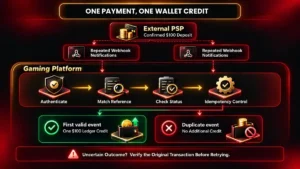
An external payment can generate more than one notification.
The platform must ensure repeated processing of the same logical payment does not create additional financial effects.
That requires appropriate transaction identifiers, idempotency controls, and ledger safeguards.
The same principle applies when a player retries an operation following a timeout.
Before submitting another financial request, the platform needs to determine whether the original transaction succeeded, failed, or remains unresolved.
Wallets, Ledgers, and Reconciliation
The payment provider processes the external financial transaction.
The gaming wallet represents the corresponding player balance within the platform.
A transaction ledger records the financial events that change that balance.
The internal wallet should not be confused with the bank or other arrangement holding underlying customer funds.
A Simplified Wallet Example
| Transaction | Available balance |
|---|---|
| Confirmed deposit | $100 |
| $20 wager | $80 |
| $50 winnings credited | $130 |
| $60 withdrawal reserved | $70 |
The player has $70 available while the $60 withdrawal remains reserved.
If the payout completes, the reservation is finalized according to the platform’s ledger design.
If the payout definitively fails, the platform needs a recorded release or reversal.
The original financial history should remain traceable rather than being overwritten by a new balance.
Wallet architecture also affects reconciliation. A seamless-wallet model maintains an authoritative platform balance through real-time transaction APIs, while a transfer-wallet model may involve separate balances within provider environments. Both require accurate transaction records, but transfer arrangements introduce additional balance movements that must be tracked and reconciled.
What Reconciliation Should Reveal
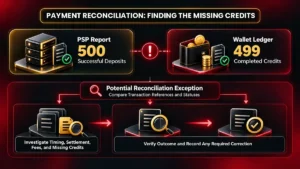
Suppose a PSP reports 500 successful deposits for a period, but the platform has only 499 corresponding completed wallet credits.
A reconciliation process should help identify the missing transaction and determine the required correction.
The comparison may involve:
| Record | Purpose |
|---|---|
| Internal payment records | Track payment requests and recorded outcomes |
| Wallet and ledger records | Show the financial effects applied to player balances |
| PSP transaction reports | Provide external processing information |
| Settlement and adjustment reports | Show settlement activity, fees, refunds, returns, and corrections |
Not every difference represents a financial error.
Timing differences, reporting cutoffs, settlement delays, and fees can cause legitimate discrepancies.
A useful reconciliation system distinguishes those differences from missing credits, duplicated entries, and other exceptions requiring action.
For operators, the objective is not simply to generate reports. It is to identify financial discrepancies, trace them to their source, and support controlled resolution.
What Happens When Payments Fail?
A declined transaction, an API timeout, and a missing wallet credit may produce similar player complaints.
They are not technically equivalent.
| Situation | Appropriate response |
|---|---|
| Provider confirms a decline | Record the result and display an accurate status |
| Request times out | Verify the original transaction before retrying |
| Webhook arrives repeatedly | Avoid duplicate wallet effects |
| Successful payment has no wallet credit | Confirm the payment and recover the missing ledger entry |
| Withdrawal outcome remains uncertain | Preserve the appropriate reservation while investigating |
| Provider and ledger records disagree | Reconcile and record any authorized correction |
Why Blind Retries Are Dangerous
A timeout means the platform did not receive a response within the expected period.
It does not prove the financial transaction failed.
Submitting another payment request while the first transaction may have succeeded can result in duplicate charges.
For withdrawals, the consequences may be more serious if a second payout is initiated before the first one’s outcome has been established.
The platform should use available provider identifiers and trusted status checks to resolve uncertainty.
Test Failure Scenarios Before Launch
Payment integration testing should cover more than successful sandbox deposits.
Relevant scenarios include delayed callbacks, duplicate events, invalid signatures, amount mismatches, provider outages, concurrent requests, and failed wallet updates.
Testing should verify the player-facing status, transaction record, and resulting ledger entries.
A payment integration is not production-ready simply because the cashier successfully completes a test transaction.
Should Operators Use Multiple Payment Providers?
A single PSP may be sufficient when it supports the operator’s markets, payment methods, currencies, deposit and payout requirements, and expected operating conditions.
Additional providers become more relevant when the existing arrangement has genuine coverage or resilience limitations.
For example, an operator expanding into another jurisdiction may need a locally supported payment method unavailable through its current provider.
A multi-provider architecture can coordinate eligible routes through a shared integration layer.
However, every new PSP creates additional integration, reporting, testing, financial, and operational responsibilities.
When Payment Orchestration Makes Sense
Consider multiple providers when there is a documented need for:
- Additional permitted payment methods or local market coverage.
- Different supported payout capabilities.
- Reduced dependency on a single provider.
- Better visibility across several existing payment arrangements.
- Consistent transaction tracking and reporting across integrations.
These benefits should be assessed against implementation and maintenance costs.
Routing Cannot Override Payment Restrictions
Payment orchestration does not guarantee higher approval rates.
An issuer decline may result from a legal restriction, merchant eligibility problem, fraud control, or another decision that routing cannot legitimately bypass.
A second provider should not receive a replacement request while the original payment’s outcome remains uncertain.
The architecture should preserve transaction identity and apply routing rules only where the relevant financial and regulatory arrangements permit them.
Security and Payment Data Protection
Payment integrations may involve sensitive transaction information, authentication credentials, administrative access, and, depending on the design, cardholder data.
Using a hosted payment page or a provider-managed payment form can reduce direct exposure to cardholder data.
It does not automatically remove PCI DSS responsibilities.
The PCI Security Standards Council’s guidance on outsourced payment processing explains that merchants retain responsibilities for understanding and managing their third-party security arrangements.
The exact obligations depend on the payment architecture and applicable compliance program.
Technical controls may also need to address API security, secrets management, webhook authentication, access permissions, logging, and vulnerability remediation.
Security requirements should be defined across the operator, PSP, infrastructure providers, and engineering team rather than assumed to belong entirely to one organization.
What Does iGaming Payment Processing Cost?
The cost of a payment setup involves more than the fee charged for an individual deposit.
Provider pricing depends on the market, merchant profile, transaction methods, currencies, risk assessment, and contractual arrangements.
Operators may also incur engineering, operational, and compliance-related expenses.
| Cost category | Typical considerations |
|---|---|
| Payment processing | PSP, gateway, acquiring, and applicable network fees |
| Payouts | Withdrawal processing and banking charges |
| Currency conversion | FX spreads, conversion fees, and cross-border costs |
| Disputes and adjustments | Chargebacks, refunds, investigations, and manual work |
| Compliance services | Identity verification, screening, and monitoring |
| Platform engineering | Integration, testing, maintenance, and provider updates |
| Finance operations | Reconciliation, exception investigation, and reporting |
A lower transaction fee may not reduce the total cost if the payment route creates frequent failures, unresolved payouts, or substantial manual reconciliation.
The financial comparison should include the entire payment lifecycle.
Metrics Worth Monitoring
| Metric | What it helps measure |
|---|---|
| Deposit approval rate | Provider approval performance for eligible requests |
| Deposit completion rate | Deposits reaching the platform’s defined completed state |
| Withdrawal completion time | Time to a specified payout milestone |
| Transaction failure reasons | Why payments fail or require investigation |
| Reconciliation exception rate | Frequency of unmatched or inconsistent records |
| Chargeback rate | Disputes measured under the applicable payment-network rules |
| Effective processing cost | Relevant payment expenses relative to completed transaction volume |
Metric definitions must remain consistent.
An approved deposit and a wallet-credited deposit are not necessarily the same event.
Likewise, a payout accepted by a provider should not be reported as delivered to the player unless the provider’s status supports that conclusion.
Separating provider performance from internal platform failures helps operators determine where corrective action is needed.
How to Choose an iGaming Payment Provider
Selecting a PSP is both a commercial and technical decision.
The operator must establish that the provider is permitted and willing to serve its business model, legal entity, markets, and transaction requirements.
The development team can then assess what the integration will require.
Payment Provider Evaluation Checklist
| Evaluation area | Decision to establish |
|---|---|
| Jurisdiction and merchant eligibility | Does the provider support the operator’s regulated activity and legal entity? |
| Deposit methods | Which permitted methods and currencies are available? |
| Withdrawal routes | Can funds be returned through suitable and compliant payment methods? |
| API capabilities | Are transaction statuses, webhooks, verification, refunds, and idempotency documented? |
| Reconciliation | Are transaction, fee, adjustment, and settlement reports sufficiently detailed? |
| Risk and security | Which controls are provided, and which remain the operator’s responsibility? |
| Commercial terms | What fees, reserves, settlement schedules, and termination provisions apply? |
| Operational support | How are outages, unresolved transactions, and technical incidents handled? |
Questions to Resolve Before Integration Begins
A productive technical discussion should establish how the provider identifies transactions, reports definitive success or failure, handles unknown outcomes, and communicates financial adjustments.
It should also clarify whether deposits and payouts use separate APIs, what reporting information is available, and which environments support testing.
The operator should document its wallet-crediting policy, approved payout routes, and reconciliation responsibilities before development proceeds.
These decisions reduce the risk of discovering late in implementation that the selected provider cannot support an essential part of the business model.
Where Red Apple Technologies Fits Into the Payment Infrastructure
Red Apple Technologies provides B2B iGaming software development and integration services. We do not act as a payment service provider or process gambling deposits and withdrawals as a financial institution.
Our engineering work connects client-selected payment and compliance services with the wider gaming platform.
Depending on the agreed scope, this can include:
- Third-party payment gateway, PSP, and supported payout API integrations.
- Wallet and transaction-ledger development.
- Transaction-state management, webhook handling, idempotency, and recovery workflows.
- KYC, identity-verification, AML, and risk-service API integrations.
- Reconciliation functionality and administrative reporting tools.
- Integration testing, failure-scenario validation, and supporting backend development.
Provider selection, financial operations, licensing, and regulatory decisions remain with the client and the appropriate authorized parties.
Businesses planning a new platform or extending an existing system can explore our iGaming Platform Development Services to understand how payment integrations fit alongside wallet architecture, transactional APIs, provider connections, and back-office systems.
Building an iGaming Payment Setup That Works Beyond Launch
A payment method can look suitable on paper and still create problems if its payout restrictions, transaction statuses, or reporting capabilities do not match the platform’s requirements.
Operators should establish several things before committing to an integration: which payment methods are permitted, how player balances are updated, what happens when transactions are interrupted, and how the financial records will be reconciled.
The provider’s financial responsibilities and the engineering team’s technical responsibilities should also be defined in advance.
A reliable payment setup is not simply one that accepts deposits. It is one in which deposits, withdrawals, wallet records, and external provider information can be consistently accounted for as the platform operates and grows.

Published by
Sameer VermaTable of Contents

Related Blogs
Discover more stories & insights that inspire

An iGaming vendor can demonstrate a polished casino platform without having built every system behind it. The game content may come from an aggregator, the wallet may be licensed from...

Online casino gaming has moved well beyond digital versions of slots, roulette, blackjack, and poker. Modern platforms combine real-time game delivery, mobile-first interfaces, live streaming, analytics, payments, identity verification, player-protection...

Online casinos look deceptively simple from the outside: a clean lobby, a few games, a deposit button, and maybe a big welcome bonus. Behind that interface, launching a real online...

A game aggregator is not just another software product. For investors, it is better understood as infrastructure: a platform that connects many game providers, delivers content through one system, and...

Launching an online casino or sportsbook requires choosing the right technology foundation. One of the most important decisions operators face is whether to use a white-label platform or build a...

Launching an online casino or sportsbook requires more than technology and game integrations. Operators must obtain a valid iGaming license from a recognized regulator before offering online gambling services. The...

Evolving into a profitable business worldwide, iGaming as a segment is not just restricted to casino games like slots, roulette, bingo, and poker. It also includes various virtual sports like...

The term iGaming is often used broadly, with many people, sometimes using it incorrectly, to describe a fast-growing segment of the digital entertainment economy. At its core, iGaming refers to...
KYC AML integration in iGaming is no longer a regulatory afterthought. It is the core infrastructure. For operators building or scaling regulated platforms, compliance architecture determines whether growth is smooth...

iGaming or internet gambling is evolving into a highly profitable business segment. Standing on a global revenue of $118 billion, investment in the industry is expected to maintain an impressive...


 Book An Appointment
 WhatsApp