


- Blog
- >
- Game Development
- >
- QA Testing
- >
- Full-Cycle Game Development: From...
Full-Cycle Game Development: From Concept and Prototype to Launch & LiveOps
Whether you’re an indie studio validating your first concept, a startup with a simple 2D casual game, or an established publisher scaling a sprawling 3D title, getting from idea to storefront takes a lot of coordinated steps. That’s the appeal of full-cycle development: one partner carries your game end-to-end, from the first sketch of an idea to the day it ships — and beyond. Below, we break down what each stage actually involves, why studios choose a full-cycle partner over piecing a project together, and how to decide which model fits your next release.
What Are the Full-Cycle Game Development Stages?
Outsourcing has become a structural part of how games get made — as production complexity rises, few studios can staff every specialty in-house, which is a core driver behind the game outsourcing services market’s projected growth from roughly $1.46 billion in 2026 toward $2.27 billion by 2032 (Research and Markets). Full-cycle development sits at the center of that shift. Here’s how it typically breaks down.
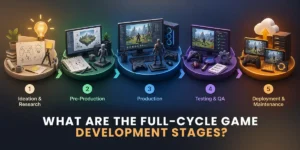
Ideation & Research
Every strong game starts with hours spent shaping a concept sharp enough to cut through a crowded market. And the market is genuinely crowded: the Apple App Store alone carried roughly 304,000 games as of 2025 (Business of Apps), with Google Play’s games catalog running in a similar range. Standing out at that scale takes more than a good idea — it takes research. A full-cycle team like our game development services typically helps with:
Intensive Market Study — Whether you’re building an Adventure game, a Hyper-Casual hit, or a competitive title built for the esports scene, your studio evaluates competitor products against current trends, flags gaps and openings, and helps shape a concept worth building.
Player Segmentation — Your studio helps identify the right player segment for your genre, which shapes everything from lifetime value to average revenue per daily active user to session length.
Revenue Streams — Deciding your monetization model early — in-app purchases, advertisements, subscriptions, or a mix — determines how you’ll fund development and retain players long after launch.
Pre-Production
This is where the plan takes shape:
GDD Preparation — The studio turns your requirements into a Game Design Document covering genre, storyline, features, level count, art direction, player progression, and a milestone timeline.
Finalizing Art & Design — Visual direction gets locked in: character look and feel, environments, UI, and the details that keep players immersed rather than frustrated. (More on how we approach this on our art & design page.)
Building Prototypes — Once the plan is set, the studio builds and runs prototypes to validate the concept before full production begins, incorporating your feedback along the way.
Production
This is where the concept becomes a real game. The team builds assets, designs levels, programs gameplay mechanics, integrates the tech stack and APIs, and builds backend infrastructure — all inside an agile workflow that keeps quality consistent as the scope grows. For a closer look at how long each phase typically takes, see our breakdown of game development timelines.
Testing & QA
A finished build doesn’t ship until it clears several categories of testing:
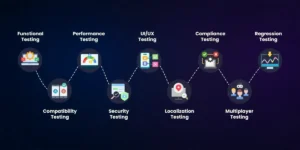
- Functional Testing — gameplay features, controls, menus, and scoring work as intended
- Compatibility Testing — smooth performance across devices, OS versions, browsers, and screen sizes
- Performance Testing — frame rate, load time, memory stability, and responsiveness under load
- Security Testing — vulnerabilities in accounts, payments, APIs, storage, and network communication
- UI/UX Testing — menus, controls, and navigation are intuitive and consistent
- Localization Testing — translated text, cultural elements, formats, and region-specific content
- Compliance Testing — platform guidelines, age ratings, privacy laws, and regional regulations
- Multiplayer Testing — matchmaking, synchronization, latency, and server stability
- Regression Testing — confirming that fixes and updates haven’t broken anything else
Most studios run this in two passes: an in-house team plays the build and flags issues first, then a beta group of external testers stress-tests it under real-world conditions before anything ships.
Deployment & Maintenance
Once the build clears every benchmark, it’s time to launch on the Play Store, App Store, and any other relevant platform. Launch isn’t the finish line, though — ongoing maintenance (debugging, version updates, security patches, and LiveOps) is what keeps a game competitive as player expectations and platform requirements evolve.
What Are the Advantages of a Full-Cycle Game Development Service?
Project Handling By One Team — Artists, coders, and project managers all sit under the same roof, working from the same vision without the friction of coordinating across separate agencies.
Better Supervision & Tracking — A single point of contact makes it easy to track milestones and give feedback that actually shapes the next sprint.
Prevent Overspending — A structured, milestone-based roadmap gives you a real cost estimate up front, so you can plan spend without hidden-cost surprises.
Faster Time to Market — A defined workflow, an experienced team, and mature tooling all compress the path from concept to launch.
Full-Cycle Game Development vs. Vendor Hiring — Which One to Choose?
It comes down to what you already have in place. Full-cycle development fits when you have a concept but not the internal team or infrastructure to execute it — one agency handles concept development, design, programming, testing, deployment, and post-launch support, which keeps quality consistent and communication simple.
Vendor hiring fits when you already have a capable internal team and just need specialized help — 2D/3D art, multiplayer development, porting, or LiveOps, for example. It’s common on AAA-scale projects where work is deliberately split across specialist teams, though it does put the coordination burden on you; poor coordination across vendors is where delays and inconsistent output tend to creep in. Esports titles are a good example of this narrower need — a studio might have the core game built but bring in a specialized partner just to handle the backend infrastructure for live tournament scale, the kind of load that can mean tens of thousands of concurrent competitive players and spectators during a single event.
Final Thought
Choosing the right engagement model shapes everything downstream — budget, timeline, and how much of the coordination burden lands on you. If you have a concept and need a partner to carry it from first sketch to live launch (and beyond), that’s exactly what full-cycle development is built for. If you’ve already got a strong internal team and just need to fill a specific gap — Android game development tooling, iOS game development platform expertise, or dedicated art production — vendor hiring is likely the leaner path.
If you’re still weighing the two, our guide to choosing a mobile game development company and our step-by-step mobile game development process walk through the decision in more depth. You can also browse our game portfolio or learn more about our team to see how we’ve approached full-cycle projects for other studios.

Published by
Kaushik Dey
Related Blogs
Discover more stories & insights that inspire

A quote tells you what a studio expects the project to cost. A portfolio shows what it has worked on. Neither tells you whether the team assigned to your game...

In our past posts, we have made sure you understand what LiveOps is, how it improves retention and engagement, and how it supports the long-term growth of a game. One...
Shipping a game used to be the finish line. Now it’s the starting point. The studios that grow consistently aren’t just building great gameplay; they’re building systems that keep players...
Presently, there are over 248,477 game apps in the Google Play Store. While the App Store of iOS comprises over 211,559 game apps (42matter). So, to increase the visibility and...


 Book An Appointment
 WhatsApp