


Generative AI in Game Development: From Localization to QA Automation
How we design, test, and launch interactive experiences is changing rapidly with the inclusion of generative AI in game development. Gone are the days of using artificial intelligence as a supplementary tool; it has become a co-creator in production pipelines. From AI-driven localization that makes games accessible globally to intelligent QA systems that test themselves, this technology represents the next frontier in game development by combining speed, scalability, and creativity across every phase of production.
The Rise of Generative AI in Games
It refers to the systems capable of producing creative content based on learned data — text, art, code, sound, or gameplay logic. Within the gaming industry, these models can craft levels, design characters, generate dialogue, and balance gameplay automatically. For developers and studios, this shift means more time for creative storytelling and less on repetitive manual work.
Advancements in real-time generative models now allow for continuous iteration. Developers no longer wait weeks to prototype ideas, as content can be generated dynamically within hours. This innovation has given both indie and AAA studios a competitive edge in quality and speed, helping them meet growing player demands while maintaining creative depth.
Asset Creation and Procedural World Building
Generative AI in gaming automates some of the most complex assets in game development, drastically improving productivity and reducing production costs. Developers can:
- Generate hyper-realistic 3D assets, terrains, and environments in seconds
- Create dynamic lighting or atmospheric effects that evolve with player progression
- Use natural language prompts for instant prototyping of characters or items
- Dynamically expand maps and worlds depending on the gameplay narrative
This evolution has allowed studios that hire game developers specializing in AI integration to create scalable, living environments without overspending on large modeling teams. Such adaptability makes game design more flexible, pushing boundaries while maintaining high artistic standards.
Localization and Cultural Adaptation
Bringing a game to a global audience has always been a challenge, particularly with matching tone, context, and emotion across languages. With AI-powered localization, generative AI models now provide real-time translation, tone consistency, and cultural sensitivity across markets.
Sophisticated models not only translate text but also understand cultural nuance and humor, preserving the authenticity of storytelling. Generative AI can even replicate a voice actor’s performance across multiple languages, ensuring character dialogue remains emotionally coherent. Furthermore, AI assists in culturally adapting visual elements, symbols, or motifs to ensure appropriateness and resonance within different regions.
QA Automation and Intelligent Testing
Quality assurance has traditionally been one of the most time-consuming aspects of game development. Manual testing, bug tracking, and regression checks often slow down production cycles, especially for large-scale or feature-rich titles. Generative AI in gaming is redefining this entire workflow.
AI-powered QA systems can now simulate human-like interactions, stress-test complex environments, and identify edge cases that traditional testing might miss. These models analyze gameplay patterns, spot anomalies, and generate detailed bug reports automatically. Even more impressive, some systems can self-correct issues by suggesting fixes in real time, allowing developers to resolve problems during active development rather than post-production.
For studios working with external QA teams or hiring dedicated game testers, this technology dramatically reduces time-to-market, improves test coverage, and enhances game stability from early prototypes to final releases.
AI-Driven Game Balancing and Player Personalization
Game balancing is critical for ensuring fairness, engagement, and replayability. Instead of relying solely on manual adjustments and extensive player feedback loops, developers are now leveraging generative AI to model millions of gameplay scenarios.
- Predict player behavior and skill progression
- Adjust difficulty dynamically based on playstyle
- Recommend optimized balancing tweaks for weapons, characters, or mechanics
- Identify potential exploits or overpowered combinations
- Enable personalized story branches or encounter difficulty
This not only enhances player satisfaction but also allows live-service games to evolve responsively with their communities. As a result, studios hiring game developers for AI game development skilled in AI-based analytics can deliver more immersive and adaptive gaming experiences without excessive manual rebalancing.
Storytelling, Dialogue Generation, and NPC Behavior
Narrative depth is one of the biggest differentiators in modern games, and generative AI brings unprecedented capabilities to storytelling.
- Create branching dialogue trees that adapt to player decisions
- Generate unique NPC interactions for every playthrough
- Maintain consistent tone, personality, and lore accuracy
- Craft side quests, lore entries, or world-building content as scale
Instead of writers spending months building extensive dialogue variations, AI assists by generating first drafts or alternative versions. Writers then refine the content, preserving creativity while accelerating production. AI-driven NPC behavior also enhances realism, allowing characters to respond dynamically to events, environment changes, or player input, making worlds feel more alive and reactive.
Automation in Code, Tools, and Game Logic Generation
Generative AI is not limited to art and storytelling; it now plays a significant role in coding and gameplay logic. Advanced models can:
- Autogenerate scripts for physics, UI, or gameplay mechanics
- Suggest optimized code structures
- Assist with debugging and error resolution
- Produce tools and plugins tailored to a game’s architecture
These capabilities allow game developers to focus on innovation instead of repetitive programming tasks. Teams that hire experienced AI-integrated developers can streamline their entire development pipeline while maintaining clean, efficient code.
Enhancing Player Support and LiveOps
Post-launch operations as part of AI game development are crucial for player retention. Generative AI supports LiveOps teams by analyzing player feedback, predicting churn, and personalizing in-game events or rewards.
AI-powered support systems can respond to player queries instantly, mimic human-like assistance, and help players resolve issues without long wait times. Combined with predictive analytics, studios can launch targeted campaigns, fix friction points before they escalate, and maintain a healthier game ecosystem.
Challenges and Ethical Considerations
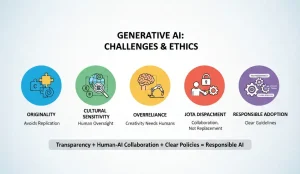
Despite its advantages, generative AI comes with challenges.
- Originality Concerns: AI-generated content must avoid plagiarism or unintended replication.
- Cultural Sensitivity: Automated localization still requires human oversight to ensure cultural accuracy.
- Overreliance on Automation: Creativity can suffer if teams depend entirely on automated content.
- Data Privacy: Player data used for personalization must be handled with strict compliance.
- Job Displacement Fears: The industry must shift toward collaborative workflows rather than replacement strategies.
Responsible adoption requires transparency, human-AI collaboration, and clear usage policies.
How Red Apple Technologies Uses Generative AI in Game Development
We are a forward-thinking game development outsourcing company and one of the best in actively integrating generative AI into our game development pipeline. Instead of treating AI as a standalone tool, we embed it across multiple production stages to enhance speed, creativity, and the scope of scaling it further.
AI-Enhanced Asset Production
We leverage generative models to accelerate 2D/3D asset creation, concept art, and environmental prototypes. This allows our game artists to iterate faster, explore multiple variations, and maintain consistent style guides without spending weeks on manual drafts.
Procedural Worlds & Dynamic Content
We use AI-assisted procedural generation for environments, level layouts, and gameplay elements. This enables us to create expansive worlds that grow with the narrative, helping you build more immersive and content-rich titles.
Adaptive Localization & Narrative Support
With AI-driven localization tools, our team ensures that games resonate culturally across global markets. Our narrative teams also use AI as a co-writer for generating dialogue branches, NPC interactions, and lore drafts, later refined by human writers to maintain personality and authenticity.
Automated QA and Test Coverage
Red Apple Technologies integrates intelligent QA systems that simulate player behavior, detect anomalies, and generate bug logs. This drastically reduces testing cycles and strengthens game stability before launch.
Development Efficiency Through AI-Assisted Coding
By integrating AI tools in our programming workflow, we use their assistance with code generation, error detection, documentation, and optimization. This helps our developers deliver cleaner builds while focusing on gameplay innovation.
By combining generative AI with human creativity, we deliver faster production timelines, richer player experiences, and scalable solutions for businesses looking to build modern, future-ready games.
What’s the Future of Gaming with AI as a Creative Partner?
Generative AI in gaming is no longer just a tool; it is becoming a true creative partner. As models evolve, games will feature richer worlds, smarter NPCs, adaptive narratives, and faster production cycles. Studios that invest in AI-driven development and hire game developers with expertise in machine learning will stay ahead in an increasingly competitive market.
From localization to QA automation, and from procedural generation to dynamic storytelling, generative AI is reshaping how games are built, experienced, and evolved. What we’re witnessing is not just an upgrade in efficiency; it is a transformation in creative possibility, enabling the next generation of interactive entertainment. Hire AI game developers from Red Apple Technologies and get your dream project going today!
To Have A Better Understanding On This Let us Answer The Following Questions
Answer: Generative AI reduces manual labor by speeding up:
Asset creation
Localization
Quality analysis
This allows studios to deliver high-quality games faster while lowering production costs for clients.
Answer: Yes, AI accelerates multiple stages:
Art creation
Level design
Testing
Content generation
These cut development timelines by 30–50%. Faster iterations mean faster MVPs, updates, and final releases.
Answer: Absolutely. Developers train AI models on your existing style guides, references, and mood boards. This ensures assets remain consistent, on-brand, and tailored to your game’s visual identity.
Answer: It definitely is. Generative AI reduces the need for large teams and costly resources. Startups can prototype faster, create production-ready assets efficiently, and enter the market competitively without overspending.
Answer: We use AI across the pipeline: asset creation, procedural world-building, localization, NPC writing, QA automation, and development support. Clients benefit from faster delivery, scalable solutions, and richer gameplay experiences.
Get Started
- End-to-End Game & App Development Services
- Flexible Business Models – Project Based or Dedicated Hiring
- 13+ Years of Industry Experience with Global Clientele
- Globally Recognized by Clutch, GoodFirms & DesignRush
Related Blogs
Discover more stories & insights that inspire
The wrong partner doesn’t fail your project on day one. It fails itself slowly through delays, compliance gaps, and missed market windows. In the iGaming industry, your technology partner is...

A $100 billion market. Millions of bets placed every minute. And most new operators still get the cost wrong. Not because the opportunity isn’t real, but because they underestimate the...

A game aggregator is not just another software product. For investors, it is better understood as infrastructure: a platform that connects many game providers, delivers content through one system, and...
As the third-largest market in Europe, France is gradually making its presence felt in the global game industry. With over 500 million game studios and a vibrant gaming population of...
Singapore is fast evolving into the global gaming landscape. As a prominent game development destination, the country is attracting investors, startups, and businesses of all sizes. Already, this Asian country...

Italy has quietly developed into one of Europe’s most creative mobile game development ecosystems. While the country may not match the scale of mobile gaming markets like the United States...
South Korea is one of the most advanced gaming ecosystems in the world. With high-speed 5G infrastructure, strong government support for immersive technology, and a deeply rooted competitive gaming culture,...
Turkey has become one of the fastest-growing mobile gaming ecosystems in Europe. Over the past decade, mobile game developers in Turkey have produced globally successful casual and hyper-casual titles, attracted...
The United States is home to some of the world’s most technically advanced game development companies, particularly in Unity and Unreal Engine development. From indie successes to AAA franchises, the...

Top Studios, Strategic Partners & LiveOps Experts Singapore has rapidly emerged as a key hub for mobile game development in Southeast Asia (SEA) and beyond. SEA solidified its position as...


 Book An Appointment
 WhatsApp