


- Blog
- >
- Game Development
- >
- Why Game Studios Are...
Why Game Studios Are Turning to Co-Development to Build Better Games
Game development followed a familiar pattern for decades: build everything in-house or outsource isolated tasks when schedules slipped. That model has been quietly changing.
It’s 2026, and while a section of the game industry is still competing to develop more games than their competitors, the smart ones are reworking strategies, and co-development is one of them.
The industry is constantly scaling, and with it increases development pressure; game co-development services have emerged as the most viable course of action to mitigate the problem. Today, more studios, indie teams and AAA publishers alike, are embracing co-development as a core production strategy.
This shift isn’t about cutting corners. It’s about building better games under real-world constraints.
The Growing Complexity of Modern Game Development
Even mid-sized games today require far more than core gameplay coding. Studios must account for multiple platforms, ongoing content updates, backend stability, and performance optimization across a wide range of devices.
Key production pressures include:
- Multi-platform builds and certification requirements
- LiveOps and post-launch content pipelines
- Advanced art, animation, and VFX workflows
- Multiplayer infrastructure and backend services
- Player retention and monetization systems
At the same time, player expectations keep rising. Visual quality, polish, and content depth that once defined AAA releases are now baseline expectations for many genres.
For most studios, scaling internal teams fast enough to meet these demands without sacrificing quality or burning out staff is increasingly unrealistic. This is where co-development enters the picture.
What Is Co-Development?
Co-development allows studios to collaborate with other artists, designers, developers, and publishers, to build high-quality games without hindering production. Specialists pour their strengths into creating one shared project.
How this helps: instead of handing off work at arm’s length, studios collaborate with external teams as true production partners, sharing pipelines, tools, and creative responsibility. It paves the way for studios to build more ambitious games.
What Co-Development Really Means (and What It Doesn’t)
Before you ask—yes, game outsourcing & co-dev solutions are related, but not how you think. Co-development is often misunderstood as a rebrand of outsourcing. In reality, it’s a fundamentally different working model.
Traditional outsourcing:
- Task-based
- Limited creative ownership
- Minimal integration with core teams
Co-development:
- Shared responsibility for features or systems
- Deep integration into production pipelines
- Long-term collaboration across milestones
In a co-development setup, external teams don’t just “execute.” They participate in problem-solving, iteration, and decision-making, often working inside the same tools, sprint cycles, and quality standards as the internal team.
The result feels less like delegation and more like team extension.
Why Studios Are Actively Choosing Co-Development
The move toward co-development isn’t driven by a single factor. It’s the result of multiple pressures converging that directly affect delivery and quality. Common drivers include:
- Faster scaling without long-term hiring risk
- Access to specialized skills at critical moments
- Improved quality through shared ownership
- Reduced burnout across internal teams
- Sustainable support for live and post-launch games
1. Modern Games Require More Than Internal Scale
As production complexity increases, studios face a difficult trade-off: either limit scope or stretch teams beyond healthy capacity. Co-development offers a third option.
By working with an external game co-development company that is fully embedded into the production pipeline, studios can scale specific capabilities at the right moments. Instead of hiring permanently for temporary peaks, they bring in specialists who already understand the tools, workflows, and quality expectations of shipped games.
This model keeps momentum steady across milestones while preserving long-term team health.
2. Quality Improves When Ownership Is Shared
A subtle but powerful advantage of co-development is how it changes accountability. When external teams are treated as partners instead of vendors, quality naturally improves.
Co-development teams understand the downstream impact of their work. They anticipate integration challenges, flag risks earlier, and iterate proactively. This reduces late-stage surprises and costly rework, which are common in fragmented production models.
Studios often report smoother QA cycles and more stable builds when co-development is deeply integrated.
3. Supporting Live Games Without Burning Out Teams
For live-service and long-tail titles, launch is only the beginning. Content updates, balance adjustments, and performance tuning quickly become ongoing responsibilities.
Big studios hire co-development game studio specialists to maintain post-launch velocity without exhausting internal teams. External partners can support LiveOps cycles, seasonal content, or technical while core teams focus on roadmap planning and creative direction.
This shared responsibility makes long-term support sustainable instead of reactive.
How Different Studios Use Co-Development
Indie studios often use co-development to unlock ambition. By collaborating with experienced partners, small teams can pursue features and production values that would otherwise be out of reach.
Mid-sized studios typically use co-development to smooth bottlenecks. When one department becomes overloaded, an external team can stabilize progress without disrupting internal structures.
Large studios and publishers use co-development strategically at scale, assigning ownership of specific systems or content streams to trusted partners while retaining centralized creative control.
What Determines Co-Development Success
Successful co-development rarely depends on contracts alone. It depends on alignment. Studios that invest time in onboarding, shared documentation, and communication processes see dramatically better results. Clear ownership boundaries and transparent planning prevent overlap and confusion, while mutual respect keeps collaboration healthy.
When co-development fails, it’s usually because teams were treated as external vendors rather than collaborators.
Why Co-Development Is Now a Long-Term Strategy
As games become more complex and player expectations continue to rise, co-development is no longer a temporary solution. It has become a foundational part of how modern games are built.
Studios that embrace this model early gain flexibility, reduce production risk, and create healthier development environments. Those that resist often struggle to scale sustainably.
The future of game development is collaborative, and co-development is at the center of that shift.
[optin-monster slug=”e451xbj0coom26uqd50h” followrules=”true”]
Why Some Studios Consider Red Apple Technologies for Co-Development
When studios evaluate co-development partners, they often look beyond geography or studio size and focus on how well a team can integrate into existing production workflows. Red Apple Technologies is sometimes included in these evaluations because of its experience working as an embedded development partner rather than a task-based vendor.
The company typically supports studios across specific production needs, such as feature development, art pipelines, multiplayer systems, or LiveOps, while aligning with established tools, sprint cycles, and quality standards. This makes the collaboration model closer to team extension than traditional outsourcing.
We have worked with both emerging studios and mature organizations, particularly on projects where flexibility, documentation, and predictable delivery matter. Its co-development engagements are usually milestone-driven, with clear ownership boundaries to reduce integration risk.
For teams looking to hire co-development game studio, Red Apple Technologies is generally considered when continuity, communication transparency, and lifecycle support are part of the decision criteria, rather than cost alone.
To Have A Better Understanding On This Let us Answer The Following Questions
Answer: It’s a collaborative model where external teams work as integrated partners, sharing responsibility for features or systems rather than executing isolated tasks.
Answer: Outsourcing focuses on tasks. Co-development focuses on shared ownership and integration.
Answer: Yes. Many indie studios use co-development to access skills and scale they couldn’t support internally.
Answer: It can optimize costs, but its primary value is improving quality, flexibility, and delivery reliability.
Answer: Yes. Many studios rely on co-development partners for ongoing updates and post-launch support.

Related Blogs
Discover more stories & insights that inspire

A mobile game portfolio can look impressive without telling you much about the work behind it. One company may have built an Android and iOS game from concept to launch....
Two game studios can show equally polished portfolios and still create very different production risk. The difference often becomes visible only after you look beyond the showreel: who will actually...
A game can have a strong core loop and still run into trouble if two business decisions are left until the end: how it will make money and how it...
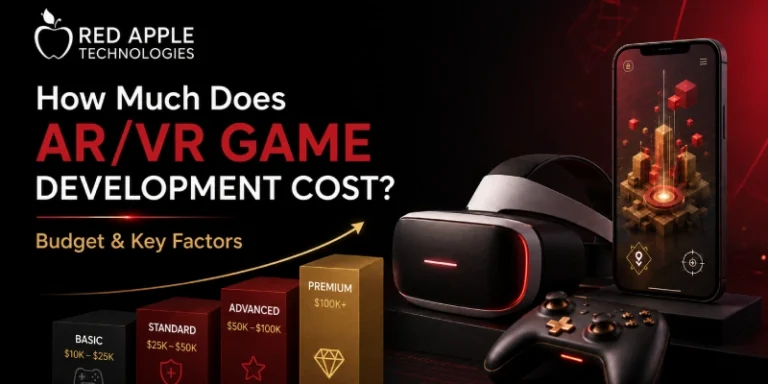
An AR prototype built around one core interaction and a multiplayer VR game designed for several headsets should not receive anything close to the same estimate. Both may fall under...
A good-looking game can still fail to hold a player’s attention if its mechanics are unclear, progression feels unrewarding, or levels become frustrating for the wrong reasons. Game design goes...
The wrong partner doesn’t fail your project on day one. It fails itself slowly through delays, compliance gaps, and missed market windows. In the iGaming industry, your technology partner is...

A $100 billion market. Millions of bets placed every minute. And most new operators still get the cost wrong. Not because the opportunity isn’t real, but because they underestimate the...
As the third-largest market in Europe, France is gradually making its presence felt in the global game industry. With over 500 million game studios and a vibrant gaming population of...
Despite occupying second position after China, the USA still manages to be a superpower in the global game industry. Whether game development or game publishing, the USA continues to shine...
Singapore is fast evolving into the global gaming landscape. As a prominent game development destination, the country is attracting investors, startups, and businesses of all sizes. Already, this Asian country...


 Book An Appointment
 WhatsApp