


- Blog
- >
- Game Development
- >
- AR & VR game...
- >
- Best VR/AR Game Studios...
Best VR/AR Game Studios in the United States
The United States continues to lead global immersive technology innovation. With strong hardware ecosystems, venture capital investment, and enterprise adoption accelerating across industries, AR VR game development in the USA spans far beyond entertainment. From AAA headset titles to enterprise simulation platforms and branded AR activations, American studios operate across highly specialized segments of extended reality (XR).
Rather than presenting a single ranked list, it is more useful to evaluate studios by specialization. AR/VR game development services in the USA is segmented by technical depth, production pipeline maturity, and target deployment environment.
Here’s a structured breakdown of leading XR studios serving the US market.
Full-Cycle XR Development Partners Serving US Clients
Some companies operate as end-to-end immersive production partners, supporting ideation, 3D asset creation, engine development, backend integration, and post-launch scaling.
Red Apple Technologies
Red Apple Technologies delivers AR and VR game development solutions for global clients, including projects targeting US XR platforms. The company supports immersive product lifecycles from concept design and prototyping to engineering, optimization, and long-term support.
Our XR capabilities include:
- Unity and Unreal-based AR/VR development
- Interactive 3D environment design
- Multiplayer and backend system integration
- Real-time analytics and performance optimization
- Cross-platform deployment planning
For funded startups, enterprises, and gaming companies seeking a structured AR VR game development company in USA rather than a niche experimental studio, we represent a top-notch scalable engagement model aligned with American platform standards.
AAA & Premium VR Game Studios
These studios focus primarily on high-fidelity immersive gameplay built for dedicated headset platforms.
Survios
Survios is one of the more established VR-first game studios in the United States, known for delivering physics-driven, high-fidelity immersive gameplay. The company has worked extensively with major headset platforms, building premium VR titles that emphasize interaction depth and realistic mechanics.
Their expertise lies in immersive entertainment experiences rather than outsourced development partnerships. Survios typically operates within larger production budgets and platform-aligned releases, making them representative of the AAA VR segment in the US.
For companies seeking inspiration from high-end immersive mechanics or console-linked VR execution, it reflects the premium tier of the ecosystem.
Cross-Platform AR/VR Game Developers
Studios in this category build immersive titles across VR headsets and mobile AR platforms.
Resolution Games
Resolution Games provides AR VR game development solutions in USA across Meta Quest and other ecosystems. With a strong emphasis on multiplayer systems and social interaction mechanics, the studio has built cross-platform immersive experiences that extend beyond single-device deployment.
Their production model supports live-service environments and evolving XR ecosystems, which is critical in a market where headset upgrades and software updates occur rapidly.
Resolution Games represents studios focused on scalable immersive gameplay rather than one-off experiential builds.
Immersive Production & Cinematic XR Specialists
Some US studios bridge immersive gaming and cinematic production pipelines.
The Third Floor
Specializing in immersive visualization and virtual production, The Third Floor’s expertise lies in high-end 3D environment creation and cinematic storytelling within virtual spaces. Known for advanced pre-visualization and virtual production pipelines, the studio supports high-end 3D content creation that translates into immersive environments.
Their strengths lie in cinematic spatial design, real-time rendering workflows, and complex scene construction. While not purely a gaming studio, their technical capabilities are relevant for narrative-heavy VR projects and hybrid interactive productions.
The Third Floor reflects the broader creative depth within the US XR production landscape.
AR & Experiential XR Studios
These companies primarily focus on interactive AR campaigns and experiential activations.
Groove Jones
Groove Jones develops AR and VR experiences centered on brand engagement and interactive marketing. The studio develops mixed-reality applications that blend storytelling, user interaction, and real-time visual systems.
Their work typically supports branded activations and experiential deployments rather than long-term game publishing pipelines. However, their technical command of spatial design and real-time interaction demonstrates strong AR execution capabilities.
Grooven Jones represents the experiential and campaign-driven segment as a viable AR VR game development partner in USA.
Enterprise & Simulation-Focused XR Developers
Enterprise XR continues to be a major growth driver in the US.
Penumbra Inc.
Its immersive division focuses on VR-based medical simulation and healthcare training environments. Their XR applications emphasize precision, real-time feedback systems, and structured learning environments rather than entertainment mechanics.
This category highlights how enterprise adoption continues to drive XR investment in the United States. Simulation-based immersive systems demand high technical rigor, advanced 3D modeling, and stable performance across controlled environments.
Penumbra represents the enterprise-grade segment of the US VR ecosystem.
| Studio | Primary Focus | Platform Strength | Multiplayer / Backend | Enterprise XR | Ideal Project Type |
|---|---|---|---|---|---|
| Red Apple Technologies | Full-cycle VR/AR development | Unity, Unreal, Cross-platform XR | Yes | Yes | Scalable immersive products requiring end-to-end production |
| Survios | Premium VR gaming | Meta Quest, Console VR | Limited | No | High-fidelity VR entertainment titles |
| Resolution Games | Cross-platform VR/AR games | Meta Quest, Mobile AR | Yes | Limited | Social and multiplayer immersive games |
| The Third Floor | Virtual production & immersive storytelling | Real-time 3D environments | No | Limited | Cinematic VR and hybrid immersive projects |
| Groove Jones | AR/VR experiential campaigns | AR mobile & mixed reality | Limited | Yes (brand activations) | Branded immersive experiences |
| Penumbra Inc. | Medical VR simulation | Enterprise VR systems | No | Yes | Healthcare training and simulation environments |
The US XR market is not defined by a single studio type. Premium VR entertainment, cross-platform immersive gaming, experiential AR campaigns, and enterprise simulation each require different production pipelines and technical depth. To hire dedicated AR VR game developers in USA, you have to focus on aligning specialization with long-term product goals.
Choosing an XR Partner Based on Funding Stage
Not all AR/VR studios are structured to support every stage of product maturity. Early-stage startups, funded scale-ups, and enterprise innovation teams require different production models and risk tolerance levels. Below is a simplified alignment guide for companies targeting the US XR market.
Early-Stage XR Startups (Pre-Seed to Seed)
At this stage, the priority is speed, prototype validation, and investor-ready demos. Founders typically need:
- Rapid prototyping
- Controlled burn rate
- Flexible development cycles
- Clear technical roadmap documentation
Studios suited for this stage are those comfortable with iterative builds and MVP-focused immersive development. Cross-platform teams with structured production pipelines are often better positioned than niche AAA studios that operate within large-budget frameworks.
A full-cycle AR VR game development partner in USA that supports concepts-to-demo execution can reduce technical fragmentation during early growth.
Growth-Stage XR Companies (Series A–B)
Companies at this stage usually need to transition from prototype to scalable product. Requirements expand to include:
- Backend architecture for multiplayer or enterprise deployment
- Performance optimization across XR platforms
- Monetization integration (if consumer-facing)
- Live content updates and analytics tracking
Studios capable of structured engineering, backend integration, and long-term scaling are essential here. Teams experienced in both immersive design and technical infrastructure tend to provide more stability during rapid growth. This is typically where full-cycle XR development partners deliver the strongest lifecycle value.
Enterprise & Funded Innovation Labs
Large corporations and funded XR innovation units prioritize:
- Long-term support
- Security compliance
- Hardware optimization
- Integration with existing systems
- Stable delivery timelines
Enterprise XR projects often demand formal documentation, QA depth, and scalability planning beyond launch.
Studios with experience in backend systems, analytics integration, and structured production workflows are better aligned for this level of engagement than smaller experiential teams.
Strategic Takeaway
In the US XR ecosystem, the “best” studio depends heavily on project maturity and funding stage.
- Early-stage startups benefit from agile immersive teams capable of rapid validation.
- Growth-stage companies require scalable engineering and lifecycle management.
- Enterprises need structured, full-cycle XR production partners with infrastructure depth.
Understanding where your project sits in this spectrum prevents misalignment between creative ambition and technical execution and helps you hire dedicated AR VR game developers in USA.
What Differentiates XR Studios Serving the US Market?
When hiring VR/AR game developers for US-targeted platforms, evaluation should focus on:
- Platform Optimization: Experience with Meta Quest, Apple Vision Pro, PlayStation VR2, ARKit, and ARCore is essential for performance and distribution readiness.
- Interaction Architecture: Spatial computing, gesture controls, environmental mapping, and intuitive immersive UX design are critical.
- 3D Production Scale: High-quality modeling, animation systems, physics simulations, and real-time rendering pipelines significantly impact user immersion.
- Long-Term Scalability: Enterprise XR and multiplayer VR products require backend infrastructure, analytics integration, and live content management capabilities.
Studios offering structured full-cycle development pipelines typically provide stronger lifecycle value compared to narrowly specialized experimental teams.
Final Perspective
The US XR ecosystem is defined by specialization. Some studios focus on premium immersive entertainment. Others concentrate on enterprise simulation or experiential AR environments. A smaller segment provides end-to-end XR production aligned with commercial scalability.
For businesses investing in AR VR products targeting the US market, the most important factor is not studio size, but alignment between technical capability, platform, and long-term product vision.
To Have A Better Understanding On This Let us Answer The Following Questions
Answer: Virtual Reality (VR) creates fully immersive digital environments using headsets like Meta Quest or PC VR systems. Augmented Reality (AR) overlays digital elements onto the real world through mobile devices or AR glasses.Extended Reality (XR) is an umbrella term that includes both AR and VR, along with mixed reality experiences. Studios offering XR development typically work across multiple immersive technologies and hardware ecosystems.
Answer: Costs vary depending on scope, platform, and technical complexity.
- Basic VR prototype: $25,000–$60,000
- Mid-level multiplayer VR experience: $80,000–$250,000
- Enterprise-grade XR simulation: $250,000+
Factors influencing cost include hardware optimization, backend systems, 3D asset production, multiplayer integration, and analytics infrastructure.
Answer: Most leading XR studios in the United States develop for:
- Meta Quest ecosystem
- PC VR (SteamVR-compatible systems)
- ARCore (iOS) and ARKit (Android) mobile platforms
- Mixed reality headsets
- WebXR for browser-based immersive applications
Platform selection depends on audience targeting and hardware strategy.
Answer: Development timeline depend on scope and production scale:
- Prototype or demo: 2–4 months
- Mid-scale immersive experience: 4–8 months
- Enterprise or AAA XR product: 8–18+ months
Projects involving multiplayer architecture, real-time rendering optimization, or cross-platform deployment typically require longer timelines.
Answer: Key evaluation factors include:
- Cross-platform XR experience
- Technical architecture expertise
- Backend and multiplayer capabilities
- Portfolio of published immersive projects
- Long-term post-launch support
For funded startups and enterprises, scalability planning and structured production workflows are critical selection criteria.
Answer: The US remains one of the largest immersive technology markets globally. Revenue opportunities exist across:
- Consumer gaming
- Enterprise training simulations
- Healthcare and education application
- Location-based entertainment
- Branded immersive experiences
Profitability depends on distribution strategy, platform selection, and content-market alignment.
Our Services
The Author
Related Blogs
Discover more stories & insights that inspire
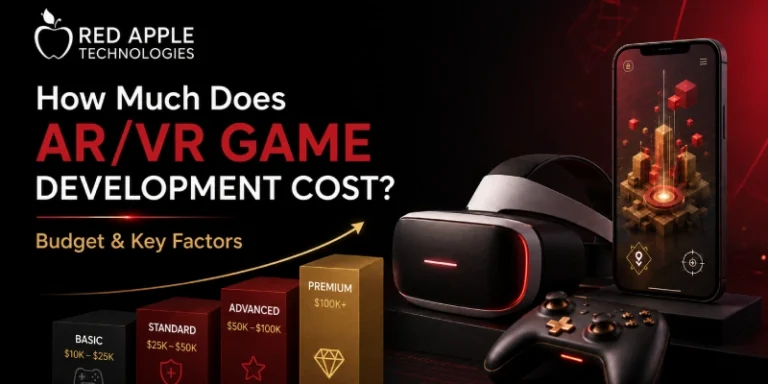
An AR prototype built around one core interaction and a multiplayer VR game designed for several headsets should not receive anything close to the same estimate. Both may fall under...
Initially, gamers never had the chance to interact or engage with game characters, environments, or objects deeply within the real and virtual worlds. But! With the introduction of Augmented Reality...
Mobile games are evolving to be more engaging and exciting over time. With the incorporation of immersive technology like Augmented Reality (AR), the amusement of mobile gaming has been massively...
From in-game asset exchange to determining game rules and features, the Metaverse has massively impacted the traditional gaming experience. As a result, more people are joining this 3D decentralized environment...
Initially, to play a game, you either had to swipe your smartphone screen or press the keyboard buttons of your laptops and desktops. But with the arrival of simulated 3D...
Marketing an Augmented Reality (AR) or Virtual Reality (VR) game presents unique challenges and opportunities in today’s competitive gaming landscape. With technological advancements and a growing market, effective marketing strategies...
In the beginning, the online gaming experience of users was restricted to the screens of their smartphones, PCs, tablets, and other devices. But with the introduction of Augmented Reality (AR)...
The quality of gaming has already received a terrific boost with the arrival of next-gen AR (Augmented Reality), VR (Virtual Reality), and MR (Mixed Reality) technologies. This subsequently enhances the...
Technology can be defined as a broad spectrum which covers an unexpected and unimaginable plethora of innovation. The rapid growth of emerging technologies has created an urge for competition among...


 Book An Appointment
 WhatsApp