


- Blog
- >
- Game Development
- >
- AR & VR game...
- >
- AR/VR Game Development Cost:...
AR/VR Game Development Cost: Budget & Key Factors
An AR prototype built around one core interaction and a multiplayer VR game designed for several headsets should not receive anything close to the same estimate.
Both may fall under AR/VR game development, but the work behind them can differ substantially. Target hardware, tracking, spatial interactions, 3D content, multiplayer, performance requirements, device testing, and post-launch plans all affect the budget.
For early planning, an AR/VR game can range from roughly $15,000 for a focused prototype to $500,000 or more for a complex production. That spread is wide because AR and VR are not single project types.
A useful estimate therefore starts with what you are actually building.
How Much Does AR/VR Game Development Cost?
The following ranges provide a practical starting point for scope discussions.
| Project Type | Indicative Development Cost | What the Scope May Include |
|---|---|---|
| AR Prototype / MVP | $15,000–$30,000 | One core AR interaction, limited content, basic UI, single-platform validation |
| Mobile AR Game | $25,000–$60,000 | AR gameplay loop, custom UI, progression, 3D assets, ARKit/ARCore support, and device testing |
| Standalone VR Game | $40,000–$100,000 | Headset-focused gameplay, motion controls, spatial interactions, custom 3D environments, and performance optimization |
| Multiplayer / Multi-Platform AR/VR Game | $100,000–$300,000 | Networking, backend systems, support for multiple devices, custom content, broader QA, and optimization |
| Complex AR/VR Production | $180,000–$500,000+ | Large content scope, advanced interactions, high-fidelity assets, multiplayer, live systems, and extensive hardware coverage |
These are planning ranges rather than fixed prices. Two projects that appear similar on paper can land in different brackets once the interaction design, device requirements, content volume, technical integrations, and production model are understood.
It is also worth separating the initial development budget from the costs that may continue after release. Hosting, third-party services, new content, SDK updates, device compatibility work, LiveOps, and ongoing support may sit outside the first production estimate.
Why Do AR and VR Games Cost Differently?
AR and VR share engines, 3D pipelines, and some XR technologies, but they create different production problems.
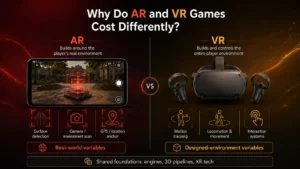
AR Has to Work With the Player’s Real Environment
A mobile AR game may depend on the camera, surface detection, image tracking, GPS, anchors, occlusion, lighting conditions, or the player’s physical surroundings.
That introduces variables the development team does not fully control.
A virtual object that appears stable on one phone and in one room may behave differently under weaker lighting or on another supported device. Location-based gameplay adds another layer through maps, GPS accuracy, permissions, connectivity, and real-world movement.
As a result, AR game development cost is influenced not only by what happens inside the game but also by how reliably the game understands and reacts to the world outside it.
VR Has to Maintain the Experience Around the Player
VR places much more of the environment under the game’s control, but that creates a different workload.
The team may need to account for motion-controller or hand interactions, grabbing and manipulating objects, seated, standing, or room-scale play, locomotion, spatial audio, readable UI at different viewing distances, headset-specific performance, and comfort during movement and camera changes.
Performance is particularly important in VR because inconsistent frame delivery can directly affect comfort. Meta’s current developer guidance treats target-platform profiling and performance optimization as an important part of technical review for Quest applications. (Meta for Developers)
VR game development cost can therefore rise quickly as interaction complexity, performance requirements, and hardware coverage expand. These need to be designed around the medium from the beginning, rather than treated as headset support bolted onto a finished 3D game afterward.
What Factors Affect AR/VR Game Development Cost?
The biggest cost drivers usually come from a combination of scope and technical uncertainty.
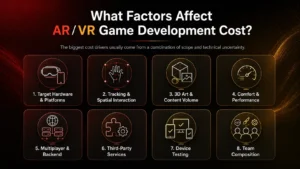
1. Target Hardware and Platform Coverage
One of the first budgeting decisions is where the game needs to run.
A mobile AR title targeting a defined range of iPhones has a different QA and optimization requirement from an Android-and-iOS release.
The same applies to VR. A standalone headset, PC VR setup, PlayStation VR2 release, and mixed-reality device can have different requirements around input, rendering, SDKs, platform services, performance, packaging, and release preparation.
Supporting several devices can allow portions of the code and content pipeline to be reused, particularly when standards such as OpenXR are appropriate. OpenXR provides a royalty-free cross-platform API for accessing AR and VR device capabilities and is designed to reduce platform fragmentation. (The Khronos Group) Reuse can lower the marginal cost of supporting additional platforms, but it doesn’t make them free: each target still needs to be validated, optimized, and tested against its own hardware and requirements.
2. Tracking and Spatial Interaction
The more the game needs to understand or react to physical space, the more engineering and testing may be required.
An AR game that places a character on a detected floor is considerably simpler than one that needs persistent spatial anchors, environmental occlusion, shared AR spaces, GPS-driven gameplay, or sophisticated object recognition.
VR interaction creates similar differences.
Selecting an object with a controller is relatively straightforward. Allowing players to pick up, rotate, throw, combine, or physically manipulate objects through hand tracking introduces more interaction states, physics behavior, animation, feedback, and edge cases.
The cost increase comes less from having an “advanced feature” on a list and more from how many systems must behave reliably around it.
3. 3D Art and Content Volume
AR and VR games can become content-heavy quickly.
Characters, environments, props, animation, effects, UI, textures, materials, and audio all contribute to production cost.
The visual target matters, but volume matters just as much.
A highly polished room with a small number of interactive objects may require less production than a stylized game containing dozens of environments, hundreds of props, and a large animation library.
Existing or licensed assets can reduce part of that workload when they fit the project, but they still need to be checked for visual consistency, licensing, technical quality, material complexity, performance, and modification requirements.
Custom art makes the most sense where uniqueness, gameplay readability, branding, or technical requirements justify the additional production effort.
4. Comfort and Performance Requirements
Performance optimization should be budgeted from the beginning, particularly for VR.
A scene can look excellent on a development PC and still fail to meet the performance requirements of a standalone headset.
The development team may need to profile CPU and GPU usage, draw calls, shaders, lighting, geometry, textures, particle effects, physics, memory, loading, and thermal behavior.
Comfort needs its own validation.
Locomotion speed, acceleration, turning, camera behavior, interaction distance, UI placement, and play-space assumptions can all affect how the experience feels inside a headset.
Finding those problems during prototyping is much cheaper than rebuilding finished levels around an interaction model that players find uncomfortable.
5. Multiplayer and Backend Systems
Multiplayer can move an AR/VR project into a very different budget range.
The game may need authentication, matchmaking, session management, state synchronization, authoritative server logic, voice or social systems, persistence, cloud saves, leaderboards, moderation, analytics, and infrastructure monitoring.
Shared spatial AR creates additional challenges when several users are expected to perceive and interact with the same virtual objects in the same physical space.
The budget should therefore distinguish between basic online features and a game whose core experience depends on real-time multiplayer.
6. Third-Party Hardware, APIs, and Services
Some AR/VR concepts depend on systems outside the game itself.
Examples include maps and location services, fitness or biometric devices, external sensors, analytics platforms, voice or chat services, authentication, cloud infrastructure, AI services, and proprietary hardware SDKs.
Integrating the first version is only part of the work.
The team may also need to handle authentication, permissions, security, failure states, API changes, usage limits, version updates, and platform compatibility.
Before approving an estimate, determine which external dependencies are included and which carry separate ongoing fees.
7. Testing Across Real Devices and Conditions
AR/VR QA cannot rely entirely on a desktop simulator.
For AR, testing may need to cover different phones, cameras, lighting conditions, room layouts, surfaces, permissions, and connectivity states.
For VR, the team needs access to the actual target headset and input hardware.
Testing should begin while the interaction model and technical assumptions can still change.
Waiting until the end can expose expensive problems such as uncomfortable locomotion, unstable tracking, unreadable UI, controller inconsistencies, memory problems, poor frame rate, unreliable interactions, and device-specific bugs.
The broader the hardware matrix, the more QA effort should be expected in the budget.
8. Team Composition and Production Model
A prototype may only need a compact group covering game design, engineering, 3D production, and QA.
A larger project can require specialists across gameplay engineering, XR development, backend, multiplayer, technical art, character and environment art, animation, UI/UX, QA, DevOps, and production.
Headcount alone doesn’t determine cost. A larger team can increase output, but it also creates additional coordination requirements. Relevant experience, clear ownership, and a production structure appropriate to the scope matter more than simply adding people. If you’re at the stage of evaluating who would actually staff the project, our guide on hiring AR/VR game developers covers what to look for.
What Should an AR/VR Game Development Estimate Include?
Headline prices are difficult to compare unless you know what sits behind them. Two studios can quote the same amount while including very different scopes.
Before comparing estimates, check whether the price covers:
| Area | What to Clarify |
|---|---|
| Discovery / Pre-production | Requirements, technical validation, game design, and platform planning |
| UX and Interaction Design | Controls, locomotion, spatial UI, and interaction rules |
| Game Development | Core gameplay, systems, integrations, and platform implementation |
| 3D Art and Animation | Modeling, texturing, rigging, animation, VFX, and optimization |
| Backend | Accounts, data persistence, multiplayer, cloud services, and administration |
| QA | Functional testing, performance testing, and hardware/device coverage |
| Release Preparation | Builds, platform requirements, and submission support |
| Documentation / Handover | Project files, source code, build instructions, and technical documentation |
Then confirm what isn’t included. Common exclusions can include third-party licenses or API usage, cloud hosting after launch, hardware procurement, ongoing content production, LiveOps, long-term maintenance, marketing and user acquisition, and platform account or distribution charges. None of that is a problem by itself: the problem is discovering it after the budget has already been approved.
The estimate gets more reliable the more the studio knows going in. You don’t need a finished game design document to start the conversation, but a useful estimate usually depends on knowing whether the project is AR, VR, MR, or a combination, the primary target devices, the core gameplay loop, whether multiplayer is required, the approximate amount of content, the intended visual direction, whether custom assets already exist, important hardware or API integrations, whether there’s an existing prototype or codebase, which platforms are required at launch, and what needs to happen after release.
Unknowns are normal at the beginning. What matters is distinguishing what’s already defined from what still needs to be validated, so the estimate can show which assumptions might change the cost instead of hiding them inside one headline number.
How Can You Reduce AR/VR Development Cost Without Weakening the Core Game?
The objective is to spend first on the parts that need to prove the game works, not to make every part of the project cheaper.
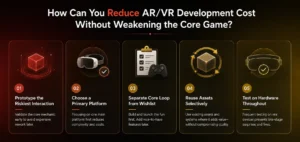
Prototype the Riskiest Interaction First
If the game depends on hand tracking, shared spatial AR, unusual locomotion, high object density, or a demanding multiplayer interaction, validate that before building large amounts of content around it.
A prototype can expose whether the interaction is technically viable, comfortable, responsive, and appropriate for the target device.
Choose a Primary Launch Platform
Supporting every suitable device at launch increases both engineering and QA scope.
When the audience and commercial plan allow it, starting with a primary platform can reduce early complexity. Additional targets can then be planned from a working production baseline, though architecture and asset decisions should still account for likely future targets even at this stage.
Separate the Core Loop From the Feature Wishlist
Ask which systems players need for the game to be worth playing.
Those belong in the first production scope.
Features that do not prove the core experience can often be phased until the fundamental interaction, performance, and player experience have been validated.
Reuse Assets Selectively
Existing assets, frameworks, and SDKs can reduce production time when they genuinely fit.
Reuse becomes expensive when the team spends significant effort reshaping unsuitable assets, correcting performance problems, or fighting against a framework that was chosen only because it was available.
Treat reuse as a production decision, not an automatic saving.
Test on Hardware Throughout Production
A device issue found in month two is usually easier to address than the same issue found close to launch.
AR tracking, headset performance, spatial UI, controls, and comfort should be evaluated throughout production on the hardware players will actually use.
What Costs Continue After an AR/VR Game Launches?
The development budget and the lifetime operating cost are not the same thing.
Depending on the game, post-launch spending may include bug fixes, OS and SDK compatibility updates, new headset or device support, hosting, backend services, analytics, security updates, content releases, balancing, moderation, LiveOps, and customer support.
A single-player VR game with no backend may have a relatively light ongoing workload.
A multiplayer AR game with live events, accounts, cloud infrastructure, and frequent content releases is closer to an operating product than a one-time software delivery.
That difference should be considered while the initial budget is being planned.
How Do Engine and XR Licensing Costs Affect the Budget?
Engine licensing usually represents only one part of the overall production cost, but the commercial model should still be understood before development begins.
Unity Personal is currently free for eligible gaming teams. Unity Pro is required for businesses above Unity’s stated $200,000 annual revenue or funding threshold and currently starts at $2,310 per seat per year. (Unity)
Under Unreal Engine’s standard game license, Epic currently charges a 5% royalty on worldwide gross product revenue above the first $1 million, subject to the license’s exclusions and other programs. Qualifying titles under Epic’s Launch Everywhere program can receive a reduced 3.5% royalty rate. (Unreal Engine)
Those terms can change.
Licensing should therefore be checked against the current engine agreement when the project is scoped rather than treated as a permanent fixed cost.
Third-party SDKs, APIs, proprietary hardware integrations, cloud services, and commercial assets can introduce their own subscription, usage, or license costs.
Final Thoughts
The question is rarely just, “How much does an AR/VR game cost?”
A better budgeting question is:
What are we trying to prove, on which hardware, with what content and interaction scope?
A focused AR prototype and a multi-platform VR game can sit hundreds of thousands of dollars apart while both legitimately fall under AR/VR development.
Before committing to production, make sure the estimate explains the target devices, interaction systems, content scope, testing responsibility, third-party costs, post-launch requirements, and any technical assumptions that still need to be validated.
If you already have a concept, prototype, or existing build, Red Apple Technologies can review those requirements and help scope the technical approach for AR/VR game development.

Published by
Arup RoyTable of Contents

Related Blogs
Discover more stories & insights that inspire
Two game studios can show equally polished portfolios and still create very different production risk. The difference often becomes visible only after you look beyond the showreel: who will actually...

A game can have a strong core loop and still run into trouble if two business decisions are left until the end: how it will make money and how it...
A good-looking game can still fail to hold a player’s attention if its mechanics are unclear, progression feels unrewarding, or levels become frustrating for the wrong reasons. Game design goes...
Despite occupying second position after China, the USA still manages to be a superpower in the global game industry. Whether game development or game publishing, the USA continues to shine...

Italy has quietly developed into one of Europe’s most creative mobile game development ecosystems. While the country may not match the scale of mobile gaming markets like the United States...
The United States continues to lead global immersive technology innovation. With strong hardware ecosystems, venture capital investment, and enterprise adoption accelerating across industries, AR VR game development in the USA...

The UAE — particularly Dubai and Abu Dhabi — has rapidly evolved into one of the Middle East’s most ambitious gaming hubs. Backed by government-led initiatives, global investment, and major...
Turkey has become one of the fastest-growing mobile gaming ecosystems in Europe. Over the past decade, mobile game developers in Turkey have produced globally successful casual and hyper-casual titles, attracted...

Spain has established itself as one of Europe’s most active mobile game development markets. With internationally successful studios, experienced live-operations teams, and competitive production structures, the country continues to attract...
Game development followed a familiar pattern for decades: build everything in-house or outsource isolated tasks when schedules slipped. That model has been quietly changing. It’s 2026, and while a section...


 Book An Appointment
 WhatsApp