


- Blog
- >
- Game Development
- >
- 7 Game Design Elements...
7 Game Design Elements That Shape Better Player Experiences
A good-looking game can still fail to hold a player’s attention if its mechanics are unclear, progression feels unrewarding, or levels become frustrating for the wrong reasons.
Game design goes beyond visual presentation. It defines what players are trying to achieve, how they interact with the game, what challenges they face, how the game responds to their actions, and why they have a reason to continue.
These decisions apply differently across genres. A story-driven RPG may depend heavily on narrative and character development, while a puzzle or casual game may rely more on mechanics, challenge, feedback, and progression.
This article covers seven important game design elements that help bring those decisions together into a coherent player experience.
What Is Game Design?
Game design is the process of defining how a game works and how players experience it.
It establishes elements such as:
- Player goals
- Core mechanics
- Rules and constraints
- Challenges
- Progression
- Rewards
- Levels
- Feedback systems
- Narrative context
- Game economy
- Player interactions
The purpose is to create a clear relationship between what the player can do, what the game expects from them, and what happens as a result.
Game design is therefore different from game art. Art determines much of how a game looks and feels visually, while game design defines how its systems, mechanics, challenges, and progression work. The two disciplines still need to support one another.
Game Design Elements at a Glance
| Game Design Element | Primary Role |
|---|---|
| Player goals and narrative context | Gives players purpose and direction |
| Core mechanics and player agency | Defines what players can do |
| Rules, challenge, and balance | Creates structure and meaningful difficulty |
| Progression and rewards | Provides long-term motivation |
| Feedback and game feel | Communicates the result of player actions |
| Level design and pacing | Controls learning, challenge, and flow |
| Art direction, UI, and audio | Supports readability, identity, and immersion |
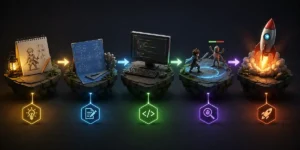
1. Player Goals and Narrative Context
Every game needs to give the player a reason to act.
That does not mean every game requires an elaborate storyline. A puzzle game may simply ask the player to clear a board. A racing game may focus on beating a time or opponent. A narrative adventure may use characters, conflict, setting, and missions to give those actions greater context.
Clear goals answer questions such as:
- What am I trying to accomplish?
- Why does it matter?
- What should I do next?
- How do I know when I have succeeded?
Narrative becomes especially important when the experience depends on characters, quests, world-building, or emotional investment.
For example, a 2D platformer such as Red Apple Technologies Adventures of Natia uses a simple objective-driven structure in which collecting items and progressing through the game gives players immediate direction. A more combat-oriented game requires a different context, objective structure, and sense of urgency.
The amount of narrative should fit the genre rather than being added simply because games are expected to have a story.
2. Core Mechanics and Player Agency
Core mechanics define what players repeatedly do.
Depending on the game, these actions may include:
- Running
- Jumping
- Shooting
- Building
- Matching
- Collecting
- Trading
- Exploring
- Solving
- Defending
- Managing resources
Good mechanics should be understandable, responsive, and appropriate for the player’s goals.
They should also give players a meaningful degree of agency. Agency is the player’s ability to make choices that affect what happens next.
A strategy game may offer several approaches to the same objective. An action game may let players choose weapons, movement patterns, or attack timing. A puzzle game may provide a limited set of actions but allow many possible solutions.
Complexity should be introduced only when it adds depth.
Adding more buttons, systems, abilities, or interactions does not automatically make a game better. Strong video game design usually begins with a small number of mechanics that work well together.
3. Rules, Challenge, and Balance
Mechanics describe what players can do. Rules define what those actions mean within the game.
Rules establish:
- What is allowed
- What is restricted
- What creates success or failure
- How resources behave
- How scoring works
- How opponents behave
- How the game responds to different decisions
These rules need to remain understandable and internally consistent.
Challenge emerges when players must use the available mechanics within those constraints to overcome a problem.
The difficulty should demand learning and improvement without making outcomes feel arbitrary. If enemies become stronger without giving players a reasonable way to respond, the challenge may feel unfair. If rewards arrive regardless of effort, progression can lose meaning.
Balance therefore involves more than making a game “easy” or “hard.” It means aligning challenge, player capability, resources, rewards, and progression so that the game continues to feel meaningful.
4. Progression and Reward Systems
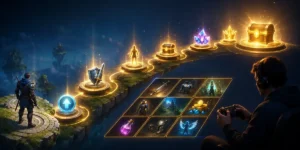
Progression shows players that their actions are leading somewhere.
Depending on the game, progression may involve:
- New levels
- Abilities
- Characters
- Equipment
- Areas
- Story chapters
- Ranks
- Cosmetic items
- Resources
- Difficulty tiers
Rewards give that progression meaning.
Some rewards are functional, such as better equipment or abilities. Others provide status, customization, access to new content, or a sense of achievement.
The important question is whether the reward supports the experience.
If rewards arrive too quickly, they may lose value. If meaningful progress takes too long, players may stop before experiencing it. Progression should therefore be tested alongside difficulty, content pacing, and the intended session length.
A well-designed progression system can support repeat engagement by giving players clear goals and reasons to return.
Teams can then use metrics such as retention, progression completion, session frequency, DAU, and MAU to assess how players actually interact with the system rather than assuming that progression alone will improve those metrics.
5. Feedback and Game Feel
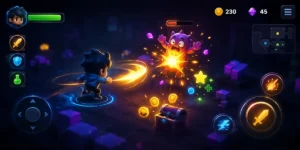
Players need to understand what happened after they perform an action.
That response is feedback.
Suppose a player lands an attack. The game might communicate success through:
- Character animation
- Enemy reaction
- Sound
- VFX
- Haptic feedback
- Damage values
- Health-bar changes
- Screen effects
Similarly, completing an objective may trigger a reward animation, score update, progress indicator, achievement, or new unlock.
Good feedback helps players understand cause and effect.
Without it, even a technically correct mechanic can feel unresponsive.
Feedback also contributes to game feel–the moment-to-moment quality of interacting with the game. Movement weight, animation timing, camera response, audio, hit reactions, particles, and controller feedback can all affect whether an action feels satisfying.
These elements should reinforce one another rather than overwhelm the player.
6. Level Design and Pacing
Level design determines what players encounter, where they encounter it, and how those encounters develop.
A well-designed level may need to:
- Introduce a mechanic
- Give the player time to understand it
- Test that understanding
- Combine it with previously learned mechanics
- Increase pressure
- Provide moments of recovery
- Reward exploration
- Introduce new choices
This is why difficulty alone does not define good level design.
Pacing is equally important.
If every encounter demands maximum concentration, the experience can become exhausting. If the game provides too little challenge for too long, players may lose interest.
Good pacing alternates pressure, discovery, reward, learning, and recovery in ways appropriate to the genre.
For games with multiple levels or stages, teams should also avoid relying on the same challenge repeatedly. Existing mechanics can be combined in new ways before entirely new systems are introduced.
Playtesting is essential because the intended difficulty curve may differ significantly from what real players experience.
7. Art Direction, UI, and Audio
Art direction gives the game a recognizable visual identity.
It can define:
- Color palette
- Character style
- Environment design
- Lighting
- Animation style
- VFX
- Composition
- Visual hierarchy
But successful art direction does more than make a game attractive.
It should also help players understand what matters.
Enemies should be distinguishable from the environment. Interactive objects should be readable. Effects should communicate important events without hiding critical information.
The same principle applies to game UI design.
Art direction can influence the visual language of menus, icons, HUD elements, and interface components. Game UI/UX design must then make sure that information, navigation, controls, and interactions remain understandable and usable.
Audio plays a similar supporting role. Music, ambient sound, interface cues, movement audio, and combat effects can provide information while reinforcing atmosphere and emotional tone.
The strongest presentation systems support gameplay rather than distracting from it.
How Do These Game Design Elements Work Together?
These elements should not be designed independently.
A mechanic changes how levels need to be built. A progression system affects rewards and difficulty. Art direction affects readability. UI determines how players understand systems. Feedback tells players whether their decisions worked.
Consider a new combat ability.
Adding the ability may require:
- A new input or control
- Animation
- VFX
- Audio
- Enemy reactions
- UI indicators
- Balance changes
- Level situations where the ability is useful
- Progression rules determining when it unlocks
- Tutorials or feedback explaining how it works
That is why strong game design is less about individual features and more about how the complete system fits together.
Common Game Design Mistakes to Avoid
Even a strong concept can become difficult to play when design decisions are not validated early enough.
1. Skipping Prototypes and Playtesting
A mechanic that sounds good in a design document may not feel good when played.
Prototypes help teams test:
- Core mechanics
- Controls
- Movement
- Combat
- Camera behavior
- Puzzle logic
- Progression concepts
- Multiplayer interactions
Testing early makes it easier to change weak ideas before large amounts of art, levels, and code depend on them.
2. Ignoring Player Feedback
Player feedback should not begin after launch.
Useful feedback can be collected during:
- Prototype testing
- Internal playtests
- Alpha testing
- Beta testing
- Soft launch
- Post-launch LiveOps
Observed behavior is often as useful as what players say. Completion rates, repeated failures, abandoned sessions, unused features, and navigation problems can reveal issues that direct feedback may miss.
3. Overcomplicating Core Mechanics
Adding complexity before players understand the basic systems can create unnecessary friction.
Introduce new mechanics gradually as players demonstrate an understanding of existing ones.
New systems should deepen the core experience rather than compete with it.
4. Creating an Unbalanced Difficulty Curve
Difficulty that rises too quickly can produce frustration. Difficulty that remains unchanged may lead to boredom.
Challenge should evolve alongside:
- Player knowledge
- Available abilities
- Resources
- Enemy behavior
- Level complexity
Playtesting should validate where players struggle and whether those failures feel fair.
5. Cluttering the Game UI
Too many menus, icons, notifications, controls, and overlays can force players to spend more attention interpreting the interface than playing the game.
Prioritize information according to what players need at that moment.
A clear UI should help players:
- Understand their current objective
- Recognize important resources
- Access essential controls
- Interpret feedback
- Navigate without unnecessary steps
Final Thoughts
Good game design aligns goals, mechanics, rules, progression, feedback, pacing, and presentation around one coherent player experience.
Not every game needs an elaborate story, complex progression system, or large number of mechanics. The right design depends on the genre, audience, platform, business model, and intended player experience.
What matters is that the major game design elements support one another.
Prototyping and playtesting should validate those decisions before large amounts of content enter production.
Red Apple Technologies provides game design services as part of its broader game development and art production capabilities, supporting projects across concept development, prototyping, gameplay design, UI/UX, art production, engineering, testing, and post-launch development.

Published by
Kaushik Dey
Related Blogs
Discover more stories & insights that inspire
Two game studios can show equally polished portfolios and still create very different production risk. The difference often becomes visible only after you look beyond the showreel: who will actually...
A game can have a strong core loop and still run into trouble if two business decisions are left until the end: how it will make money and how it...
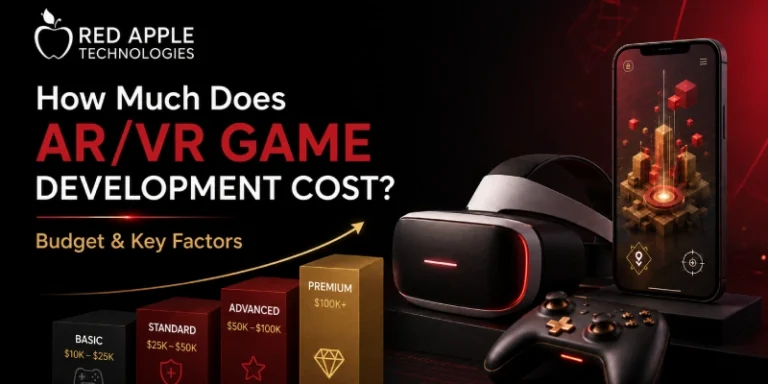
An AR prototype built around one core interaction and a multiplayer VR game designed for several headsets should not receive anything close to the same estimate. Both may fall under...
Despite occupying second position after China, the USA still manages to be a superpower in the global game industry. Whether game development or game publishing, the USA continues to shine...
Italy has quietly developed into one of Europe’s most creative mobile game development ecosystems. While the country may not match the scale of mobile gaming markets like the United States...

The UAE — particularly Dubai and Abu Dhabi — has rapidly evolved into one of the Middle East’s most ambitious gaming hubs. Backed by government-led initiatives, global investment, and major...
Turkey has become one of the fastest-growing mobile gaming ecosystems in Europe. Over the past decade, mobile game developers in Turkey have produced globally successful casual and hyper-casual titles, attracted...

Spain has established itself as one of Europe’s most active mobile game development markets. With internationally successful studios, experienced live-operations teams, and competitive production structures, the country continues to attract...
Game development followed a familiar pattern for decades: build everything in-house or outsource isolated tasks when schedules slipped. That model has been quietly changing. It’s 2026, and while a section...
At some point, most gamers have said, just a few more minutes, only to discover that hours have passed without noticing. That isn’t a mere distraction; it’s a reflection of...


 Book An Appointment
 WhatsApp