


- Blog
- >
- Game Development
- >
- Mobile Game Development
- >
- How to Choose the...
How to Choose the Right Game Development Company in the USA
Two game studios can show equally polished portfolios and still create very different production risk.
The difference often becomes visible only after you look beyond the showreel: who will actually work on the game, what the studio built on previous titles, how milestones are reviewed, where technical risks are surfaced, who owns the repositories, and what happens when the project changes after production begins.
That makes choosing a game development company in the USA less about finding the longest service list and more about finding a partner whose production model fits the game you are trying to ship.
Location matters, but it is only one part of that decision. US-based, offshore, and hybrid teams can all work well when responsibilities, communication, ownership, quality expectations, and delivery processes are clear.
If you are still building an initial shortlist, RAT’s Best Game Development Companies in the USA guide covers the broader company-comparison intent. This article focuses on what to verify after names start appearing on that shortlist.
What Should You Check Before Choosing a Game Development Partner?
A useful evaluation should answer questions in several different areas rather than reducing the decision to portfolio quality or price.
| Evaluation area | What you need to understand |
|---|---|
| Project fit | Does the team understand the type of game, platforms, production stage, and workstreams involved? |
| Shipped experience | Has it delivered comparable work, and what did it actually own? |
| Assigned team | Who will work on the project, at what seniority, and with what continuity? |
| Production process | How are milestones, builds, reviews, risks, and scope changes managed? |
| Technical fit | Can the team explain architecture, performance, backend, multiplayer, and platform risks where relevant? |
| Ownership | Who owns the IP, source code, repositories, platform accounts, documentation, and production assets? |
| Commercial clarity | What is included, excluded, assumed, and subject to change? |
| Post-launch responsibility | What happens after release when bugs, platform updates, LiveOps, or new content enter the roadmap? |
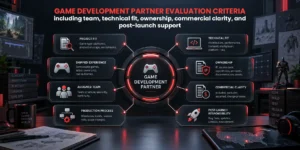
Strength in one area does not offset a serious gap in another. An attractive portfolio cannot fix unclear IP terms, and a competitive quote cannot fix a team that lacks the required platform experience.
Start by Defining What You Need the Partner to Own
Before comparing companies, define the problem you are actually asking them to solve.
A studio brought in for full-cycle development is being evaluated for a different responsibility than one joining an existing production to handle multiplayer engineering, art production, QA, porting, or LiveOps.
Your initial project brief does not need to answer every technical question. It should, however, give potential partners enough context to understand the shape of the work.
That usually means clarifying the game concept, production stage, target platforms, existing code or assets, intended quality bar, major features, multiplayer or backend requirements, launch window, approximate budget band, and whether support is expected beyond release.
Engine and technology decisions do not always need to be locked before those conversations begin. If architecture has not yet been validated, part of the studio’s job may be to explain why one approach fits the product better than another.
A good partner should be able to distinguish between what is already decided and what still needs technical validation.
Verify Relevant Shipped Work, Not Just Portfolio Volume
A large portfolio tells you that a company has produced a lot of work.
It does not automatically tell you whether the team can build your game.
Look for evidence that matches the difficult parts of the project.
If you are planning a multiplayer action game, a portfolio dominated by offline puzzle titles tells you relatively little about networking capability. If the target is console, mobile experience alone does not prove familiarity with console performance budgets, certification, controller behavior, or platform services.
Where possible, play shipped games rather than relying solely on screenshots, trailers, or artwork.
Then ask what the company actually contributed.
A studio may have built an entire title, handled one engineering system, provided art production, supported a port, or joined late for optimization and QA. All are valid contributions, but they demonstrate different capabilities.
Case studies are useful for the same reason, provided the discussion goes beyond the polished summary. Ask what constraint created the hardest problem, how the team approached it, what changed during production, what evidence supports the stated result, and which roles made the important decisions.
That conversation usually reveals more than another page of portfolio thumbnails.
Meet the People Who Will Actually Build the Game
The company’s history is not the same thing as the experience of the team assigned to your project.
Before signing, understand who will own production and technical decisions.
For a substantial engagement, that may include the producer or project lead, technical lead, relevant art lead, and specialists responsible for backend, multiplayer, porting, or other demanding workstreams.
Seniority matters, but continuity matters too.
Find out whether the proposed people are actually available, whether they are expected to remain for the planned duration, what happens if a key contributor leaves, and whether any part of the work will be subcontracted.
This is particularly important with distributed production.
A remote or hybrid team is not inherently harder to manage than a colocated one. Problems appear when ownership is unclear, communication depends on one coordinator, or the people shown during the sales process disappear after the contract is signed.
Ask for the operating model, not simply the office address.
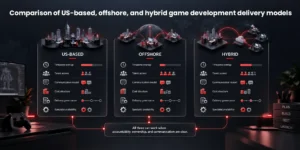
Compare US-Based, Offshore, and Hybrid Teams on the Right Criteria
Choosing a company for a US-facing game does not require every person on the project to be based in the United States.
US studios may offer closer timezone alignment and easier local coordination. Offshore teams can change the cost structure and widen access to specialist talent. Hybrid companies may combine local commercial or production coordination with distributed development.
None of those models is automatically better.
What matters is whether the delivery setup works for the production.
Timezone overlap should be concrete. Instead of asking whether the company “works with US teams,” ask how many working hours overlap, who attends milestone reviews, when engineering leads are reachable, and how blocking issues are escalated.
The same applies to subcontracting.
If another company or external specialist will handle part of the work, that arrangement should be visible before production starts. Responsibilities, access, confidentiality, quality control, and ownership should not become surprises midway through the project.
Review How Production Is Actually Run
Methodology labels such as Agile or Scrum reveal less than studios sometimes suggest.
What matters is how the game moves from one reviewable state to another.
Ask how discovery is handled, what happens before full production, how milestones are defined, when playable builds become available, how acceptance works, and how production risks are surfaced.
A useful process gives you something concrete to evaluate throughout development rather than asking you to trust status reports until the final build appears.
That might involve prototypes, vertical slices, regular playable builds, milestone reviews, risk registers, issue tracking, sprint demonstrations, or another structure suited to the project.
Scope changes also deserve attention before the work begins.
Games evolve. Mechanics change, technical problems appear, platform requirements move, and feedback can alter priorities. The contract and production process should explain how those changes are assessed, approved, priced, and scheduled.
A studio that promises the original plan will never change is giving you less useful information than one that can explain how change is controlled.
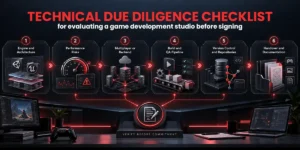
Run a Technical Due-Diligence Pass Before Signing
You do not need to turn the first partner meeting into a full architecture review.
But technical assumptions capable of changing the schedule or budget should be examined before the contract becomes difficult to unwind.
Useful questions include:
- Why does the proposed engine or architecture fit this game?
- What are the biggest technical risks the team sees before production?
- How will performance be measured on the target devices?
- How will multiplayer, backend, cloud, or platform services be handled where applicable?
- What do the build, QA, version-control, and release pipelines look like?
- What will be transferred at handover, and in what condition?
For the deeper engineering review, use RAT’s Game Development Studio Technical Checklist. That article owns the detailed technical-due-diligence intent, so this page does not need to reproduce every architecture, performance, QA, security, and handover question.
Check the Requirements That Actually Apply to Your Game
“US compliance” is not one universal checklist.
Requirements depend on what the game does, where it is distributed, who plays it, what information it collects, how it monetizes, and which platforms are involved.
A children’s product creates different privacy and consent questions from an adults-only premium PC title. A game collecting accounts, behavioral data, voice, location, or other personal information may create obligations that a completely offline game does not. Console, mobile, PC, and web platforms also impose their own submission, privacy, payment, content, and technical requirements.
The development partner does not replace qualified legal advice.
Its job is to understand when product and technical decisions have compliance implications, raise those issues early, and build the agreed requirements correctly once they are defined.
Accessibility deserves similar treatment.
Do not settle for a claim that a game will be “accessible.” Ask which accessibility requirements or design goals are part of the project, how they will be tested, and whether they affect UI, controls, text, audio, color, input, or other systems.
Clarify IP, Source Code, Repositories, and Accounts Early
Ownership should not be something you discover during handover.
The contract should make clear who owns the game IP, source code, artwork, animation, documentation, custom tools, and other deliverables produced for the project.
Repository access matters just as much.
For a project you own, understand where the source code lives, who administers access, how backups are handled, and what happens when the engagement ends.
The same principle applies to platform and infrastructure accounts.
Store accounts, cloud environments, analytics, backend services, certificates, build systems, and other production infrastructure can create painful dependencies if they remain under accounts you do not control.
The goal is not to remove the studio from the workflow. It is to prevent operational lock-in that was never intentionally agreed.
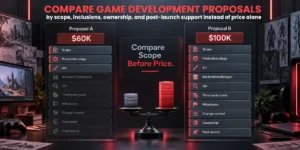
Compare Proposals on Equal Scope
A lower quote is useful only when it describes the same responsibility.
One proposal may include design, backend engineering, QA, platform submission, project management, and a post-launch warranty. Another may quote only implementation.
Those are not competing prices for the same thing.
Before comparing totals, line up the assumptions.
| Proposal area | What to compare |
|---|---|
| Scope | Features, systems, platforms, content, and deliverables |
| Production stage | Discovery, prototype, vertical slice, full production, porting, or support |
| Art | What is created, supplied, adapted, or excluded |
| Backend/multiplayer | Whether server-side systems are included |
| QA | Device/platform coverage, regression, performance, and release testing |
| Third-party costs | Licences, services, middleware, infrastructure, or paid tools |
| Milestones | Deliverables and acceptance criteria |
| Change control | How new or changed work is priced and scheduled |
| Ownership | Source, IP, accounts, documentation, and handover |
| Post-launch | Warranty, maintenance, LiveOps, monitoring, or future releases |
RAT’s Game Development Costs by Country guide covers the separate cost-comparison intent in more detail. This page should remain focused on how to evaluate the proposal, not recreate a country-by-country pricing article.
Define Post-Launch Responsibility Before Launch
A game’s needs do not stop when the store page goes live.
Even a premium title may need bug fixes, platform updates, compatibility work, performance patches, or new releases. A live-service game can add content production, telemetry analysis, events, economy changes, backend operations, moderation, and recurring QA.
Clarify what the development partner is expected to own after release.
That includes the initial warranty period, response expectations for critical issues, ongoing team availability, maintenance arrangements, infrastructure responsibilities, content updates, and any LiveOps work.
A studio can be an excellent production partner without being the right long-term LiveOps partner. The important part is knowing which relationship you are buying before launch.
Red Flags Worth Taking Seriously
| Warning sign | Why it matters |
|---|---|
| Portfolio claims without clear contribution | You cannot tell what capability the work actually proves |
| The proposed team is vague | The people evaluated before signing may not be the people assigned |
| Every technical question gets a sales answer | Engineering risks may not have been examined |
| Repositories or accounts remain permanently vendor-controlled | Handover and continuity become harder |
| The quote has no exclusions or assumptions | Scope disputes become more likely |
| Milestone acceptance is unclear | Payment and delivery disagreements become difficult to resolve |
| Subcontracting is hidden or poorly defined | Accountability, access, and confidentiality become unclear |
| Testing begins only near release | Technical risk accumulates late in production |
| Post-launch responsibility is undefined | Urgent issues can fall between teams after launch |
A warning sign is not always an automatic rejection. Several of these combined, however, should change the level of diligence required before signing.
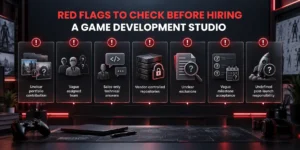
Questions to Ask Before You Choose a Game Development Company
| Warning sign | Why it matters |
|---|---|
| Portfolio claims without clear contribution | You cannot tell what capability the work actually proves |
| The proposed team is vague | The people evaluated before signing may not be the people assigned |
| Every technical question gets a sales answer | Engineering risks may not have been examined |
| Repositories or accounts remain permanently vendor-controlled | Handover and continuity become harder |
| The quote has no exclusions or assumptions | Scope disputes become more likely |
| Milestone acceptance is unclear | Payment and delivery disagreements become difficult to resolve |
| Subcontracting is hidden or poorly defined | Accountability, access, and confidentiality become unclear |
| Testing begins only near release | Technical risk accumulates late in production |
| Post-launch responsibility is undefined | Urgent issues can fall between teams after launch |
A good partner does not need to answer every question instantly. It should be able to answer them clearly once the relevant people are involved.
Final Thoughts
Choosing the right game development company in the USA is not a contest between the longest portfolio, the largest team, or the lowest estimate.
The better decision comes from matching the game’s actual risks with a team that can demonstrate relevant shipped work, assign the right people, run production visibly, explain its technical choices, protect ownership, and stay accountable when plans change.
Geography can influence communication and cost, but delivery discipline matters more than an address.
If you are moving from partner evaluation into actual production planning, Red Apple Technologies supports full-cycle development, co-development, engineering, art, QA, porting, and LiveOps across mobile, PC, console, web, and immersive projects. Explore Game Development at Red Apple Technologies

Published by
Kaushik DeyTable of Contents

Related Blogs
Discover more stories & insights that inspire
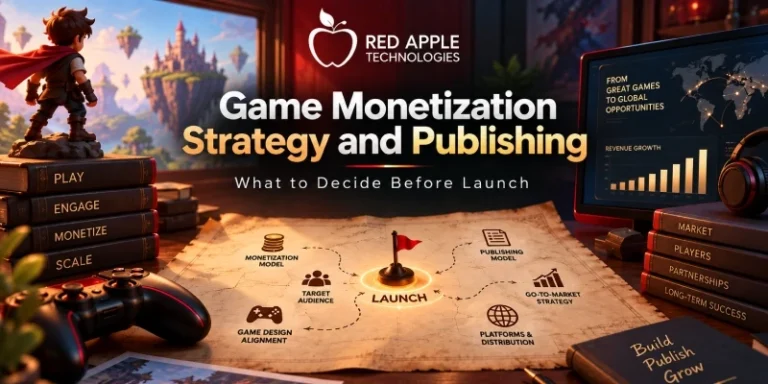
A game can have a strong core loop and still run into trouble if two business decisions are left until the end: how it will make money and how it...
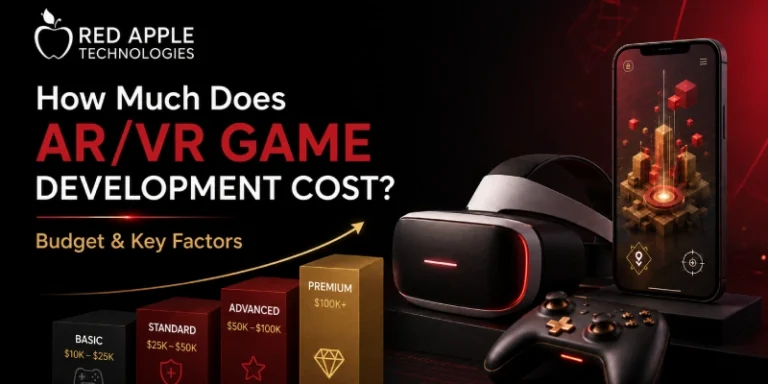
An AR prototype built around one core interaction and a multiplayer VR game designed for several headsets should not receive anything close to the same estimate. Both may fall under...
A good-looking game can still fail to hold a player’s attention if its mechanics are unclear, progression feels unrewarding, or levels become frustrating for the wrong reasons. Game design goes...
Despite occupying second position after China, the USA still manages to be a superpower in the global game industry. Whether game development or game publishing, the USA continues to shine...
Italy has quietly developed into one of Europe’s most creative mobile game development ecosystems. While the country may not match the scale of mobile gaming markets like the United States...
The UAE — particularly Dubai and Abu Dhabi — has rapidly evolved into one of the Middle East’s most ambitious gaming hubs. Backed by government-led initiatives, global investment, and major...
Turkey has become one of the fastest-growing mobile gaming ecosystems in Europe. Over the past decade, mobile game developers in Turkey have produced globally successful casual and hyper-casual titles, attracted...
Spain has established itself as one of Europe’s most active mobile game development markets. With internationally successful studios, experienced live-operations teams, and competitive production structures, the country continues to attract...
The UK has long been one of Europe’s strongest gaming ecosystems, producing globally successful studios across console, PC, and mobile. Today, mobile game development companies in the UK combine technical...
Southeast Asia (SEA) is a region that gives the toughest competition to companies looking to penetrate the mobile game development market here. Even with a place with a wide variety...


 Book An Appointment
 WhatsApp