

Best Game Development Companies in USA: 2026 Guide
Finding a game development company is relatively easy. Finding one whose production model fits the game you need to ship is harder.
Some studios can take responsibility for an entire production. Others are better suited to AAA co-development, ports and remasters, engineering, art production, or long-term content support. Those differences matter more than portfolio size alone.
This guide compares game development companies relevant to US production teams and US-facing projects. It includes both US studios and global development companies with publicly documented game-development work. Physical office location is not used as a quality signal or ranking criterion.
Rather than treating every provider as interchangeable, the comparison focuses on what each company appears equipped to own, based on publicly available first-party evidence.
What Engagement Models Do Game Development Companies Offer?
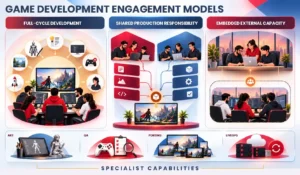
Game development companies can work under very different delivery structures. Three of the most common are full-cycle development, co-development, and dedicated-team engagement.
In a full-cycle development model, the external company takes responsibility for most or all of the production lifecycle, which may include discovery, design, engineering, art, QA, release preparation, and post-launch work.
In co-development, your internal team and the external studio share production responsibility. The external partner may own selected systems, features, levels, engineering, art, ports, or other workstreams while working inside the broader production.
A dedicated team gives you a stable external team over an extended period. The team can integrate with your existing production structure and provide sustained engineering, art, QA, or multidisciplinary capacity without requiring the external company to own the entire game.
Some companies also specialize in services such as porting, art production, cinematics, QA, or LiveOps. These are capability specializations rather than separate engagement models. Understanding that distinction is more useful than trying to identify one company as universally “best.”
How We Selected the Companies in This Guide
This guide reviews publicly available evidence from company websites, official project pages, service documentation, and published game credits.
The assessment considers evidence of shipped work, game-development specialization, full-cycle, co-development, or dedicated-team capability, platform and engine experience, engineering and production depth, art and QA support, porting or adaptation experience, post-launch capability where relevant, and the type of production responsibility each company publicly demonstrates.
We have not assigned arbitrary numerical quality scores or unsourced cost ratings.
Red Apple Technologies publishes this guide and is included in the comparison. Red Apple Technologies is presented first so that relationship is explicit. Its placement should not be read as an independently verified number-one ranking. The remaining companies are included for the production capabilities and project evidence available from their own published material.
Game Development Companies to Consider in 2026
1. Red Apple Technologies
Engagement models: Full-cycle development, co-development, and dedicated teams
Public evidence reviewed: Cooking Team, Beltway Beatdown, broader Game Development portfolio
Relevant when: Several production disciplines need to be coordinated within one delivery model
Red Apple Technologies covers development across mobile, PC, console, web, and immersive projects, with Unity and Unreal capabilities alongside game art, QA, porting, backend development, and post-launch support. Its current Game Development offering describes a production process spanning discovery and pre-production through vertical-slice validation, full production, performance work, release preparation, and LiveOps.
Cooking Team: Restaurant Games provides useful evidence of this multi-discipline model. The project combined Unity development, backend engineering, art, QA, progression, monetization, and an ongoing content pipeline. Its Google Play listing currently shows more than 10 million downloads and roughly 233,000 reviews.
Beltway Beatdown represents a different production profile. The Android and iOS title was built in Unity around a simple arcade mechanic, with progression, rewards, upgrades, leaderboards, monetization, 2D art, and QA developed as part of the same production.
2. Blind Squirrel Games
Primary model: Full development, co-development, ports, and remasters
Public evidence reviewed: BioShock: The Collection, New World, Warframe Mobile, Delta Force: Black Hawk Down
Relevant when: AAA production support, adaptations, ports, remasters, or substantial integrated co-development are required
Blind Squirrel Games publishes unusually clear information about what its teams contributed to individual projects.
For BioShock: The Collection, the studio describes engineering and art work across the remastered collection. Its New World project involved engineering, art, audio, design, character systems, world-building, UI, quests, and related live-service work. Blind Squirrel also handled development of the iOS port of Warframe and contributed across engineering, art, design, and audio to the single-player campaign for Delta Force: Black Hawk Down.
That public evidence makes the company especially relevant where a production already has substantial scale or existing IP and needs an external studio capable of taking meaningful ownership rather than simply supplying individual contributors.
3. Certain Affinity
Primary model: AAA development and co-development
Public evidence reviewed: Halo, Call of Duty, Hogwarts Legacy, New World, DOOM
Relevant when: Action games, multiplayer, large established franchises, and deeply integrated AAA development are central to the project
Certain Affinity has built a substantial public work history around action games and co-development. Its portfolio currently lists 40 products across 17 franchises, including long-running involvement with Halo and Call of Duty, alongside work on Hogwarts Legacy, New World, DOOM, World of Tanks, and other releases.
Its published capabilities cover end-to-end development, multiplayer design, audio and cinematic design, usability, and QA. Its production material also describes pre-production, prototyping, development, testing, content support, and continued post-launch work.
For teams comparing providers for a substantial AAA action or multiplayer production, this history offers stronger evidence than generic claims about genre expertise.
4. Iron Galaxy Studios
Primary model: Co-development, engineering support, platform migration, and lead development
Public evidence reviewed: Skyrim, Uncharted: Legacy of Thieves, Apex Legends, Metroid Prime Remastered
Relevant when: Platform migration, performance work, engineering-heavy co-development, or technically demanding console and PC production is involved
Iron Galaxy’s portfolio is particularly useful because projects are categorized by the role the studio performed, including co-development, engineering support, migration support, lead development, and original development. Its public history includes work on titles such as Skyrim, Uncharted: Legacy of Thieves, Apex Legends, Metroid Prime Remastered, Diablo II: Resurrected, and other major releases.
For Uncharted: Legacy of Thieves, Iron Galaxy describes owning the PC optimization process, including ultrawide support and platform-specific features. On Skyrim, the studio supported the Nintendo Switch version and implemented Switch-specific functionality. Its more recent Apex Legends work includes Switch and Switch 2 migration support, rendering work, optimization, feature development, and QA.
That makes Iron Galaxy particularly relevant when the difficult part of the engagement is technical ownership rather than broad full-cycle production.
5. Streamline Studios
Primary model: Full development, co-development, art production, QA, and ongoing support
Public evidence reviewed: Cyberpunk 2077, Street Fighter 6, Armored Core VI, Stellar Blade
Relevant when: Development and art need to scale together inside a large or content-heavy production
Streamline Studios publishes a broad portfolio spanning full development, co-development, art, QA, open-world production, LiveOps, remasters, platform expansion, and original IP work. Its current portfolio includes projects such as Cyberpunk 2077, Street Fighter 6, Armored Core VI, Stellar Blade, MultiVersus, Outriders, and Death Stranding.
Its Cyberpunk 2077 case study documents post-release co-development involving C++ engineering, optimization, bug fixing, system refactoring, cross-progression work, and additional feature development. For Street Fighter 6, Streamline describes extensive environment, prop, costume, character-model, and stage-production work. Its Stellar Blade case study shows integration into an Unreal Engine environment-production workflow.
This combination is useful when engineering, art, content production, and continued development cannot be separated cleanly into unrelated vendors.
6. Virtuos
Primary model: Co-development, engineering, adaptation, and art production
Public evidence reviewed: Dark Souls: Remastered, Marathon, Outriders, broader engineering and art portfolio
Relevant when: Large-scale multidisciplinary co-development, adaptations, technical engineering, or extensive art production is required
Virtuos organizes its current services around game development, engineering, and art production. Its game-development work includes adaptations, post-launch content, gameplay and design, and IP development, while its engineering offering covers engine enhancement, tool development, rendering, performance optimization, feature development, networking, and infrastructure.
The company’s public Marathon case material shows how Pipeworks, a Virtuos studio, expanded from a small support role into ownership of gameplay features across design, engineering, UI/UX, art, QA, and production. The wider Virtuos portfolio also includes work such as Dark Souls: Remastered, Outriders, and numerous art and engineering engagements.
Its art-production practice extends from concept and standalone assets through animation, VFX, levels, characters, environments, cinematics, and in-engine integration.
Game Development Companies Serving the USA: Quick Comparison
| Company | Engagement model / primary delivery model | Particularly relevant for |
|---|---|---|
| Red Apple Technologies | Full-cycle + co-development + dedicated team | Multi-discipline game development, mobile/cross-platform work, art, QA, backend, porting, LiveOps |
| Blind Squirrel Games | Full development + co-development + ports/remasters | AAA production, established IP, ports, remasters, integrated development |
| Certain Affinity | AAA development + co-development | Action games, multiplayer, established franchises, AAA production |
| Iron Galaxy Studios | Co-development + engineering + migration | Platform migration, optimization, engineering-intensive production |
| Streamline Studios | Full development + co-development + art | Art-heavy production, large content pipelines, co-development, ongoing support |
| Virtuos | Co-development + engineering + art | Large-scale AAA work, adaptations, engineering, art production |
The table should be read as a production-fit comparison, not a league table. The right choice depends on what the external company must own.
Which Type of Game Development Company Fits Your Project?
When You Need a Complete Game Build
A full-cycle engagement calls for more than isolated engineering capacity.
The company needs to coordinate design, gameplay, art, QA, platform requirements, release preparation, and any backend or post-launch work within one production plan. A long service list is less useful than evidence that those disciplines have actually moved through one delivery process.
Red Apple Technologies, Blind Squirrel Games, Streamline Studios, and Certain Affinity all publish evidence of broader development responsibility, although the scale and type of productions they typically demonstrate differ considerably.
When You Need AAA Co-Development
Co-development changes the evaluation criteria because your internal team already owns part of the production.
The external company needs to work inside an established codebase, art direction, schedule, review structure, tooling environment, and quality bar. Public evidence from Certain Affinity, Iron Galaxy, Blind Squirrel, Streamline, and Virtuos shows substantial experience with this kind of integrated work.
When You Need Porting, Remastering, or Platform Expansion
A generic claim of “cross-platform development” does not prove porting capability.
Look for projects where the studio has documented what changed between platforms, including controls, rendering, memory, performance, platform services, certification requirements, UI behavior, and hardware-specific features.
Iron Galaxy’s published work on Skyrim, Uncharted, and Apex Legends provides unusually concrete evidence in this area. Blind Squirrel also documents remaster and mobile-port work through BioShock: The Collection and Warframe Mobile.
When Art Must Be Integrated With Development
A standalone art supplier and an integrated game-production partner solve different problems.
Where art moves directly into an active build, technical art, engine integration, performance constraints, revision ownership, content pipelines, and coordination with design and engineering become part of the engagement.
Streamline and Virtuos both publish extensive evidence around art production integrated with broader game-development pipelines. Red Apple Technologies also combines game art with engineering, QA, and wider production support.
When You Mainly Need Engineering Capacity
First establish whether the requirement is additional developers working under your direction or an external team taking ownership of an engineering workstream.
Those are different engagement models.
Iron Galaxy, Virtuos, Certain Affinity, and Blind Squirrel all publish evidence of engineering-heavy work where responsibility extends beyond supplying individual programmers.
How Should You Evaluate the Companies on Your Shortlist?
A company list should narrow the field, not decide the contract.
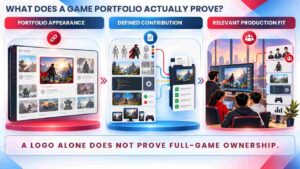
Once you have a shortlist, verify what each studio actually contributed to comparable games, who would be assigned to your production, whether important work would be subcontracted, how builds and milestones are reviewed, how scope changes are handled, and who owns the source code, repositories, accounts, assets, and documentation.
The dedicated How to Choose the Right Game Development Company in the USA guide covers that partner-selection process in detail.
Projects with meaningful architecture, multiplayer, backend, performance, platform, security, or legacy-code risk should then move into a deeper Game Development Studio Technical Checklist before the agreement is finalized.
Keeping those questions on their dedicated pages prevents this comparison guide from competing with the partner-selection and technical-due-diligence content.
What Does It Cost to Hire a Game Development Company?
There is no useful standard price for hiring a game development company because the underlying work can differ radically.
A prototype, mobile full-cycle project, AAA co-development workstream, multiplayer backend, console port, and long-running LiveOps engagement may all fall under “game development,” while requiring very different teams and schedules.
When comparing estimates, make sure the proposals describe equivalent responsibility across production stage, platforms, features, art, backend, multiplayer, QA, release work, third-party services, documentation, handover, and post-launch support.
For detailed pricing and geography-related cost analysis, use Cost to Hire a Game Development Company: A Country-Wise Breakdown. This comparison page should stay focused on company and production fit.
Final Thoughts
The strongest game development companies do not all solve the same production problem.
A studio known for AAA engineering may be an excellent choice for a difficult platform migration and unnecessary for a smaller full-cycle mobile game. A large co-development provider may bring extensive production capacity, while another project may benefit more from a multidisciplinary team capable of taking broader ownership from design through launch.
Build the shortlist around what the external company needs to own, not which company appears largest or most recognizable.
Then verify the assigned people, shipped work, production process, technical fit, commercial boundaries, ownership terms, and handover before making the final decision.
For teams looking for one production relationship across game design, engineering, art, QA, backend, porting, and post-launch support, Red Apple Technologies provides full-cycle development, co-development, and dedicated-team support across multiple platforms and production stages.

Published by
Kuntal Dutta
Related Blogs
Discover more stories & insights that inspire
A mobile game portfolio can look impressive without telling you much about the work behind it. One company may have built an Android and iOS game from concept to launch....

A $100 billion market. Millions of bets placed every minute. And most new operators still get the cost wrong. Not because the opportunity isn’t real, but because they underestimate the...
As the third-largest market in Europe, France is gradually making its presence felt in the global game industry. With over 500 million game studios and a vibrant gaming population of...
Singapore is fast evolving into the global gaming landscape. As a prominent game development destination, the country is attracting investors, startups, and businesses of all sizes. Already, this Asian country...
Italy has quietly developed into one of Europe’s most creative mobile game development ecosystems. While the country may not match the scale of mobile gaming markets like the United States...
South Korea is one of the most advanced gaming ecosystems in the world. With high-speed 5G infrastructure, strong government support for immersive technology, and a deeply rooted competitive gaming culture,...
Turkey has become one of the fastest-growing mobile gaming ecosystems in Europe. Over the past decade, mobile game developers in Turkey have produced globally successful casual and hyper-casual titles, attracted...
The United States is home to some of the world’s most technically advanced game development companies, particularly in Unity and Unreal Engine development. From indie successes to AAA franchises, the...
Top Studios, Strategic Partners & LiveOps Experts Singapore has rapidly emerged as a key hub for mobile game development in Southeast Asia (SEA) and beyond. SEA solidified its position as...
Leading Developers, Production Partners & Strategic Collaborators France is one of Europe’s most influential gaming markets, combining creative excellence with strong technical education and structured production systems. According to Newzoo,...


 Book An Appointment
 WhatsApp