


- Blog
- >
- mobile game ideas
- >
- mobile game development company
- >
- Best Mobile Game Development...
Best Mobile Game Development Companies USA: 2026 Guide
A mobile game portfolio can look impressive without telling you much about the work behind it.
One company may have built an Android and iOS game from concept to launch. Another may have contributed engineering, art, backend systems, QA, porting, or post-launch content to an existing production.
Both can legitimately show mobile-game experience, but they prove different capabilities.
For teams comparing mobile game development companies for US projects, the useful question is not simply which names appear beside recognizable games.
What does the available evidence show each company can actually own on a mobile production?
This guide compares six development companies with publicly documented mobile-game capability. The focus is on Android and iOS production, gameplay engineering, backend and systems work, QA and optimization, porting, LiveOps, and the level of production responsibility visible in their published work.
The companies are not ordered as a universal quality ranking. Red Apple Technologies publishes this guide and appears first so that relationship is clear.
At a Glance: Mobile Game Development Companies in This Guide
| Company | Published Mobile Evidence | Broader Supporting Capabilities | Delivery Structure |
|---|---|---|---|
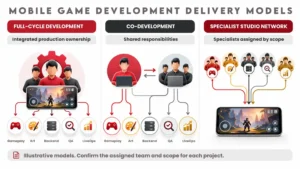
| Red Apple Technologies | Android and iOS projects with defined production responsibility. | Backend, progression, monetization, art, QA, LiveOps and porting. | Full-cycle + co-development |
| Amber | Named mobile projects across full development and co-development. | Engineering, backend, content systems, QA and LiveOps. | Full development + co-development |
| Room 8 Group | Mobile and cross-platform work within broader development programs. | Backend, DevOps, networking, optimization, QA and porting. | Game development + technology solutions |
| Keywords Studios | Mobile development and QA across a specialist studio network. | Engineering, art, QA, localization, LiveOps and porting. | Multi-studio co-development network |
| Kevuru Games | Dedicated Android and iOS development offering. | Game development, art, testing and porting. | Full development + external production support |
| Starloop Studios | Dedicated Android and iOS development with published mobile work. | Backend, online systems, QA, LiveOps, art and porting. | Full-cycle + co-development |
The table summarizes the type of evidence each company publishes. It is not a scorecard.
The more useful question is whether the demonstrated work resembles the responsibilities your project needs an external team to own.
Why These Companies Made the List
This guide is limited to companies that publish evidence relevant to external mobile game production.
That is different from identifying successful mobile-game publishers or IP owners.
A business can operate major mobile titles without providing development teams that another studio, publisher, or product owner can engage for an external project. For this comparison, there needs to be visible evidence of development, co-development, or production support offered to other organizations.
Relevant evidence includes named mobile projects, Android or iOS development, defined engineering responsibilities, backend or online systems, monetization and platform integrations, device optimization, mobile QA, porting, and continued post-launch production.
Not every company needs to demonstrate every capability. A specialized co-development team may suit one project while another requires broader ownership across engineering, art, backend, QA, release, and LiveOps.
Portfolio logos are therefore treated as supporting evidence rather than proof of full mobile-development capability unless the company’s actual contribution is clear.
Red Apple Technologies
Red Apple Technologies is included because its published mobile work shows responsibility extending beyond gameplay implementation into backend systems, progression, art, monetization, testing, and continued production.
The company’s broader game development model covers full-cycle production and co-development across mobile, PC, console, web, and immersive platforms. Its dedicated Mobile Game Development offering connects Android and iOS production with art, backend systems, QA, porting, monetization, and post-launch support.
Its case studies provide more useful evidence than a service list alone.
Cooking Team: Restaurant Games is a time-management restaurant simulation built around cooking, progression, renovation, quests, boosters, upgrades, advertising, in-app purchases, persistent progress, and an ongoing content pipeline.
The published production team includes Unity developers, backend developers, QA, 2D artists, animation, and project management. The game has surpassed 10 million downloads on Google Play.
Beltway Beatdown demonstrates a different mobile production profile.
The Android and iOS title uses a straightforward one-tap arcade mechanic, but the complete product incorporates 50 levels, character behaviors, progression, currency, equipment upgrades, rewards, power-ups, leaderboards, monetization, game design, 2D art, and QA.
Together, the two projects demonstrate mobile production across very different game structures while showing how engineering interacts with systems, content, art, testing, and monetization.
That multidisciplinary structure becomes relevant when a project needs several of those responsibilities managed through one production plan rather than distributed across unrelated suppliers.
Amber
Amber’s published mobile work covers both full development and co-development, with individual projects showing responsibilities beyond gameplay implementation.
Its portfolio includes mobile projects where teams have contributed engineering, production, QA, LiveOps, design, content, monetization, tooling, and backend-related systems.
Work associated with titles such as Candy Crush Saga and Candy Crush Soda demonstrates feature and content development around mature live products. Its published Monument Valley 3 involvement includes work connected to LiveOps and content distribution, while other mobile projects demonstrate broader full-development and continuing-production responsibilities.
The evidence is therefore weighted toward mobile games that continue evolving after release rather than one-time implementation alone.
Amber also operates at a considerably larger scale than many conventional external-development studios. Its structure covers full development, co-development, art, development support, LiveOps, QA, localization, player support, and related production services.
Within this comparison, Amber represents the larger co-development and continuing-production end of the mobile outsourcing market rather than a narrow mobile implementation vendor.
Room 8 Group
Room 8 Group’s mobile relevance is most visible through its technical and cross-platform capabilities rather than through positioning as a dedicated mobile-development specialist.
Its current structure combines broader game-development work with technology services covering areas such as backend infrastructure, DevOps, networking, multiplayer, performance optimization, porting, rendering, and related engineering.
These responsibilities become relevant when a mobile game depends on more than the client build itself. Online systems, device performance, platform services, backend infrastructure, certification or compliance requirements, and recurring releases can all introduce separate technical workstreams.
Room 8 also publishes QA capability across compatibility, performance, regression, compliance, certification, automation, and live-game support.
Its porting work adds another dimension, including platform adaptation, performance optimization, UI and input changes, online functionality, saves, graphics, and other platform-specific requirements.
Within this comparison, Room 8 Group represents a more technical and large-scale co-development model where mobile may form part of a wider multi-platform or systems-heavy production.
Keywords Studios
Keywords Studios operates differently from a conventional standalone mobile-development company.
Its game-development business is built around a network of specialist studios and teams that can contribute different capabilities to a production.
Published mobile capabilities extend across development, co-development, engineering, art, mobile optimization, porting, QA, localization, and LiveOps.
Its mobile QA material also addresses issues such as device and operating-system compatibility, performance, in-app purchases, multiplayer considerations, and App Store and Google Play requirements.
This structure can suit productions where responsibility is intentionally distributed. A larger publisher, for example, may require engineering support in one area, QA capacity in another, localization across several markets, additional art production, and continuing support after launch rather than assigning an entire product to one external studio.
That network structure also changes the due-diligence question. Group-level capability does not establish which studio, production unit, or individual specialists would work on a particular project. The assigned team becomes more important than the breadth of the overall organization.
Kevuru Games
Kevuru Games publishes dedicated Android and iOS development capabilities alongside wider game-development, testing, art, and porting services.
Its mobile material specifically addresses several constraints that distinguish mobile production from general cross-platform development.
Android work has to account for device fragmentation and differences in hardware capability. iOS development introduces its own platform requirements, memory considerations, integrations, optimization, and testing requirements.
Kevuru’s porting material also treats moving a game to mobile as an adaptation process rather than a simple build export. Controls, assets, performance, interface behavior, and platform constraints may all need to change.
The company can support projects from prototyping onward or join an existing production, placing it across both earlier-stage development and external production support.
Within this comparison, Kevuru is one of the closer commercial equivalents to a conventional full-development and co-development provider because its service coverage overlaps across mobile engineering, game production, art, testing, porting, and external team support.
Starloop Studios, Part of Magic Media
Starloop Studios publishes dedicated Android and iOS development alongside broader full-cycle, co-development, backend, QA, porting, and post-launch capabilities.
Its mobile offering covers native platform requirements as well as Unity-based and cross-platform production.
Published work and service material extend beyond the mobile client itself into backend architecture, online systems, game economy design, art production, testing, optimization, and continued support.
Its porting practice also covers movement between mobile, PC, and console environments.
That combination places Starloop in a similar commercial category to multidisciplinary external-development companies capable of entering either a complete production or a defined co-development workstream.
Its position within the wider Magic Media organization adds another layer of production capacity compared with a standalone studio.
What Counts as Strong Mobile Production Evidence?
A company appearing in the credits or portfolio of a mobile game does not automatically prove full mobile-development capability. The strength of the evidence depends on how clearly the production responsibility can be identified.
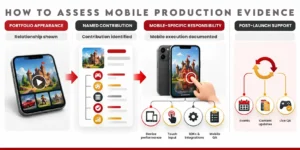
A Logo or Screenshot
A game appearing in a portfolio confirms some relationship with the project.
It does not tell you whether the company developed the game, ported it, produced several assets, performed QA, implemented one feature, or supplied engineers to another team.
The logo is therefore a starting point rather than evidence of broad capability.
A Named Game With a Defined Contribution
Evidence becomes more useful when the company’s role is stated.
That might include gameplay engineering, Android or iOS development, backend integration, UI, art, QA, porting, monetization, LiveOps, or another clearly defined workstream.
The responsibility can then be compared with the work your project needs to outsource.
Mobile-Specific Production Responsibility
Stronger evidence shows that the team handled problems created specifically by mobile production.
Examples include Android device fragmentation, iOS and Android build pipelines, memory limits, touch interaction, performance across hardware tiers, SDK integration, platform services, store requirements, battery or thermal considerations, and device compatibility testing.
This demonstrates more than familiarity with an engine that happens to export to mobile.
Continued Responsibility After Release
For a live mobile product, launch is only one production milestone.
Post-launch evidence may include recurring events, content releases, economy adjustments, offer systems, A/B testing, analytics, backend operations, live QA, bug fixing, release management, and continued optimization.
This becomes especially important when the business model depends on retention, recurring engagement, or ongoing monetization rather than a largely fixed launch build.
Final Thoughts
A mobile portfolio becomes meaningful when you can see what happened behind the release.
Who owned the gameplay? Who handled Android and iOS differences? Was the backend part of the engagement? Who integrated purchases, ads, analytics, or other SDKs? How was performance validated across devices? And if the game remained active after launch, who continued supporting it?
Those details separate a company that has worked somewhere on a mobile game from one with evidence relevant to the production responsibility you actually need.
The companies in this guide demonstrate different forms of that capability.
Amber’s published work is weighted toward larger mobile co-development, LiveOps, systems, and continuing production. Room 8 Group shows stronger emphasis on technical co-development, backend infrastructure, porting, optimization, and large-scale production support. Keywords Studios represents a distributed network of specialist development and production teams. Kevuru Games and Starloop Studios overlap more directly with the multidisciplinary full-development and co-development model.
Red Apple Technologies published mobile projects demonstrate another version of that model, bringing gameplay engineering, backend systems, art, progression, monetization, QA, and continued production into the same delivery structure.
For teams that need those disciplines coordinated across a mobile production, explore Red Apple Technologies Mobile Game Development capabilities. For platform-specific requirements, see Android Game Development and iOS Game Development.

Published by
Kuntal Dutta
Related Blogs
Discover more stories & insights that inspire
The wrong partner doesn’t fail your project on day one. It fails itself slowly through delays, compliance gaps, and missed market windows. In the iGaming industry, your technology partner is...

A $100 billion market. Millions of bets placed every minute. And most new operators still get the cost wrong. Not because the opportunity isn’t real, but because they underestimate the...
As the third-largest market in Europe, France is gradually making its presence felt in the global game industry. With over 500 million game studios and a vibrant gaming population of...
Singapore is fast evolving into the global gaming landscape. As a prominent game development destination, the country is attracting investors, startups, and businesses of all sizes. Already, this Asian country...
Italy has quietly developed into one of Europe’s most creative mobile game development ecosystems. While the country may not match the scale of mobile gaming markets like the United States...
South Korea is one of the most advanced gaming ecosystems in the world. With high-speed 5G infrastructure, strong government support for immersive technology, and a deeply rooted competitive gaming culture,...
Turkey has become one of the fastest-growing mobile gaming ecosystems in Europe. Over the past decade, mobile game developers in Turkey have produced globally successful casual and hyper-casual titles, attracted...
The United States is home to some of the world’s most technically advanced game development companies, particularly in Unity and Unreal Engine development. From indie successes to AAA franchises, the...
Top Studios, Strategic Partners & LiveOps Experts Singapore has rapidly emerged as a key hub for mobile game development in Southeast Asia (SEA) and beyond. SEA solidified its position as...
Leading Developers, Production Partners & Strategic Collaborators France is one of Europe’s most influential gaming markets, combining creative excellence with strong technical education and structured production systems. According to Newzoo,...


 Book An Appointment
 WhatsApp