


Hire Unreal Dedicated Developers for Game Development: A Complete Guide for 2026
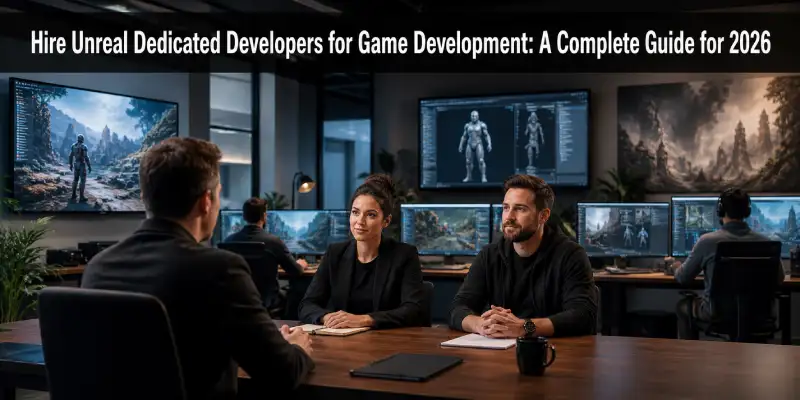
Stunning visuals. Console-level performance. And a development process that can either scale or collapse based on who you hire — that’s the reality of building games with Unreal Engine.
It’s one of the most powerful game engines in the world, but also one of the most demanding. And that’s exactly why businesses don’t just look for developers anymore; they look to hire Unreal dedicated developers who can handle complexity from day one.
If you’re planning a serious game project, your choice of team will define everything from performance to profitability.
Why Unreal Engine Changes the Hiring Game
Unreal isn’t just another engine. It’s built for high-end, real-time experiences. From photorealistic environments to large-scale multiplayer systems, it pushes both hardware and development teams to their limits.
That’s also why projects built on Unreal tend to fail quietly when the team lacks experience. Complex digital products rarely fail because of bad ideas — they fail due to execution gaps. In Unreal projects, those gaps show up as performance issues, missed deadlines, or systems that don’t scale.
What It Really Means to Hire Unreal Dedicated Developers
When you hire dedicated Unreal developers, you’re not just filling roles but also building a focused production unit. Unlike freelancers juggling multiple clients, dedicated developers work exclusively on your project. That continuity matters more than most teams realize, especially when working with complex systems like rendering pipelines or multiplayer logic.
A typical dedicated Unreal team includes core engineering, design, and testing capabilities, but what really matters is how well they function together over time. That’s where dedicated teams outperform fragmented hiring approaches.
In-House vs Outsourced: Where Most Decisions Go Wrong
At some point, every studio faces the same question: build internally or partner externally? Building an in-house team gives you control, but it comes with a slower ramp-up and significantly higher costs. Hiring experienced Unreal talent is not easy, and retaining them is even harder.
This is why many studios choose to work with an Unreal development agency instead. Instead of spending months assembling a team, they get immediate access to specialists who have already worked on similar systems. That speed alone can shift your entire go-to-market timeline. It’s also why businesses increasingly prefer to hire Unreal dedicated developers through an external Unreal development partner rather than building everything from scratch.
What Separates Average Developers from Dedicated Unreal Experts
Not all developers who “know Unreal” are equipped to handle production-level projects. The difference shows up in areas like performance optimization, architecture decisions, and multiplayer stability.
Strong dedicated Unreal Engine developers typically bring expertise in:
- C++ and Blueprint integration for performance and flexibility
- Real-time rendering optimization (especially for high-end visuals)
- Multiplayer systems and network replication
- Cross-platform deployment strategies
These are not optional skills. They’re essential if your game needs to perform under real-world conditions.
Understanding the Cost of Hiring Unreal Developers
Unreal development isn’t cheap, but poor hiring is far more expensive. Developer rates vary widely depending on experience and region, but what matters more is how efficiently your team delivers. A small, highly experienced team can often outperform a larger, less specialized one. This is one reason many companies partner with an Unreal game development company instead of building large in-house teams. It allows them to balance cost with execution quality.
Why Businesses Prefer Unreal Development Partners
As projects scale, so do risks. Managing rendering pipelines, gameplay systems, AI logic, and multiplayer infrastructure simultaneously requires more than just coding. It requires coordination. That’s where a reliable Unreal development partner becomes valuable.
Experienced companies like Red Apple Technologies approach development as a structured process rather than a series of tasks. They bring in established workflows, tested pipelines, and teams that already know how to collaborate under pressure. For businesses, this translates into fewer delays, fewer surprises, and better long-term outcomes.
What Working with an Unreal Development Agency Looks Like
A professional Unreal development agency doesn’t just execute your idea; they refine it, structure it, and build it for scale. Instead of isolated development efforts, you get a coordinated process that includes planning, execution, testing, and iteration. The real advantage isn’t just speed — it’s predictability.
When teams have done this before, they know where projects typically fail and how to avoid those pitfalls early.
The Hidden Cost of Hiring Wrong
Most teams don’t realize this upfront, but the biggest cost in Unreal development isn’t development — it’s rework. Fixing performance issues late in development, rewriting gameplay systems, or re-architecting multiplayer logic can multiply your budget quickly. That’s why the decision to hire Unreal dedicated developers is less about cost savings and more about risk reduction.
When Should You Hire Dedicated Unreal Developers?
Not every project needs a full team from day one. But if your game involves high-end visuals, multiplayer systems, or cross-platform deployment, then dedicated developers are no longer optional. They’re essential.
Final Thoughts
Unreal Engine gives you the power to build extraordinary experiences. But that power only translates into results if your team knows how to use it. Choosing whether to work with an Unreal game development company, an Unreal development agency, or an external Unreal development partner isn’t just a hiring decision — it’s a strategic one.
Because in Unreal development, the gap between average execution and expert execution isn’t small — it’s massive.
To Have A Better Understanding On This Let us Answer The Following Questions
Answer: It means hiring a team that works exclusively on your Unreal project, ensuring focus, consistency, and better execution.
Answer: Costs vary based on experience and region, but dedicated teams typically range from mid to high investment depending on complexity.
Answer: Agencies offer faster setup and access to expertise, while in-house teams provide more control. Many businesses choose a hybrid approach.
Answer: Focus on experience, technical expertise, scalability, and proven project delivery, not just pricing.
Answer: Because it supports high-end graphics, real-time systems, and advanced multiplayer features, which require deeper technical expertise.
Get Started
- End-to-End Game & App Development Services
- Flexible Business Models – Project Based or Dedicated Hiring
- 13+ Years of Industry Experience with Global Clientele
- Globally Recognized by Clutch, GoodFirms & DesignRush
Related Blogs
Discover more stories & insights that inspire
Hiring for Unreal Engine isn’t as straightforward as it looks on paper. You can review portfolios, check years of experience, and still end up with a team that struggles once...
Most teams think they have a hiring problem. They don’t. They have a structure problem discussed as a hiring problem. Because when a project slows down, the instinct is predictable:...
There’s a moment in almost every Unreal project where progress starts to feel heavier. Not slower in an obvious way, but heavier. Features take longer to implement. Fixes don’t stay...

There’s a pattern you start noticing if you talk to enough game studios in San Francisco. They don’t struggle with ideas. They don’t struggle with funding. They struggle with execution...
Australia may not be the largest mobile gaming market globally, but it consistently punches above its weight. From games amassing billions of downloads to award-winning indie successes, every reputable mobile...
Beyond entertainment, games have also evolved into a profitable business option where your chances of success depend on: Choosing The Right Game Genre Targeting the Right Audience Group Crafting an...
Whether it is making strategic decisions, providing employee training, or fulfilling other organizational goals, simulation has evolved as an indispensable tool in global businesses. From Healthcare to Education, Software Development,...
Visual realism is crucial in gaming. If you can provide immersive and realistic experiences, your games are likely to succeed. Gameplay mechanics and storyline, while part of the equation, are...
Whether playing games on mobile, console, or desktop, previously it was impossible for you to closely interact with different virtual characters, environments, and objects. But with the introduction of new-age...
Metaverse has not only disrupted the conventional gaming experience of users but also armed businesses with a profitable business option. Displaying a robust market size of $22.7 billion, you have...


 Book An Appointment
 WhatsApp