


Game Development Studio Technical Checklist: What to Verify Before Hiring
- Blog
- >
- agency or freelancer for...
- >
- game development company
- >
- Game Development Studio Technical...
Our Services
A quote tells you what a studio expects the project to cost. A portfolio shows what it has worked on.
Neither tells you whether the team assigned to your game can maintain the target frame rate, design the multiplayer architecture, manage a production codebase, recover from a failed deployment, or hand over a project another team can actually maintain.
Those questions usually surface later, when changing direction becomes expensive.
Before hiring a game development studio, technical due diligence should therefore go beyond asking which engines or programming languages the company uses. You need to understand how the team makes technical decisions, how it proves those decisions work, and what you will receive when the engagement ends.
The checklist below is designed for that stage. You do not need to be an engineer to use it. The goal is knowing what to ask and recognizing when an answer deserves a closer look.
Quick Technical Due-Diligence Checklist
A studio doesn’t have to hand over a large technical document before the contract is signed, but it should be able to explain these areas clearly enough for you to understand how the project would be run.
1. Confirm Relevant Engine and Architecture Experience
Knowing Unity or Unreal Engine is not the same as knowing how to architect your game.
A studio may have extensive experience with one engine but limited experience with the particular systems your project needs.
Start with questions such as:
-
Why are you recommending this engine?
-
Which parts of our game create the greatest technical risk?
-
What would you prototype before full production?
-
Which systems would be custom-built?
-
Which systems would rely on third-party tools or services?
-
What would make you change the recommended architecture?
The quality of the reasoning matters more than the name of the engine.
For example, a multiplayer action game, a 2D browser title, and a graphically intensive console game may all be technically feasible in more than one engine. The better choice depends on target hardware, performance requirements, team skills, content pipeline, networking needs, schedule, and existing technology. If Unity versus Unreal is specifically the decision in front of you, our Unity vs Unreal comparison covers that trade-off in more depth than a hiring checklist should. And if you’re specifically vetting a studio’s Unreal experience, our guide on hiring Unreal developers walks through what to look for.
Be cautious if a studio recommends the same technology stack for almost every project before asking detailed questions about the game.
A credible technical team should be able to explain why a tool fits, not merely confirm that it can use it.
2. Verify Experience on the Platforms You Intend to Ship
“Cross-platform development” can hide a lot of complexity.
A shared codebase may reduce duplicated work, but mobile, PC, console, browser, and XR releases can still differ in performance, memory, input, screen layout, network conditions, platform SDKs, build configuration, device compatibility, and submission and release processes.
Find out whether the studio has actually shipped games on the specific platform families you’re targeting, rather than simply confirming the engine supports them, and what usually changes between those builds.
A team that has actually handled multi-platform production should be able to discuss the trade-offs without pretending that every platform receives the same build with a different export setting.
If multiple platforms are part of the roadmap, that should influence architecture and asset planning from the beginning.
3. Review Multiplayer, Backend, and Cloud Capability
Backend expertise may matter less for a game with no online accounts, persistence, multiplayer, cloud services, or connected features.
For a multiplayer, social, competitive, or live-service game, it can become one of the most important selection criteria.
Ask how the studio approaches player authentication, matchmaking, session management, state synchronization, authoritative game logic, persistence, databases, leaderboards, regional infrastructure, server scaling, and failure recovery.
Do not settle for:
“Yes, we build multiplayer games.”
Push for what architecture they would use and why.
For example, who decides the authoritative game state? What happens if a player disconnects mid-session? How will the game behave under poor network conditions? How will the team test expected concurrency?
The exact answers will differ by project.
What matters is whether the studio recognizes the problems that need to be solved.
4. Ask How Performance Will Be Budgeted and Measured
Performance should have measurable targets.
A team should know what it is trying to achieve before optimization becomes an emergency near launch.
Depending on the project, that may include targets for frame rate, frame time, memory use, loading time, package size, network traffic, server tick performance, battery or thermal behavior on mobile, and minimum supported hardware.
Find out when profiling begins.
Performance testing should begin during production, not after the game is effectively complete.
Representative scenes should be tested throughout development because performance problems often come from the interaction between art, code, animation, physics, networking, UI, and effects, rather than from one system in isolation.
It’s also worth confirming which devices or hardware configurations will be used for performance validation.
Testing only on high-end developer hardware tells you very little about the weakest device you intend to support.
5. Inspect the Code, Version-Control, and Documentation Process
A game can work today and still be difficult to maintain six months later.
Before hiring a studio, understand how its developers manage the codebase.
Useful questions include:
-
Which version-control system will be used?
-
Will you have access to the repository throughout development?
-
How are branches managed?
-
Is code reviewed before being merged?
-
Are coding standards documented?
-
How are technical decisions recorded?
-
How are third-party dependencies tracked?
-
What happens when a key developer leaves the project?
The answers matter because games rarely remain static.
Features change. Bugs appear. SDKs are updated. Platforms change their requirements. New developers join the team.
What matters is whether another competent developer could understand the architecture, build the project, and identify the responsibilities of important systems from what’s documented, not whether every line of code is explained.
If only one person knows how a critical part of the game works, that is a project risk.
6. Understand the Build, QA, and Release Pipeline
QA needs to start well before development ends, not once it’s finished.
Find out how builds are created, distributed, tested, and approved throughout production. A mature workflow may include automated or repeatable builds, development and release branches, staging environments, smoke testing, regression testing, compatibility testing, performance testing, release candidates, crash reporting, and defect tracking.
The sophistication of the pipeline should match the project. A small prototype doesn’t need the infrastructure of a large live game, but a project expected to receive frequent releases shouldn’t depend on one developer manually creating every production build from their local machine.
Worth asking, too: how are bugs prioritized?
A studio should distinguish between a cosmetic issue and something that prevents progression, corrupts data, crashes the game, or affects transactions.
7. Review Security and Third-Party Dependencies
Security requirements vary significantly depending on the game.
An offline single-player game has a different risk profile from a title that stores player accounts, processes purchases, exposes backend APIs, or runs competitive multiplayer.
Relevant areas may include authentication, API access, sensitive credentials, admin permissions, server-authoritative logic, player data, payment or in-app-purchase integrations, dependency vulnerabilities, backend access, and secrets and configuration management.
You should also know which external services the game depends on: analytics, authentication, cloud hosting, matchmaking, voice or chat, attribution, ads, payment or IAP systems, and crash reporting are all common candidates.
Find out who is responsible for evaluating, integrating, updating, and replacing those dependencies.
A third-party SDK can save substantial development time, but it can also become a long-term dependency. The team should know what happens if its pricing, API, licence, platform support, or maintenance status changes.
8. Confirm Who Will Actually Work on Your Game
This is one of the easiest things to overlook.
A company’s portfolio represents work delivered by the organization over time. It does not necessarily represent the exact people who will be assigned to your project.
Before signing, find out who the technical lead will be, which developers are expected to join, what comparable problems those people have solved, how much senior oversight the project receives, whether important work will be subcontracted, and what happens if someone leaves.
For a technically demanding project, meeting the technical lead before committing can reveal much more than another sales presentation.
You should be able to discuss the actual project risks with someone responsible for solving them.
If every technical question has to be taken away and answered later by an unnamed development team, you do not yet know enough about the people you are hiring.
Technical capability is only one part of the selection process. If you are also evaluating team structure, communication, candidate review, engagement models, and other hiring considerations, see our broader guide to hiring a dedicated development team.
9. Clarify Source Code, IP, Accounts, and Handover Before Signing
Technical ownership becomes especially important if the relationship ends or another team takes over the product.
Before work begins, the agreement should make clear what happens to source code, original art and animation, design documents, build scripts, project files, cloud infrastructure, developer accounts, store accounts, analytics accounts, third-party licences, credentials, and technical documentation.
Contractual and IP arrangements vary by engagement and jurisdiction, so these terms should be reviewed appropriately before signing.
From a technical standpoint, however, one principle is simple:
You should know what you will receive at handover and whether another qualified team could continue working with it.
Repository access is also worth discussing before production begins rather than when the relationship ends.
The same applies to confidentiality. If you need to share unreleased game concepts, IP, technical documents, publishing plans, or other sensitive information during evaluation, an NDA can be put in place before detailed project information is exchanged.
10. Verify How the Studio Will Support the Game After Launch
Development often continues well past shipping. Even a finished premium game may need critical bug fixes, platform updates, compatibility work, and security patches. Online and live games add more on top: server monitoring, crash analytics, API monitoring, latency tracking, player-support tooling, content releases, balancing, LiveOps, and infrastructure scaling.
Confirm what support is included in the development agreement and what becomes a separate engagement, and how production issues get detected in the first place.
There is a meaningful difference between relying on player reports to discover problems and proactively monitoring crashes, API failures, latency, or server health after release.
If the game is intended to operate for years, maintenance should form part of the architecture conversation before launch.
Red Flags During a Technical Evaluation
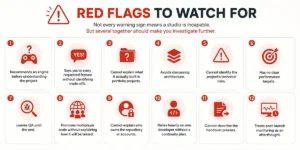
Not every warning sign means a studio is incapable. But several together should make you investigate further.
Watch for a studio that:
-
recommends an engine before understanding the project;
-
says yes to every requested feature without identifying trade-offs;
-
cannot explain what it actually built in portfolio projects;
-
avoids discussing architecture;
-
cannot identify the project’s technical risks;
-
has no clear performance targets;
-
leaves QA until the end;
-
promises multiplayer scale without explaining how it will be tested;
-
cannot explain who owns the repository or accounts;
-
relies heavily on one developer without a continuity plan;
-
cannot describe the handover process;
-
treats post-launch monitoring as an afterthought.
A useful technical discussion should include trade-offs, constraints, and risks.
A capable team should be willing to explain when an approach creates unnecessary risk and identify what needs to be prototyped before it becomes part of the production plan. Unconditional confidence is less useful than a clear explanation of the trade-offs.
Questions to Ask Before Hiring a Game Development Studio
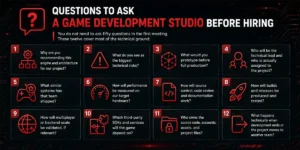
You do not need to ask fifty questions in the first meeting. These twelve cover most of the technical ground:
-
Why are you recommending this engine and architecture for our project?
-
What do you see as the biggest technical risks?
-
What would you prototype before full production?
-
Who will be the technical lead and who is actually assigned to the project?
-
What similar systems has that team shipped?
-
How will performance be measured on our target hardware?
-
How will source control, code review, and documentation work?
-
How will builds and releases be produced and tested?
-
How will multiplayer or backend scale be validated, if relevant?
-
Which third-party SDKs and services will the game depend on?
-
Who owns the source code, accounts, assets, and project files?
-
What happens technically when development ends or the project moves to another team?
The objective is not to catch a studio out.
It is to understand whether both sides are making the same assumptions before those assumptions become expensive.
Final Thoughts
Technical due diligence should leave you with more than confidence in a studio’s presentation.
You should understand who will build the game, why the proposed architecture fits, what technical risks remain, how those risks will be tested, how progress will be verified, and what you will own when the engagement ends.
That makes the selection process much more useful than comparing portfolios and quotations alone.
If you are currently evaluating development partners, Red Apple Technologies’ game development capabilities cover engineering, game art, QA, multiplayer, platform development, deployment, and post-launch support.
The more useful starting point, however, is the technical discussion: what the project needs, where the risk sits, and what should be validated before full production. Whichever studio you choose, walking into that conversation with these questions will make the evaluation more focused and easier to compare.
The Author

Related Blogs
Discover more stories & insights that inspire
Southeast Asia has transformed from a cost-driven outsourcing destination into a serious production ecosystem for global game studios. Over the last decade, countries such as Singapore, Vietnam, Indonesia, and Malaysia...
KYC AML integration in iGaming is no longer a regulatory afterthought. It is the core infrastructure. For operators building or scaling regulated platforms, compliance architecture determines whether growth is smooth...

At some point, most gamers have said, just a few more minutes, only to discover that hours have passed without noticing. That isn’t a mere distraction; it’s a reflection of...

Hiring a game development company is rarely just about building a game. For startups, it determines whether an idea reaches the market before resources run out. For enterprises, it determines...
The decision between a 2D and a 3D game development company is rarely just about visuals. For businesses, startups, and studios, it’s a strategic choice that affects cost, timelines, player...
The video game industry is reshaping the world economy at an unprecedented pace. Depicting a robust market size of $298.98 billion, opportunities in this segment are rapidly growing. With the...
According to DataReportal, people are spending around 6 hours and 40 minutes on gaming every day. This indicates how video games have become engaging in recent times. Harnessing leading-edge technologies...

Board games are also one of the top genres in mobile gaming. This is evident with the robust global market size of $2.19 billion, which, in 2035, shall reach the...

Besides evolving the conventional gaming experience of users, the Metaverse is also presenting businesses with exciting opportunities in an evolving landscape of technology. According to the Morgan Stanley report, the...

Showcasing an active global player segment of over 100 million and 60 million in the United States, investments are scaling up in online poker games. However, to ensure a thumping...


 Book An Appointment
 WhatsApp