


The Complete Guide to Game Development Companies in Canada: Pricing, Talent, and Trends
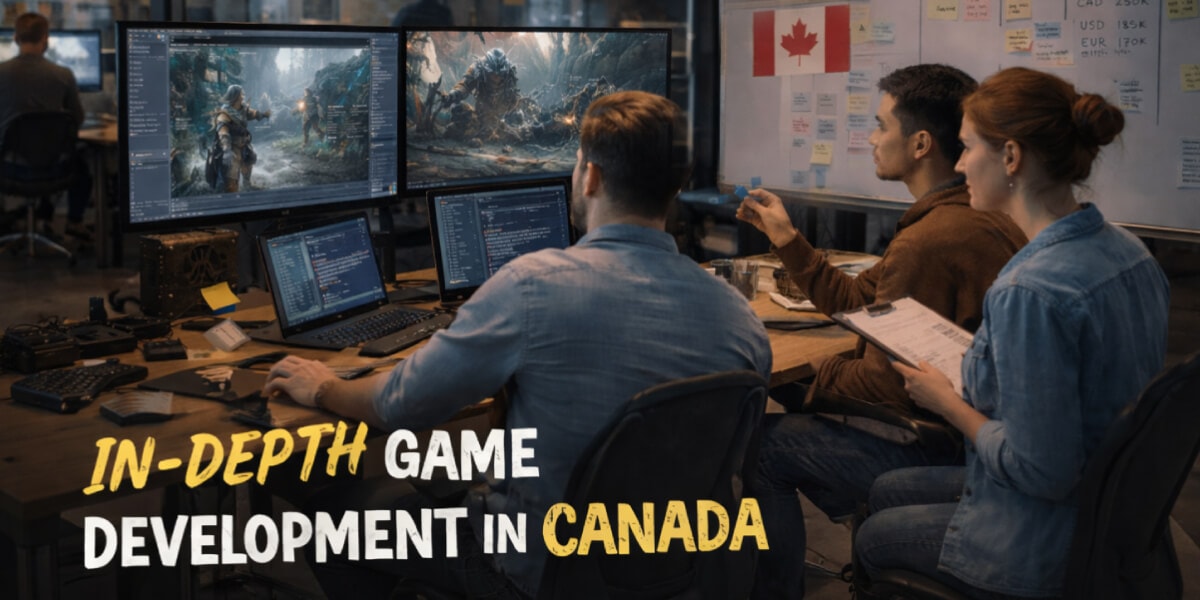
Canada has emerged as one of the most dependable regions to engage a game development company, not because it offers the lowest rates, but because it consistently delivers quality, structure, and long-term reliability.
The Canadian video game industry generated over CAD $5.1 billion in revenue in 2024, placing the country among the world’s most mature gaming ecosystems. With more than 821 studios operating nationwide, Canada is frequently shortlisted by startups, publishers, and enterprises looking to hire game developers in Canada for scalable, production-ready projects.
This guide explains when Canada is the right choice, when it isn’t, and what buyers should realistically expect around Canada game development pricing, talent availability, and evolving market direction.
Why Canada Is Often Shortlisted for Game Development
Canada works well when buyers prioritize predictability, communication quality, and lifecycle thinking. It becomes a weaker fit when cost minimization is the primary objective.
One reason Canada remains competitive as a Canada game development company hub is its workforce depth. More than 34,000 professionals are employed across the Canadian game dev industry, spanning engineering, art, QA, and production roles. This scale enables long-term team stability rather than short-term, execution-only engagements.
Canada’s value proposition weakens when buyers expect offshore-style pricing with nearshore governance. The region is optimized for sustainable delivery, not disposable builds.
Talent Landscape: Strengths and Trade-Offs
Canadian teams perform best in structured, collaborative environments where long-term ownership matters. Most game development companies in Canada are experienced with modern engines, cross-platform production, and LiveOps workflows.
These strengths are most visible in:
- Ongoing live games and service-based titles
- Backend-heavy architectures
- Multi-platform releases
- Enterprise-grade production pipelines
Canada becomes less competitive for projects built around rapid churn, frequent team changes, or ultra-low-cost experimentation. The talent market favors continuity over volume, which benefits scalable products more than short-lived prototypes.
Want to dive right into the best game development companies in Canada? Here’s our list of the Top 10 Game Development Companies in Canada: Complete 2026 Guide!
Game Development Pricing: What Buyers Should Expect
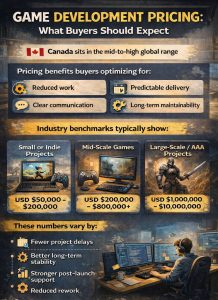
Canada game development pricing sits in the mid-to-high global range, and that positioning is intentional. Pricing works when buyers are optimizing for:
- Reduced work
- Predictable delivery
- Clear communication
- Long-term maintainability
It fails when buyers benchmark Canada purely against offshore regions without accounting for quality and governance differences. Industry benchmarks commonly referenced across GDC and IGDA insights indicate:
- Small or indie projects: USD 50,000–$200,000+
- Mid-scale games: USD $200,000–$800,000+
- Large-scale or AAA projects: USD $1M–$10M+
These ranges vary based on scope, platform complexity, and LiveOps requirements, not geography alone. Buyers who hire game developers in Canada often offset higher upfront costs with fewer delivery setbacks and stronger post-launch stability.
Government Incentives and Regional Advantages
Government incentives play a major role in shaping the Canada game development company ecosystem. Several provinces offer digital media and R&D tax incentives reaching up to ~37.5% of eligible development costs. These incentives encourage studios to invest in long-term teams, compliance, and production maturity.
For buyers, this translates into game development companies that are structured for sustained delivery, not short-term contracting.
Engagement Models Commonly Used by Canadian Game Development Companies
Most Canadian game development companies favor engagement models that emphasize clarity and accountability. These models work best when:
- Scope is reasonably defined
- Stakeholders align early
- Decision authority is clear
Dedicated team models are commonly used for long-running products and LiveOps-heavy roadmaps. Fixed-price engagements tend to succeed only for clearly bounded modules or extensions.
Friction arises when clients expect constant scope changes without timeline or budget adjustments. Canadian teams adapt, but not without structure.
Communication and Time-Zone Alignment
Canada remains attractive for North American and European clients due to strong time-zone overlap and cultural familiarity. Communication-heavy projects benefit most from this alignment.
This advantage diminishes when buyers operate in regions with limited overlap and expect continuous real-time collaboration. Canada delivers the most value when communication quality is actively used, not minimized.
Canadian Game Dev Industry Trends Shaping the Market
Several Canadian game dev industry trends are influencing how studios operate and where buyers see value:
- Increased emphasis on LiveOps and post-launch pipelines
- Growing specialization rather than generalist teams
- Strong focus on backend scalability and performance
- Continued growth in mobile and service-based games
Globally, mobile gaming now accounts for over 50% of total industry revenue, shaping how Canadian studios invest in talent and infrastructure. These trends favor buyers planning for product longevity, not just launch milestones.
When Canada Is the Right Choice and When It Isn’t
Canada is a strong fit when:
- You need a reliable long-term development partner
- LiveOps and post-launch support are part of the roadmap
- Documentation and communication quality matter
- Predictability outweighs aggressive cost cutting
Canada is less suitable when:
- Cost minimization is the primary objective
- Projects rely on rapid churn with minimal continuity
- Governance and process are viewed as overhead
How Experienced Buyers Evaluate a Canada Game Development Company
Experienced buyers look beyond portfolios when selecting a Canada game development company. They ask:
- How stable are teams across multi-year engagements?
- How are risks documented and escalated?
- What happens after launch?
- How does pricing evolve as scope changes?
Canadian studios tend to perform well when these lifecycle-focused questions drive the evaluation process.
Why Some Teams Include Red Apple Technologies in Their Evaluation
When teams evaluate a game development company, they often look beyond location and rates to assess delivery reliability, collaboration structure, and long-term support capability. Red Apple Technologies is sometimes included in this evaluation because of its experience working across multiple stages of the game development lifecycle rather than focusing on a single production function.
The company operates as a game development partner, supporting clients with defined scopes, milestone-driven delivery, and cross-functional coordination. This approach tends to align with projects where continuity, documentation, and post-launch readiness are as important as initial development.
The company works with both startups and established organizations, typically on projects that require clear ownership, predictable execution, and the ability to scale or transition teams as products evolve. Its role is often complementary, supporting internal teams or external stakeholders rather than replacing them.
For buyers comparing options globally, including Canada-based providers, Red Apple Technologies is generally considered when flexibility, communication transparency, and lifecycle alignment are part of the selection criteria, rather than geography alone.
Final Perspective
Canada’s game development ecosystem rewards buyers who think long-term. It is not optimized for shortcuts, but for sustainable production, quality control, and collaborative delivery.
For organizations that value stability, communication maturity, and lifecycle thinking, hire game developers Canada, as it remains one of the most dependable choices, supported by measurable industry scale, experienced talent, and mature production practices.
To Have A Better Understanding On This Let us Answer The Following Questions
Answer: Yes, Canada is a strong choice when project stability, communication quality, and long-term scalability matter. Canadian game development companies are well suited for mid-to-large projects, LiveOps-driven games, and products that require structured production pipelines rather than short-term execution.
Answer: Canada game development pricing is typically higher than offshore regions but competitive among nearshore markets. Costs vary based on game type, platform, and team composition, but buyers usually pay a premium for predictability, documentation, and reduced rework rather than raw development hours.
Answer: They can be, but only if the startup has a clear roadmap and realistic funding. Canadian teams work best when scope is defined and decision-making is structured. Very early-stage startups seeking rapid experimentation at minimal cost may find other regions more suitable.
Answer: Canadian studios commonly excel in mobile games, multiplayer and backend-heavy systems, live-service games, and cross-platform titles. Their strengths lie in lifecycle management rather than one-off builds.
Answer: Hiring game developers in Canada makes sense if you prioritize communication, governance, and long-term product health. Offshore outsourcing may reduce initial costs but often requires more oversight. The right choice depends on whether you value cost efficiency or delivery reliability more.
Answer: Most established Canadian studios are experienced with LiveOps, analytics integration, backend scaling, and post-launch iteration. This makes them suitable for games that require continuous updates, monetization tuning, and performance optimization.
Answer: Yes. A significant portion of Canada’s game industry revenue comes from exports. Canadian game development companies are accustomed to working with global publishers and clients across North America and Europe.
Answer: Dedicated team and milestone-based models are most common. Canadian studios tend to avoid loosely defined time-and-materials engagements unless governance and scope controls are in place.
Answer: Canada is not positioned as the lowest-cost destination. However, many buyers consider it cost-effective over the full project lifecycle due to fewer delays, stronger documentation, and better post-launch stability.
Answer: Look beyond portfolios. Assess team stability, communication processes, LiveOps capability, risk management practices, and how pricing adapts as scope evolves. These factors matter more than visual alone.
Get Started
- End-to-End Game & App Development Services
- Flexible Business Models – Project Based or Dedicated Hiring
- 13+ Years of Industry Experience with Global Clientele
- Globally Recognized by Clutch, GoodFirms & DesignRush
Related Blogs
Discover more stories & insights that inspire
A game aggregator is not just another software product. For investors, it is better understood as infrastructure: a platform that connects many game providers, delivers content through one system, and...
Despite occupying second position after China, the USA still manages to be a superpower in the global game industry. Whether game development or game publishing, the USA continues to shine...
Not long ago, virtual reality was treated as an experimental side project for game studios. Today, immersive technology has become a serious part of the global gaming industry, and Canada...
Italy has quietly developed into one of Europe’s most creative mobile game development ecosystems. While the country may not match the scale of mobile gaming markets like the United States...

The iGaming industry continues to expand rapidly as more markets legalize online gambling and digital betting platforms become easier to launch. The global online gambling market reached approximately $78.7 billion...
Game development followed a familiar pattern for decades: build everything in-house or outsource isolated tasks when schedules slipped. That model has been quietly changing. It’s 2026, and while a section...

You’re reading this because 2026 isn’t just another year in gaming; it’s the tipping point where AI rewrites pipelines, cloud erases hardware barriers, and player creators become your most profitable...
With rising investments, game development has evolved into a profitable business alternative worldwide. Be it startups, agencies, Fortune 500 organizations, or angel investors, everyone is keen to join this creative...

With the rising competition in the gaming industry, delivering top-notch gaming experiences is becoming a vital step to retain and engage maximum players. Presently, there are over 3.58 billion gamers...

Hiring a game development company is rarely just about building a game. For startups, it determines whether an idea reaches the market before resources run out. For enterprises, it determines...


 Book An Appointment
 WhatsApp