

The Ultimate Guide to Choosing the Best Game Development Company
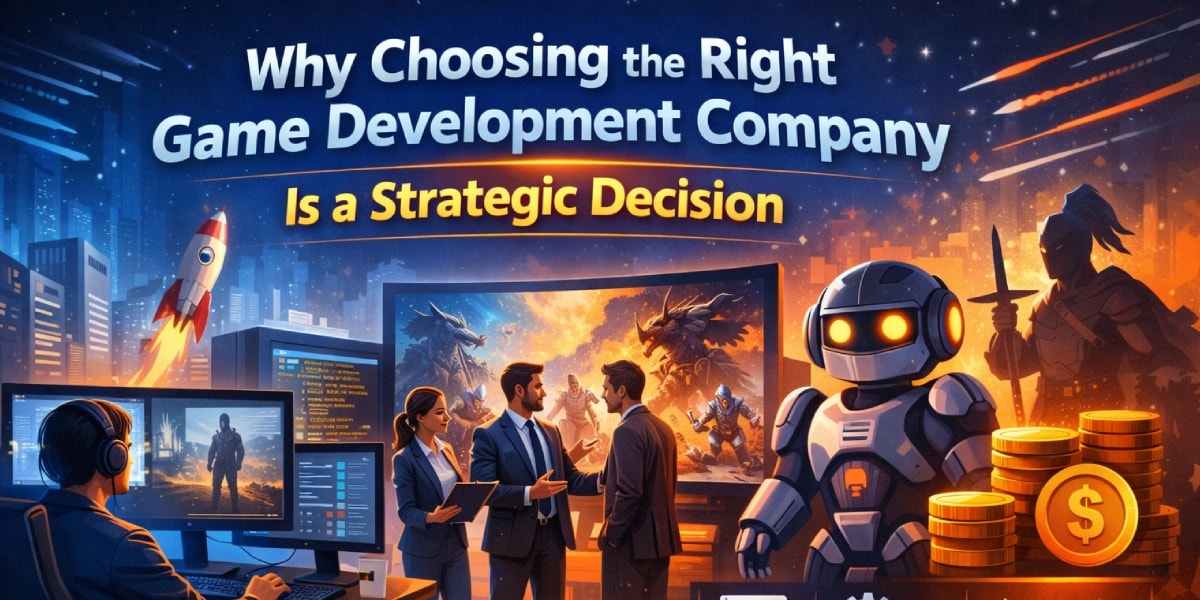
Choosing the best game development company is one of the most consequential decisions in a game’s lifecycle. The company you partner with will influence development cost, delivery timelines, technical stability, post-launch performance, and long-term scalability.
This guide serves as a game development partner selection guide for founders, studios, and publishers who want to make an informed, risk-aware decision, not just pick a vendor based on surface-level comparisons.
Why Choosing the Right Game Development Company Is a Strategic Decision
Game development is not a linear execution task. It is a multi-phase, collaborative process that spans concept validation, production, launch, and LiveOps.
When you hire a game development company, you are effectively choosing:
- A technical decision-maker
- A creative collaborator
- A long-term delivery partner
That is why understanding how to choose a game development company correctly is critical to product success.
Step 1: Define Your Game Development Goals Clearly
Before evaluating vendors, clarify what you actually need. Ask yourself:
- What type of game are you building?
- Which platforms will it support?
- Are you looking for end-to-end delivery or partial support?
- Will you need long-term LiveOps and updates?
Clear requirements make it easier to hire game development experts who are aligned with your scope rather than over- or under-engineering your product.
Step 2: Understand the Types of Game Development Companies
Not all companies offering game development services operate the same way.
- Product-focused game studios prioritize their own IPs.
- Service-led game development companies focus on client projects, co-development, and outsourcing.
- Freelance teams offer flexibility but require higher management effort.
For most businesses, a professional game development company with a service-first model provides better predictability and accountability.
Step 3: Evaluate Experience That Matches Your Game Type
A visually impressive portfolio does not automatically mean a company is the right fit. Instead of asking “What games have you built?’, ask:
- Have you built games similar to ours in complexity?
- Do you understand our monetization and retention goals?
- Have you handled post-launch optimization before?
This is a key step in any game development partner selection guide because relevant experience reduces risk significantly.
Step 4: Assess Technical Depth, Not Just Tools
Most companies list popular engines like Unity or Unreal. That alone is not differentiation. Look deeper into:
- Backend and multiplayer architecture
- Cloud infrastructure and scalability
- Performance optimization and analytics
- LiveOps tooling and pipelines
The best game development company designs systems that scale, not just builds what’s required for launch day.
Step 5: Review Development Process and Delivery Maturity
Process maturity determines whether a project stays on track. Ask how the company handles:
- Sprint planning and milestone delivery
- QA, testing, and bug triage
- Documentation and knowledge transfer
- Change requests and scope control
A professional game development company follows repeatable, transparent workflows, not ad-hoc execution.
Step 6: Understand Team Structure and Talent Allocation
Knowing who will work on your game is critical. Clarify:
- Will you have a dedicated team?
- What is the senior-to-junior ratio?
- Are specialists included (backend, DevOps, QA, LiveOps)?
When you hire game development experts, you want a balanced team and not one overloaded with juniors or dependent on a single individual.
Step 7: Evaluate Communication and Collaboration Practices
Communication breakdowns are one of the most common causes of failed projects. Assess:
- Reporting frequency and clarity
- Single point of contact vs. fragmented communication
- Time zone overlap and availability
- Willingness to discuss risks openly
Strong communication is often what separates an average vendor from the best game development company for long-term collaboration.
Step 8: Compare Engagement Models, Not Just Pricing
Cost alone is a poor decision metric. Common engagement models include:
- Fixed-price delivery
- Time & material
- Dedicated team models
A trustworthy game development company will recommend an engagement model based on your project’s risk profile without simply pushing the one that benefits them most.
Step 9: Evaluate Quality Assurance and Testing Rigor
QA is not optional—it directly impacts player experience and retention. Ensure the company:
- Has a structured QA workflow
- Performs device, platform, and performance testing
- Uses professional bug tracking systems
- Includes regression testing before releases
Skipping QA may reduce upfront cost but increases long-term risk.
Step 10: Assess Post-Launch and LiveOps Capabilities
Successful games are maintained and improved after launch. Before finalizing, confirm whether the company supports:
- LiveOps and content updates
- Server monitoring and scaling
- Analytics-driven balancing
- Long-term maintenance
A company that plans beyond launch demonstrates a true product mindset.
Step 11: Review IP Protection and Security Practices
When you hire a game development company, your IP must be protected. Ask about:
- IP ownership and contract clauses
- NDAs and confidentiality
- Access controls and data security
- Platform compliance experience
Mature companies treat security as standard practice.
Step 12: Ask Strategic Questions Before Making a Decision
Ask questions that reveal accountability:
- What risks do you foresee in this project?
- How do you handle scope changes?
- What happens if timelines slip?
- How do you support scaling post-launch?
How a company answers is often more important than the answer itself.
Step 13: Choose Long-Term Value Over Short-Term Savings
The best decision is rarely the cheapest one. The best game development company for your project is the one that aligns with:
- Your product vision
- Your development timeline
- Your risk tolerance
- Your long-term growth strategy
This mindset is at the core of any reliable game development partner selection guide.
Why Some Businesses Consider Red Apple Technologies
When evaluating a game development company, many businesses look for partners that combine technical depth, process maturity, and long-term product thinking. Red Apple Technologies is often considered in this context due to its service-led approach to game development.
The company typically works with startups, indie studios, and growing businesses that need structured, end-to-end game development support rather than one-off execution. Its delivery model emphasizes clear communication, defined processes, and scalable team structures, factors that become increasingly important as games evolve beyond launch.
Another reason some teams explore Red Apple Technologies as a development partner is its experience across different game types and engagement models. This flexibility allows clients to start with a focused scope and expand development, LiveOps, or support as the product grows.
Rather than positioning itself as a one-size-fits-all solution, the company tends to align projects based on technical feasibility, timeline expectations, and long-term goals, an approach that resonates with teams looking for predictability and continuity over short-term cost savings.
Final Thoughts
Choosing the right game development company is a strategic investment, not a procurement exercise. By understanding how to choose a game development company based on experience, process, communication, and long-term support, you significantly increase your chances of success.
A thoughtful selection today prevents costly rework, delays, and operational challenges tomorrow.
To Have A Better Understanding On This Let us Answer The Following Questions
Answer: A company is the right fit if it demonstrates experience with your game type, explains technical decisions clearly, offers transparent processes, and shows readiness to support your game beyond launch. The evaluation checklist helps validate this objectively.
Answer: Common red flags include:
- Vague timelines or pricing
- Overpromising features without technical validation
- Lack of QA or LiveOps discussion
- Unclear team structure
- Avoidance of risk-related questions
Answer: If you want a single accountable partner, an end-to-end game development company is usually the better option. Specialized vendors may reduce short-term cost but often increase coordination effort and risk in complex projects.
Answer: Both models can work. Local companies offer proximity and easier collaboration, while offshore partners provide cost efficiency and scalability. The key factor is not location but process maturity, communication quality, and delivery reliability.
Answer: Shortlisting 3–5 companies is ideal. This allows meaningful comparison without overwhelming decision-making. Use the checklist to score each vendor consistently.
Answer: Ask questions such as:
- How do you handle scope changes?
- What risks do you see in this project?
- Who owns the IP and source code?
- What post-launch support is included?
Answer: LiveOps experience is critical for mid-core, multiplayer, and long-term games. Without it, post-launch costs, player churn, and operational challenges increase significantly.
Answer: It is possible but risky and expensive. Transitioning mid-project often involves knowledge loss, delays, and rework. That’s why through vendor evaluation upfront is essential.
Answer: For evolving products, the dedicated team model usually provides the best balance of flexibility, continuity, and cost control. Fixed-price models work better for well-defined scopes.
Answer: Focus on trial project value rather than hourly rates. A slightly higher upfront cost with a reliable partner often reduces long-term expenses caused by delays, bugs, or scalability.
Answer: You should proceed once:
- Technical approach is validated
- Scope and engagement model are clear
- Risks are openly discusses
- Communication feels transparent and structured
Get Started
- End-to-End Game & App Development Services
- Flexible Business Models – Project Based or Dedicated Hiring
- 13+ Years of Industry Experience with Global Clientele
- Globally Recognized by Clutch, GoodFirms & DesignRush
Related Blogs
Discover more stories & insights that inspire
The wrong partner doesn’t fail your project on day one. It fails itself slowly through delays, compliance gaps, and missed market windows. In the iGaming industry, your technology partner is...

A $100 billion market. Millions of bets placed every minute. And most new operators still get the cost wrong. Not because the opportunity isn’t real, but because they underestimate the...
A game aggregator is not just another software product. For investors, it is better understood as infrastructure: a platform that connects many game providers, delivers content through one system, and...
As the third-largest market in Europe, France is gradually making its presence felt in the global game industry. With over 500 million game studios and a vibrant gaming population of...
Singapore is fast evolving into the global gaming landscape. As a prominent game development destination, the country is attracting investors, startups, and businesses of all sizes. Already, this Asian country...
Italy has quietly developed into one of Europe’s most creative mobile game development ecosystems. While the country may not match the scale of mobile gaming markets like the United States...
South Korea is one of the most advanced gaming ecosystems in the world. With high-speed 5G infrastructure, strong government support for immersive technology, and a deeply rooted competitive gaming culture,...
Turkey has become one of the fastest-growing mobile gaming ecosystems in Europe. Over the past decade, mobile game developers in Turkey have produced globally successful casual and hyper-casual titles, attracted...
Southeast Asia has transformed from a cost-driven outsourcing destination into a serious production ecosystem for global game studios. Over the last decade, countries such as Singapore, Vietnam, Indonesia, and Malaysia...
How we design, test, and launch interactive experiences is changing rapidly with the inclusion of generative AI in game development. Gone are the days of using artificial intelligence as a...


 Book An Appointment
 WhatsApp