


Business Benefits of LiveOps for Mobile and Online Games

Why do you think games like PUBG, Clash of Clans, and Mobile Legends have been relevant for years? Most games disappear after launch. Is it just the graphics that hold up, or does it have something to do with the gameplay quality? Here’s the truth:
The difference between a winning game and an out-of-touch game is the difference between what happens after launch.
The studios that continue to grow are generally the ones that treat their games like evolving platforms instead of finished products. They listen to players, refine systems, introduce new experiences, and regularly improve engagement.
That ongoing process is what LiveOps is really about, and when we talk about mobile games, it is one of the biggest drivers of long-term business growth.
Launch Revenue Is No Longer Enough
A successful launch could carry a game for a long time, but that was a long time ago (pun intended). That model has changed, and the most successful mobile and online games today depend heavily on recurring engagement rather than one-time purchases.
According to Statista, mobile games generated hundreds of billions in global app revenue largely through ongoing in-app purchases and live engagement models rather than initial downloads alone. That shift changed how studios think about growth.
Instead of focusing only on acquisition, they now focus on retention, engagement, and lifetime value, all areas where LiveOps services for mobile games play a major role.
LiveOps Extends the Life of a Game
Without LiveOps, most games follow a predictable pattern. There’s excitement at launch, with player activity spiking with a game’s release, which means incoming revenue. However, that doesn’t last long because the pace falls. Players complete available content. Engagement drops. Revenue becomes inconsistent.
LiveOps changes that trajectory by introducing reasons for players to stay involved. New events, evolving challenges, seasonal content, and personalized rewards create momentum that keeps the game active long after release.
From a business perspective, this matters because extending player activity directly increases lifetime value, and lifetime value is often more important than initial download numbers.
Retention Becomes More Practical
One of the biggest business advantages of LiveOps is stability. Studios without structured LiveOps often experience unpredictable engagement patterns. Activity spikes during updates, then drops sharply afterward.
Games with mature LiveOps systems tend to maintain steadier player activity because engagement isn’t tied to occasional content releases; it’s continuous. This predictability affects more than gameplay metrics. It improves:
- Revenue forecasting
- Marketing efficiency
- Community growth
- Monetization planning
For businesses operating live games, predictable engagement is extremely valuable.
Better Retention Means Better Revenue
Retention and monetization are closely related. Players who return consistently are far more likely to make purchases over time than players who engage briefly and leave.
For instance, a regular player in a game who does not initially spend money on in-game cosmetics or upgrades has high chances of paying for in-game cosmetics or upgrades in the future. Retention remains one of the strongest indicators of long-term mobile game profitability.
That’s why many studios now prioritize retention-focused systems before aggressive monetization strategies. A strong LiveOps model improves revenue not by forcing purchases, but by increasing the amount of time players stay connected to the game.
LiveOps Makes Games Feel Alive
This part is easy to underestimate until you see it working well. Games with active LiveOps feel different. There’s always something happening —
A new event. A limited-time challenge. A reason to log in.
Players start feeling like they’re participating in an evolving world rather than consuming static content. That emotional difference matters more than most metrics can capture. It creates habits, communities, and social interaction. And those things are incredibly difficult for competitors to replicate quickly.
Data Helps Studios Make Smarter Decisions
One of the less visible business benefits of LiveOps is how much clearer decision-making becomes. Without LiveOps, many studios operate largely on assumptions:
- What players enjoy
- What causes drop-offs
- What drives spending
With LiveOps, behavior becomes measurable in real time. Teams can track:
- Which events increase session time
- Which rewards improve retention
- Where players lose interest
That feedback loop helps studios refine their strategy continuously instead of waiting months to understand what worked. This is one reason businesses often work with a dedicated game LiveOps company rather than managing everything internally.
Today, Mobile Games Depend on LiveOps More Than Ever
Mobile gaming, in particular, has become deeply tied to LiveOps. The market is crowded. Player attention is short. Competition is constant. In that environment, maintaining visibility and engagement requires continuous interaction with players. That’s why many successful mobile titles invest heavily in:
- Seasonal updates
- Events calendars
- Personalized offers
- Community-driven content
A specialized LiveOps agency for game businesses helps studios manage these systems consistently without overwhelming internal teams.
Online Games Need Long-Term Engagement Loops
Online multiplayer games face a different kind of challenge. Their value depends heavily on active communities. When engagement drops, matchmaking quality suffers. Social activity declines. The experience starts feeling empty, even if the core gameplay is strong. This is why LiveOps solutions for online games are so important.
LiveOps helps sustain the ecosystem around the game, not just the game itself. It keeps communities active and gives players ongoing reasons to participate.
The Operational Side Matters Too
Running LiveOps effectively requires more coordination than many studios expect. Content planning, analytics, balancing, monetization, and deployment all need to work together. Without structure, LiveOps can quickly become reactive instead of strategic.
That’s why companies increasingly rely on a LiveOps business growth partner to handle execution systematically.
At Red Apple Technologies, we support studios by combining analytics, engagement planning, and operational management into a more sustainable process. For many businesses, that external support improves both efficiency and scalability.
Small Improvements Compound Into Major Growth
One of the most interesting things about LiveOps is that growth often comes from incremental changes, like a slightly better event structure, a more balanced reward system, and a small increase in player return rates.
Individually, these improvements may seem minor. But over time, they compound into meaningful business results. Expect higher retention, stronger monetization, longer player lifecycles, and more stable revenue streams. That’s why LiveOps tends to create lasting advantages rather than temporary spikes.
Bottomline
LiveOps is no longer just a support layer for games; some may mistake it for that. For mobile and online titles, it has become part of the business model itself. The ability to retain players, adapt quickly, and continuously improve engagement now plays a direct role in revenue growth and long-term sustainability. Increasingly, the studios that grow the fastest are the ones that understand this early.
To Have A Better Understanding On This Let us Answer The Following Questions
Answer: They include post-launch operations like events, updates, analytics, and monetization optimization designed to improve retention and revenue.
Answer: They help maintain player engagement, support active communities, and extend the lifecycle of online games.
Answer: By increasing player retention, improving lifetime value, and creating more predictable recurring revenue.
Answer: Yes. Even smaller games benefit from structured engagement strategies and regular content updates.
Answer: They help studios manage engagement, analytics, monetization, and content operations to support long-term growth.
Get Started
- End-to-End Game & App Development Services
- Flexible Business Models – Project Based or Dedicated Hiring
- 13+ Years of Industry Experience with Global Clientele
- Globally Recognized by Clutch, GoodFirms & DesignRush
Related Blogs
Discover more stories & insights that inspire
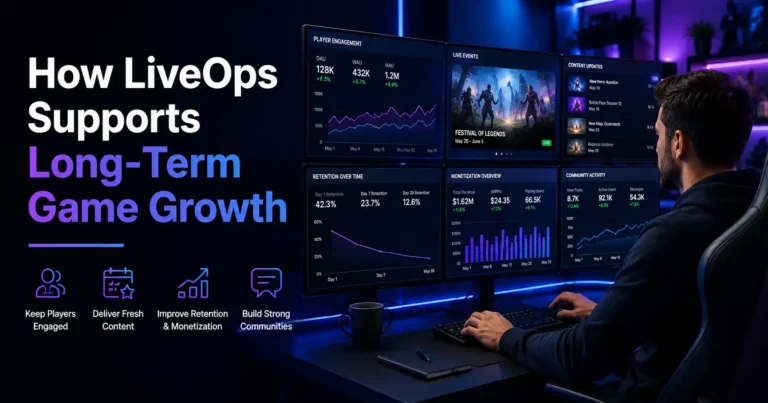
This isn’t anything new—some games launch with massive attention and still disappear within a year, while others grow slowly by keeping players engaged—the latter generate revenue for years. Luck? No!...

Most games don’t lose players because they’re bad. They lose players because they stop giving people a reason to return. That’s the real challenge after launch. You’ve already built the...
In our past posts, we have made sure you understand what LiveOps is, how it improves retention and engagement, and how it supports the long-term growth of a game. One...

LiveOps Explained Without the Buzzwords To those looking to build a game for the first time, a game doesn’t end at launch, it evolves. Players expect new content, fresh challenges,...
San Francisco continues to be one of the most influential hubs for game development innovation. But in today’s landscape, success is no longer defined by launch metrics alone. The real...
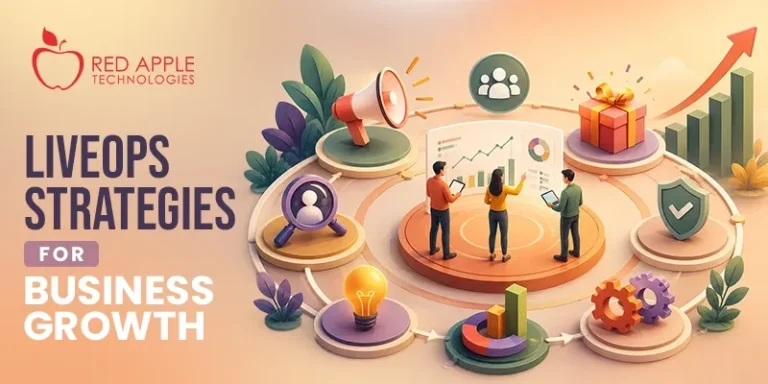
Shipping a game used to be the finish line. Now it’s the starting point. The studios that grow consistently aren’t just building great gameplay; they’re building systems that keep players...
A full-cycle game development approach is not defined by how quickly a game is shipped or how many features it includes at launch. It is defined by how consistently the...


 Book An Appointment
 WhatsApp