


What Are LiveOps Solutions and Why Do They Matter for Games?

LiveOps Explained Without the Buzzwords
To those looking to build a game for the first time, a game doesn’t end at launch, it evolves. Players expect new content, fresh challenges, balanced economies, and reasons to return regularly. Without that ongoing evolution, even well-built games lose momentum faster than most studios anticipate. That’s where LiveOps comes in.
Live operations (LiveOps) is the structured process of managing, updating, and optimizing a game after it goes live. It connects player behavior, content updates, and monetization into a continuous cycle designed to keep the game relevant and profitable over time.
What Are LiveOps Solutions for Games?
At a practical level, LiveOps solutions for games are the tools, processes, and strategies used to operate a game post-launch. This includes everything from running in-game events to analyzing player data and refining monetization models. But the real value lies in how these elements work together.
A typical LiveOps system includes:
- Content updates such as events, challenges, and seasonal features
- Player segmentation and personalization
- Real-time analytics and performance tracking
- In-game economy management
- Monetization optimization
Individually, these functions are useful. Combined, they form a system that continuously improves the player experience while supporting business growth.
Why Games Without LiveOps Struggle Over Time
A lot of games are built as if launch is the finish line. Everything is designed for that initial release, features, progression systems, monetization. But once players move through that content, there’s nothing left to sustain interest. That’s when drop-offs happen.
Without structured game LiveOps services, updates tend to be reactive. A new feature gets added because engagement dropped. An event gets introduced because players are leaving. The problem is, by the time you react, you’re already behind. LiveOps changes that dynamic by making iteration continuous instead of occasional.
What LiveOps Actually Looks Like in Practice
From the outside, LiveOps is often visible through events and updates. But behind those updates is a much more deliberate process. Teams are constantly observing how players behave, where they spend time, where they disengage, what motivates them to return. That information shapes everything that follows.
A limited-time event isn’t just content, it’s a test.
A new reward system isn’t just progression. It’s a retention strategy.
This is why working with a structured game operations agency tends to produce better outcomes. The focus shifts from “what should we add next?” to “what should we improve next?”
The Shift From Static Games to Living Systems
What makes LiveOps so important today is how player expectations have changed. Games are no longer static experiences. Players expect them to evolve. This is especially visible in mobile gaming, where ongoing engagement directly impacts revenue. Insights from Statista show that long-term player activity contributes significantly more to revenue than initial installs. That shift has pushed studios to think differently. Instead of building a complete experience upfront, they build a foundation that can grow over time.
Retention Is the Real Starting Point
It’s tempting to think of LiveOps as a monetization tool. But monetization only works when players stay. The real focus of LiveOps solutions for games is retention, giving players a reason to come back regularly. That might be through daily rewards, evolving challenges, or new layers of progression. Once that habit is built, monetization becomes a natural extension rather than a forced mechanic.
Why Personalization Is Becoming Standard
As games scale, treating all players the same becomes less effective.
New players need guidance. Experienced players need depth. High-value players expect exclusive experiences.
LiveOps makes it possible to tailor content to these different segments. Instead of one universal update, you create multiple experiences within the same game. This not only improves engagement but also makes the game feel more responsive to individual players.
The Operational Side Most People Don’t See
One of the reasons studios partner with a LiveOps company for mobile games is the complexity behind the scenes. Managing LiveOps at scale involves coordinating multiple moving parts:
- Content schedules
- Data analysis
- Economy balancing
- Technical deployment
Without a structured approach, this quickly becomes overwhelming. That’s why many teams bring in a LiveOps growth partner, not just to execute updates, but to manage the entire system efficiently. Companies like Red Apple Technologies focus on connecting these elements, ensuring that updates, analytics, and monetization work together instead of in isolation.
The Compounding Effect of Small Improvements
One of the most underrated aspects of LiveOps is how small changes add up:
- A slight improvement in retention here
- A better-performing event there
- A more balanced progression system over time
Individually, these changes might seem minor. But over weeks and months, they compound into significant growth. This is what turns LiveOps from a maintenance activity into a business strategy.
When LiveOps Makes the Biggest Difference
Not every game needs a complex LiveOps system from day one. But the moment your game depends on long-term engagement, whether for retention, community building, or monetization, LiveOps becomes essential. The earlier it’s integrated into your development thinking, the easier it is to scale later.
Conclusion
LiveOps isn’t about doing more but doing things with intention. For instance, using player behavior to guide decisions, refining systems continuously, and building a game that doesn’t just launch successfully, but stays relevant. In a market where players have endless choices, that ability to evolve is what keeps a game alive.
To Have A Better Understanding On This Let us Answer The Following Questions
Answer: They are systems and strategies used to manage and improve a game after launch through updates, analytics, and player engagement.
Answer: Because player engagement drops over time without continuous updates, and LiveOps helps maintain retention and revenue.
Answer: It manages post-launch activities like events, analytics, and monetization to keep the game performing well.
Answer: No, they are used across mobile, PC, and console games, though they are most common in mobile.
Answer: A partner that helps scale engagement and revenue by managing and optimizing LiveOps strategies.
Get Started
- End-to-End Game & App Development Services
- Flexible Business Models – Project Based or Dedicated Hiring
- 13+ Years of Industry Experience with Global Clientele
- Globally Recognized by Clutch, GoodFirms & DesignRush
Related Blogs
Discover more stories & insights that inspire
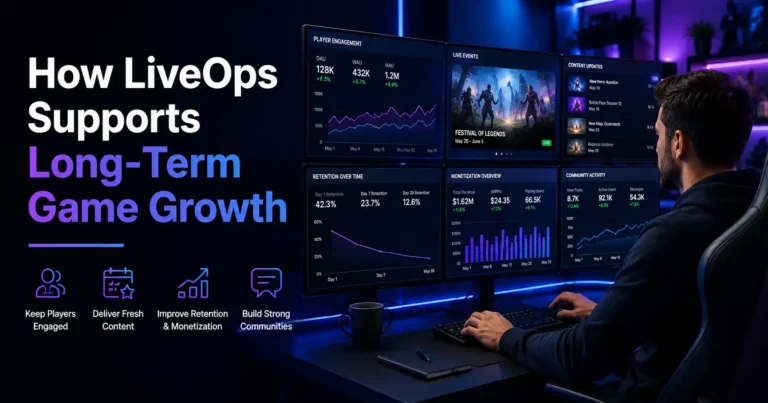
This isn’t anything new—some games launch with massive attention and still disappear within a year, while others grow slowly by keeping players engaged—the latter generate revenue for years. Luck? No!...
Most games don’t lose players because they’re bad. They lose players because they stop giving people a reason to return. That’s the real challenge after launch. You’ve already built the...
Why do you think games like PUBG, Clash of Clans, and Mobile Legends have been relevant for years? Most games disappear after launch. Is it just the graphics that hold...
In our past posts, we have made sure you understand what LiveOps is, how it improves retention and engagement, and how it supports the long-term growth of a game. One...
San Francisco continues to be one of the most influential hubs for game development innovation. But in today’s landscape, success is no longer defined by launch metrics alone. The real...
Shipping a game used to be the finish line. Now it’s the starting point. The studios that grow consistently aren’t just building great gameplay; they’re building systems that keep players...
A full-cycle game development approach is not defined by how quickly a game is shipped or how many features it includes at launch. It is defined by how consistently the...


 Book An Appointment
 WhatsApp