


Game Monetization Strategy and Publishing: What to Decide Before Launch
- Blog
- >
- Game Development
- >
- Game Monetization Strategy and...
Our Services
A game can have a strong core loop and still run into trouble if two business decisions are left until the end: how it will make money and how it will reach the market.
Those decisions are related, but they are not the same.
Game monetization defines how the product generates revenue. That may come from an upfront purchase, in-app purchases, advertising, subscriptions, downloadable content, or a combination of models.
Game publishing deals with how the game is funded, positioned, distributed, marketed, and supported on its way to market. You may handle those responsibilities yourself or work with an external publisher.
Both choices can influence production much earlier than launch.
A free-to-play game may need an economy, analytics, purchase flows, offer systems, and LiveOps infrastructure. A premium console game may need a very different content and release plan. A publishing agreement can influence platforms, milestones, launch timing, marketing requirements, and even the commercial model.
The right time to think about monetization and publishing is therefore before full production locks those decisions in. Planning both early gives the team time to test assumptions before they become expensive production constraints.
What Is Game Monetization?
Video game monetization is the system through which a game generates revenue.
The important word is system.
Monetization is more than an in-game store or an advertisement between levels. It can influence progression, content design, rewards, economy balance, analytics, backend requirements, update cadence, and how players perceive value.
That makes this a better question than simply asking which model earns the most:
Which revenue model fits this game without weakening the experience players came for?
A model that suits a free-to-play mobile puzzle game may make little sense for a narrative PC title. A business model that works at launch may also need to evolve as a live game develops a larger content pipeline and more mature player segments.
Which Game Monetization Models Should You Consider?
Most games use one or more of the following approaches.
| Monetization Model | How Revenue Is Generated | What to Consider |
|---|---|---|
| Premium / Upfront Purchase | Players pay to access the game | Price perception, acquisition, launch sales, discount strategy |
| In-App Purchases | Players buy currency, cosmetics, items, unlocks, or other digital value | Economy balance, fairness, purchase value, payer conversion |
| In-Game Advertising | Revenue comes from ad impressions or engagement | Placement, frequency, interruption, eCPM, fill rate |
| Subscriptions | Players pay periodically for continuing access or benefits | Ongoing value, renewal, content cadence, churn |
| Battle / Season Passes | Players buy access to a progression-based reward track | Season cadence, reward quality, progression pacing |
| Downloadable Content (DLC) / Expansions | Players purchase additional content | Installed audience, production cost, attach rate |
| Hybrid Monetization | Two or more compatible models operate together | Player segmentation, complexity, conflicts between models |
Brand partnerships and sponsorships can create additional revenue, particularly for games with an established audience or a strong IP fit. They are better treated as partnership revenue than as the foundation of the game’s monetization architecture.
Premium and Upfront Purchase
Premium monetization is straightforward from the player’s perspective: pay once and receive the game.
It can work well when the product has a clear value proposition before purchase, particularly in PC and console markets.
The challenge is that most of the buying decision happens before the player has experienced the game. Marketing, reviews, community interest, demos, wishlists, franchise recognition, and store visibility can therefore carry considerable weight.
Premium games can still generate post-launch revenue through DLC, expansions, cosmetic content, or other optional purchases. That creates a hybrid premium model without requiring the base game to become free-to-play.
In-App Purchases
In-app purchases, or IAPs, allow players to buy optional digital goods or features.
Depending on the product, those might include virtual currency, cosmetic items, additional content, permanent unlocks, inventory capacity, or convenience features.
Adding the purchase flow is relatively straightforward. Deciding what carries enough value to sell without degrading the unpaid experience is harder.
In competitive games, monetization also has to account for fairness. A purchase that provides acceptable convenience in one genre may undermine competitive integrity in another.
This is why monetization and game-economy design should be considered together.
For a deeper look at IAP, advertising, subscriptions, passes, and hybrid approaches on mobile, see our mobile game monetization guide.
In-Game Advertising
Advertising can generate revenue without requiring every player to spend directly.
But ad formats are not interchangeable.
Rewarded ads give players the choice to watch an advertisement in return for clearly defined in-game value.
Interstitial ads temporarily take over the screen, usually at a natural transition point.
Banner ads occupy a designated area of the interface.
Native or contextual advertising can be integrated more closely into the game environment.
Playable advertising is slightly different. A playable is usually an interactive ad creative that allows someone to sample the advertised product. It should not be treated as a separate monetization model alongside IAP, premium pricing, or subscriptions.
The design question is less about how many advertisements the game can technically show and more about where advertising can exist without repeatedly breaking the player’s flow.
Subscriptions, Battle Passes, and Recurring Value
Recurring monetization only works when the game continues to provide something worth returning for.
A subscription may offer ongoing benefits, premium features, content, or an ad-free experience.
A battle or season pass usually connects monetization to progression during a defined period. Players purchase access to a premium reward path and unlock rewards through participation.
Both models create an ongoing production obligation.
If rewards become repetitive, the content cadence breaks down, or the value proposition stops feeling worthwhile, participation and renewal can weaken.
A recurring revenue model therefore needs a recurring value model behind it.
DLC and Expansions
DLC works differently from a constant in-game economy.
Instead of selling smaller transactions throughout the player journey, the studio creates an additional content package such as a new campaign, character set, region, mission group, mode, or story expansion.
This can fit premium games particularly well because the base product has already established an audience and a value proposition.
The commercial question becomes whether enough of that installed audience will want the additional content to justify producing it.
Hybrid Monetization
Hybrid monetization combines compatible revenue models.
A game might use free access, optional IAP, rewarded advertising, and a season pass.
Another might combine an upfront purchase with DLC and cosmetic purchases.
Hybrid monetization works best when every revenue stream has a distinct role. If two systems compete for the same value or repeatedly interrupt each other, another revenue stream can make the economy harder to understand, and the player experience worse.
How Should You Choose a Game Monetization Strategy?
Genre matters, but genre alone should never decide the business model.
The better evaluation starts with how the game actually works.
Start With the Player’s Value Exchange
Ask what players consider valuable.
It could be completing a self-contained story, collecting and customizing characters, progressing over months, competing with other players, discovering new content, expressing identity, or saving time.
That answer helps determine what can reasonably sit behind a purchase and what needs to remain part of the core experience.
A strong revenue model gives players something they understand and value. It should not depend on making ordinary gameplay deliberately frustrating.
Consider How Players Enter the Game
A premium game asks players to commit financially before play.
A free-to-play title removes that entry barrier but needs another way to generate revenue later.
Those approaches create different acquisition problems.
If bringing a large number of players into the funnel is central to the business model, free access may matter more. If the game offers a clearly differentiated and largely complete experience, premium pricing may make more sense.
Design Around Progression and Economy
Monetization becomes particularly sensitive when it touches progression.
Selling cosmetics is fundamentally different from selling power. Selling optional convenience is different from creating an artificial obstacle and then charging players to remove it.
Before implementing IAP, passes, currencies, or progression systems, define:
- what players earn through play;
- what can be purchased;
- whether purchased value affects competition;
- how resources enter and leave the economy;
- what happens when highly engaged players reach the end of progression.
This is where monetization becomes part of game design rather than a payment feature.
Be Realistic About Content Cadence
Subscriptions, passes, events, and live-service monetization all assume that the game will continue changing.
That requires production capacity.
A team that can comfortably launch a game may not automatically have enough bandwidth to produce new events, rewards, balancing changes, offers, and content every few weeks.
A recurring monetization model should therefore be matched to the operation required to sustain it.
Account for Platform and Player Expectations
Platform matters.
Players may expect very different commercial models across mobile free-to-play games, premium PC releases, console titles, browser games, and live multiplayer products.
Store policies and available purchase mechanisms also vary.
The monetization strategy has to fit both player expectations and the rules of the platforms where the game will ship.
Which Metrics Tell You Whether Monetization Is Working?
Revenue alone does not tell you whether the model is healthy.
A game can improve short-term revenue while damaging retention or player trust.
The right metrics depend on the model.
| Revenue Model | Useful Metrics |
|---|---|
| Advertising | eCPM, fill rate, impressions per active user, ad revenue, ad ARPDAU |
| IAP | Payer conversion, ARPPU, purchase frequency, refund behavior |
| Subscription / Pass | Purchase or attach rate, renewal, churn, engagement with paid content |
| Premium / DLC | Units sold, conversion, refunds, DLC attach rate |
| Overall Game Health | Retention, ARPDAU, LTV, session behavior, engagement |
ARPDAU means average revenue per daily active user.
ARPPU means average revenue per paying user.
eCPM represents effective revenue per thousand ad impressions.
LTV means lifetime value, or the estimated revenue value of a player over their relationship with the game.
These metrics become most useful when considered together.
If ad ARPDAU rises while retention declines sharply, for example, the team should investigate whether increased ad pressure is contributing to the problem.
Likewise, a high payer conversion rate does not automatically indicate a healthy economy if the system weakens competitive balance or creates unsustainable progression.
What Should a Game Publishing Strategy Cover?
A game publishing strategy starts with a basic distinction: distributing a game through storefronts and working with an external publisher are related, but they are not the same decision.
Storefront and Platform Publishing
This is the operational process of releasing a game through destinations such as Steam, Google Play, Apple’s App Store, console storefronts, or other distribution platforms.
It can involve store setup, builds, metadata, age ratings, pricing, regional availability, review or certification requirements, release configuration, and post-launch updates.
A development team can handle this directly without signing with an external publisher.
Working With a Game Publisher
A game publisher is a business partner that may take responsibility for some combination of development funding, marketing, distribution, public relations, localization, QA, porting, platform relationships, and production support.
The exact scope depends on the deal.
A publisher does not automatically assume every responsibility after signing.
That distinction matters because self-publishing and working with a publisher are strategic choices, while submitting a build to a storefront is an operational requirement.
Self-Publishing vs Working With a Game Publisher
The better route depends on what the team already has and what it needs.
| Consideration | Self-Publishing | External Publisher |
|---|---|---|
| Development Funding | You provide or raise it | Publisher may provide funding |
| Marketing | Your responsibility | May be publisher-led or shared |
| Revenue | More revenue remains with you before other costs | Subject to recoupment and revenue share |
| Control | Typically greater | Depends on contract and approval rights |
| Distribution Work | Your team manages it | Publisher may provide operational support |
| Market Expertise | Must exist internally or be hired separately | Publisher may bring genre, regional, or platform expertise |
| Commercial Risk | Primarily yours | May be shared depending on the agreement |
| Contract Complexity | Lower | Significantly higher |
Self-publishing can make sense when you already have the funding, marketing capability, audience access, and release expertise needed to bring the product to market.
A publisher can become valuable when the project needs capital, wider distribution, marketing capacity, platform relationships, production support, or expertise the internal team does not have.
What Do Game Publishers Look For?
A publisher is evaluating two things at once:
Is this game commercially interesting?
and:
Can this team realistically deliver it?
Different publishers have different portfolios and risk appetites, but several areas commonly matter.
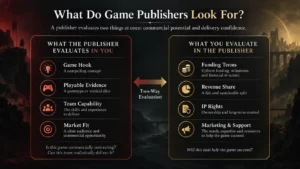
A Clear Game Hook
The publisher should be able to understand why the game deserves attention.
That may come from its gameplay, art direction, IP, technology, genre positioning, community appeal, or an unusual mechanic.
A pitch that takes too long to explain what makes the product interesting is already carrying extra risk.
Playable Evidence
A concept document communicates intention.
A playable build communicates reality.
Publishers will often want enough playable evidence to judge the core loop, quality bar, production direction, and major risks.
That does not necessarily mean a fully polished demo.
Depending on the stage of the project, a strong prototype or vertical slice may be enough to make the important parts concrete.
Audience and Market Positioning
Who is the game for?
What else do those players currently play?
Which platforms matter?
Why would this title attract attention in that market?
A publisher needs more than a broad demographic such as “players aged 18-35.”
The stronger pitch explains what kind of player is likely to care about the game and why.
Monetization and Commercial Model
Publishers also need to understand how revenue is expected to work.
For a premium game, that may involve pricing, expected sales, DLC potential, and discount strategy.
For a free-to-play title, the discussion may include IAP, advertising, subscriptions, passes, economy structure, and LiveOps.
What matters is showing that the commercial model fits the product and that the underlying assumptions are credible.
Team Capability and Production Readiness
Publishers care more about execution capability than raw headcount. They want to know whether the people responsible for the project can execute it.
Useful evidence can include relevant shipped work, specialist experience, current team composition, technical capability, production leadership, external dependencies, and known hiring requirements.
A smaller team with the right experience can present less risk than a much larger team without clear ownership.
Budget, Milestones, and Funding Requirements
A publisher needs to understand how much development remains, what it will cost, when major milestones occur, what funding is being requested, and how the budget connects to the production plan.
The schedule should leave room for testing, certification, marketing preparation, localization, and other release dependencies rather than treating “content complete” as the same thing as “ready to launch.”
IP and Rights
You should be able to explain what you actually own.
That includes relevant source code, characters, artwork, trademarks, music, licensed technology, and third-party assets.
Any unresolved ownership or licensing issue can become a serious problem once a publisher begins due diligence.
What Should You Evaluate in a Game Publisher and Publishing Deal?
A publishing deal is a two-way evaluation. You are deciding whether to give another company commercial rights, revenue participation, influence over the product, or all three.
Evaluate the publisher just as carefully.
Funding and Recoupment
If the publisher is funding development or marketing, understand how that money is treated.
Clarify:
- what is recoupable;
- which revenue is used for recoupment;
- the order in which costs are recovered;
- whether marketing expenditure is recoupable;
- whether additional spending can be added without your approval.
The recoupment structure often matters more to the economics of the deal than the headline advance.
Revenue Share
Understand exactly how revenue is divided after applicable platform deductions, taxes, refunds, recoupment, or other contractually defined costs.
A revenue-share percentage means little until you know what that percentage is applied to.
Marketing Commitments
“Publisher will market the game” is not a useful commitment by itself.
Clarify what the publisher plans to do, what budget is committed, who creates marketing assets, who manages PR and creators, and what happens if the marketing plan changes.
A well-known publisher with no meaningful commitment to your particular title may provide less value than the brand name suggests.
IP, Sequel, and Franchise Rights
Determine who owns the underlying IP and what rights the publisher receives.
Look beyond the first game.
The agreement may address sequels, expansions, spin-offs, adaptations, merchandising, ports, or future titles.
Those provisions can matter long after the original development budget has been recouped.
Platforms, Territories, and Term
A publisher may receive rights only for certain platforms or regions, or it may request broader control.
Know where the agreement applies, which platforms are covered, how long the rights last, and what happens when the agreement ends.
Avoid granting rights the publisher does not actually need to perform its role.
Milestones and Approval Rights
If funding is tied to milestones, understand exactly how those milestones are accepted.
Vague acceptance criteria can create disputes over quality, scope, payment, and schedule.
The same applies to creative approvals.
Know which decisions require publisher approval and which remain with the development team.
Reporting, Payment, and Termination
The less exciting clauses often become the most important when something goes wrong.
The agreement should clearly address sales reporting, payment timing, audit rights, breach, missed milestones, termination, and what happens to distribution rights when the relationship ends.
Publishing agreements can materially affect IP and long-term revenue, so appropriate legal review should happen before signing.
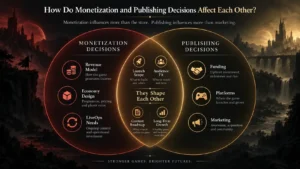
How Do Monetization and Publishing Decisions Affect Each Other?
This is where the two subjects meet.
A monetization decision changes more than the store.
A publishing decision changes more than marketing.
The Revenue Model Can Change the Production Plan
A premium single-player game may be largely complete at launch.
A free-to-play live game may require economy management, analytics, segmentation, store tooling, event systems, remote configuration, ongoing content, and LiveOps.
Those are development and operating costs, not simply monetization features.
Platform Choice Can Affect Monetization
Different platforms have different player expectations, purchase systems, technical requirements, and commercial rules.
The business model therefore has to work in the environment where the game will actually be sold and played.
Publisher Strategy Can Affect Pricing and Revenue Design
A publisher may bring experience with pricing, regional strategy, storefront discounts, launch timing, DLC, live-service models, or user acquisition.
That input can be valuable, but commercial recommendations still need to fit the game’s design and audience.
A Live-Service Model Changes the Funding Requirement
A live game needs money after launch.
Servers, content, balancing, QA, community operations, analytics, and releases create an ongoing operating requirement.
That affects how much capital the project needs and therefore what type of publishing or financing arrangement may make sense.
How Are Game Monetization and Publishing Evolving?
The useful shifts are not limited to individual technologies. They are changing how games are operated and brought to market.
Hybrid Monetization Is Becoming More Deliberate
More games combine compatible revenue streams instead of relying on one.
But mature hybrid monetization is not simply “add ads, purchases, subscriptions, and a pass.”
It is about designing different commercial paths that make sense for different player behaviors without forcing every monetization mechanic on everyone.
LiveOps Connects Monetization With Retention
For games designed to operate over time, monetization increasingly interacts with events, progression, economy tuning, offers, segmentation, and recurring content.
The game becomes an operated product rather than a fixed release.
For a deeper look at how events, economy tuning, segmentation, and recurring content support monetization after launch, see our guide to LiveOps and game monetization.
Decisions Are Becoming More Data-Informed
A monetization model should not remain unchanged simply because it appeared in the original design document.
Teams can evaluate player progression, offer performance, spending behavior, retention, ad engagement, and content participation.
The objective is controlled iteration.
Changing the economy every week because one dashboard moved is not strategy. Neither is ignoring clear evidence because the original plan said otherwise.
Distribution Strategy Is Broader Than One Store
Publishing strategy increasingly means choosing the right combination of platforms, storefronts, regions, communities, and launch channels for the specific game.
Every additional distribution channel needs to justify the work it creates. Each platform can introduce technical work, certification or review, store operations, support, and marketing requirements.
The route to market deserves the same discipline as the engine or monetization model.
A Pre-Launch Monetization and Publishing Checklist
Before the project moves too far into production, you should be able to answer these questions:
| Decision | What Should Be Clear |
|---|---|
| Primary Revenue Model | What generates revenue first? |
| Player Value | What are players paying for, and why is it valuable? |
| Fairness | Can monetization affect competition or progression in harmful ways? |
| Platform Fit | Does the model fit the target storefronts and player expectations? |
| Content Cadence | Can the team sustain subscriptions, passes, DLC, or LiveOps? |
| Measurement | Which metrics determine whether the model is working? |
| Publishing Route | Self-publishing or external publisher? |
| Funding | What capital is needed through launch and after launch? |
| Publisher Terms | What rights, revenue, and control are being exchanged? |
| IP | Who owns the game and the assets required to ship it? |
Some questions can remain open early in production. But the team should know which questions are settled and which still need validation.
Final Thoughts
Game monetization and publishing should not be treated as decisions for the week before release.
The revenue model can affect progression, economy, analytics, backend architecture, content production, and LiveOps.
The publishing route can affect funding, timelines, platforms, marketing, rights, and commercial control.
When those decisions are made early enough, they can support the game rather than forcing the game to adapt around them later. A game monetization strategy built alongside the publishing plan, rather than after it, is what makes that possible.
If you are still shaping the production plan, Red Apple Technologies can support the broader process from discovery and playable validation through engineering, art, QA, release preparation, and post-launch operations. Explore game development.
The Author

Related Blogs
Discover more stories & insights that inspire
A good-looking game can still fail to hold a player’s attention if its mechanics are unclear, progression feels unrewarding, or levels become frustrating for the wrong reasons. Game design goes...
Despite occupying second position after China, the USA still manages to be a superpower in the global game industry. Whether game development or game publishing, the USA continues to shine...

Italy has quietly developed into one of Europe’s most creative mobile game development ecosystems. While the country may not match the scale of mobile gaming markets like the United States...
The UAE — particularly Dubai and Abu Dhabi — has rapidly evolved into one of the Middle East’s most ambitious gaming hubs. Backed by government-led initiatives, global investment, and major...
Turkey has become one of the fastest-growing mobile gaming ecosystems in Europe. Over the past decade, mobile game developers in Turkey have produced globally successful casual and hyper-casual titles, attracted...
Game development followed a familiar pattern for decades: build everything in-house or outsource isolated tasks when schedules slipped. That model has been quietly changing. It’s 2026, and while a section...

At some point, most gamers have said, just a few more minutes, only to discover that hours have passed without noticing. That isn’t a mere distraction; it’s a reflection of...

You’re reading this because 2026 isn’t just another year in gaming; it’s the tipping point where AI rewrites pipelines, cloud erases hardware barriers, and player creators become your most profitable...
With rising investments, game development has evolved into a profitable business alternative worldwide. Be it startups, agencies, Fortune 500 organizations, or angel investors, everyone is keen to join this creative...
Hiring a game development company is rarely just about building a game. For startups, it determines whether an idea reaches the market before resources run out. For enterprises, it determines...


 Book An Appointment
 WhatsApp