


- Blog
- >
- Game Development
- >
- Mobile Game Development
- >
- Mobile Game Development Costs...
Mobile Game Development Costs and Market Fit in 2026
Mobile games are no longer just a mere pastime. They have evolved into a major economic power hub across the globe. Whether startups, agencies, or enterprises, investment in mobile game development is on the rise. It has resulted in a stunning improvement in the quality of games. This covers flexible gameplay features, captivating visuals, next-gen tech integration, and unique storylines. As a result, people are becoming more attracted to playing mobile games over a longer session.
In 2033, the global size of the mobile game sector is projected to reach the value of $359.81 billion. Today, it stands at a figure of $144.12 billion. It reflects immense possibilities for businesses that want to invest in mobile gaming. But to achieve success and growth in this sector, they should seek help from an experienced game development company. Apart from conceiving unique ideas to build mobile games, it will also allow them to cover the costs of mobile game development efficiently.
At present, when building a top-quality game, you need to have enough budget at your disposal. It is because to create a mobile game app, you will come across numerous factors that ultimately determine your overall project cost. In this blog, we will guide you in identifying these vital factors to ensure your solid brand presence in mobile gaming.
What Influences Your Cost of Mobile Game Development
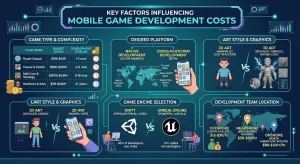
In a mobile game project, several factors impact your project budget. This includes:
Game Type
When working on a mobile gaming project, you need to decide its category in advance. This often plays a crucial role in deciding your mobile game development costs in 2026. At the same time, it also allows you to engage the most sought-after user base. This eventually widens your revenue-growth possibility.
| Game Genre | Budget Range (Approx) | Development Timeline (Approx) |
|---|---|---|
| Hyper-Casual Games | $15,000-$40,000 | 1-2 months |
| Casual & Puzzle Games | $60,000-$250,000 | 4-8 months |
| Mid-Core & Strategy Games | $300,000-$1,500,000+ | 8-18 months |
| Hardcore & AAA Games | $3,000,000-$20,000,000+ | 2+years |
Desired Platform
You also need to decide whether you want to build your game for a specific platform, such as Android or iOS, or for both.
In addition to native development, cross-platform game development is also emerging as a lucrative option for businesses worldwide. It enables them to build and launch their games targeting multiple devices and OS. This increases their market and audience reach.
Region-wise, the Data Insights Market provides the current market share of cross-platform gaming. You should take a good look. It will widen your prospects in mobile game development.
- North America- 35%
- Europe-28%
- Asia-Pacific- 25%
- Rest of the World- 12%
Building a robust and scalable cross–platform game requires in-depth expertise and skills. Hence, it will be worth seeking assistance from a recognized mobile game development company. This will also let you understand why the popularity of cross-platform games is growing over time.
Art Style
2D games often come with a minimalist design where you do not have to craft characters and environments with minute details and realism. As such, your budget for 2D art in game development hardly exceeds.
However, in 3D game art, you have to concentrate on the detailed portrayal of characters, environments, and objects. It involves processes like modeling, sculpting, UV mapping, texturing, rigging, animation, lighting, and rendering. It ultimately raises your project cost.
Game Engine Selection
As the project owner, you need to decide whether to use Unity or Unreal for game development. Right now, 60% of game developers are using the Unity game engine. Whereas 55% of game developers utilize Unreal Engine in game development.
Hence, to use the ideal game engine for your project, consulting a recognized game development agency like Red Apple Technologies will be very useful. It will also allow you to make a wise decision between Unity vs Unreal to build a successful game app.
Development Team Location
The geographic location of your development team significantly impacts the overall project budget. Offshore development teams in regions such as South Asia typically charge between $15–$30 per hour. No doubt, it makes them a cost-effective option for many studios.
Whereas, nearshore teams, located in neighboring or nearby countries, usually range from $30–$60 per hour. On the other hand, when you choose onshore teams in North America or Western Europe, the cost may exceed $80–$150 per hour.
Selecting the right outsourcing model depends on your budget, communication preferences, and project complexity. Partnering with an experienced mobile game development company like Red Apple Technologies can be fruitful. It helps to ensure reliable delivery, improved productivity, and high-quality outcomes through structured workflows and dedicated expertise.
How to Make Your Mobile Game Market Fit in 2026
As competition in the mobile game sector is intensifying, you have to deploy impactful steps that will raise your dividends and returns after the release of your game. To do so efficiently, our blog is going to offer you some useful insights. This includes:
Focus on Customized Experience
This involves adding AI-driven non-player characters, designing tailored gameplay levels, crafting personalized features, monetization, and beyond. It will automatically increase your game’s popularity and relevance among next-gen players.
Encourage User-Generated Content
As players are devoting time and effort to playing your games, it is your responsibility as the game owner to make their gameplay experience more exciting. For that, you should allow them to add and create unique content to your game platform. Besides ensuring community-building, it will result in your game’s quality over time.
In return, you need to acknowledge their contributions with profile badges and ratings. Presently, adding user-generated content is evolving into a spectacular trend. According to Guillaume Carmona, “User-generated content is transforming games from defined experiences into evolving, community-driven platforms.”
Introduce Hybrid Monetization
After your game is launched, you should not deploy a single revenue model. Instead, you should introduce two or more revenue models. For instance, you can combine the monetization model of in-app purchases with advertisements and time-bound offers. It will allow your game to retain more players and eventually ensure a surplus revenue growth.
According to the App Samurai report, 72% of game developers are adopting hybrid monetization strategies. The report also mentions that the implementation of the hybrid monetization model in hyper-casual game titles has resulted in a surge of ARPU by 28%.
Run Frequent Updates
As a game owner, you should not be complacent even when your game’s performance is satisfactory. Instead, you should focus on adding new content and feature updates through LiveOps under the guidance of an experienced mobile game development company. Right now, 95% of developers are using the LiveOps model. It is helping them to boost revenue generation through in-app purchase by 10%.
Next-Gen Technologies that are Reshaping the Standard of Mobile Gaming
Artificial Intelligence (AI)
The utilization of this cutting-edge technology in game development is increasing with each passing time. Right now, AI investment in the game industry has touched the mark of $7.05 billion. In 2034, it is forecasted to reach a figure of $37.89 billion.
Leveraging AI, you perform tasks like procedural content generation, smart NPC creation, analyze real-time player behaviours, and deliver a safe and transparent in-game environment.
Ubisoft, a leading game studio, has efficiently harnessed the potential of AI to test its games like Watch Dogs and Assassin’s Creed to detect and eliminate bugs. Similarly, another game studio, NetEase, has used the power of AI in crafting non-player characters that can interact with players naturally based on past performances and gameplay styles.
Blockchain
With the introduction of Blockchain in gaming, players are also emerging as creators to shape the quality of gaming. They also have the privilege to add in-game assets like characters, skins, features, and costumes in blockchain-based games to showcase their creativity and innovative potential. Presently, the market size of Blockchain gaming has reached the market size of $154.46 billion. In 2030, it is expected to touch the margin of $614.91 billion.
Blockchain has gained significant visibility in Web3 games like Axie Infinity, Gods Unchained, Axie Infinity, Mythereum, and beyond. In the Decentraland game, Blockchain enables gamers to build, purchase, and exchange virtual lands as genuine owners. While in Axie Infinity, players can collect and breed mall creatures that are known as Axies. The game is developed on the Etherium platform and permits players to trade these Axies to gain a sense of accomplishment with substantial revenue generation.
AR & VR
Initially, you had to keep your eyes on the screen of a smartphone or laptop to play your favorite game. But with the introduction of these 3D immersive technologies, you are getting a beyond-the-screen gaming experience with captivating visuals. While Augmented Reality (AR) allows you to expand your gameplay pleasure from screen to the real-world environment, Virtual Reality (VR) allows you to experience the digital world of gaming through simulation.
In the Pokémon Go game, AR allows players to chase and capture Pokémon with their natural surroundings. While in the VR games like Half-Life: Alyx, players are perceived to penetrate deeper into the world of imagination and fantasies.
Release Successful Mobile Games with Red Apple Technologies
Our presence in the mobile gaming industry is over 15+ years. At Red Apple Technologies, we not only develop games but also create memorable experiences with a fine blend of imagination and development tools like Unity, Unreal, and HTML5. It is our responsibility to ensure that you gain success and growth in the mobile game segment. For that, we provide you with advantages like:
Player-Centric Design
In mobile game development, player comfort is always our top priority. Hence, we focus on integrating an intuitive and simple UI/UX design. It will enable your players to understand the game rules easily. This will also motivate them to compete and engage with your gameplay levels smoothly.
Cross-Platform Development
Our game developers make sure that your games receive maximum players and installations across the globe. So, they efficiently harness the ability of game engines like Unity and Unreal. This empowers them to build games that run flawlessly across Android, iOS, Linux, etc., without affecting the end-user experience.
Porting Solutions
As competition in the mobile game industry is increasing every day, we make sure that clients have the option to port their existing and high-performing games to mobile platforms from PC and other devices. Our porting solutions are based on absolute precaution and perfection to ensure that your game runs smoothly on the mobile devices of distinct screen sizes.
Post-launch Support
Our task is not finished by launching your game. We are also specialized in offering post-launch maintenance solutions like debugging, version updates, feature enhancement, performance optimization, and much more to enhance the relevancy and popularity of your mobile games among next-gen players.
Closing Statement
When you are developing mobile games, it is important that you select the right genre, technology stack, and monetization models. For assistance, you can connect with the enterprising team of Red Technologies. They will provide you with end-to-end assistance to add value to your mobile game idea with increased returns. It shall also let you hire mobile game developers of immense expertise and skills to ensure the desired outcome.

Published by
Arup RoyTable of Contents

Related Blogs
Discover more stories & insights that inspire
A mobile game portfolio can look impressive without telling you much about the work behind it. One company may have built an Android and iOS game from concept to launch....
Two game studios can show equally polished portfolios and still create very different production risk. The difference often becomes visible only after you look beyond the showreel: who will actually...
The wrong partner doesn’t fail your project on day one. It fails itself slowly through delays, compliance gaps, and missed market windows. In the iGaming industry, your technology partner is...

A $100 billion market. Millions of bets placed every minute. And most new operators still get the cost wrong. Not because the opportunity isn’t real, but because they underestimate the...
As the third-largest market in Europe, France is gradually making its presence felt in the global game industry. With over 500 million game studios and a vibrant gaming population of...
Singapore is fast evolving into the global gaming landscape. As a prominent game development destination, the country is attracting investors, startups, and businesses of all sizes. Already, this Asian country...
Italy has quietly developed into one of Europe’s most creative mobile game development ecosystems. While the country may not match the scale of mobile gaming markets like the United States...
South Korea is one of the most advanced gaming ecosystems in the world. With high-speed 5G infrastructure, strong government support for immersive technology, and a deeply rooted competitive gaming culture,...
Turkey has become one of the fastest-growing mobile gaming ecosystems in Europe. Over the past decade, mobile game developers in Turkey have produced globally successful casual and hyper-casual titles, attracted...
Spain has established itself as one of Europe’s most active mobile game development markets. With internationally successful studios, experienced live-operations teams, and competitive production structures, the country continues to attract...


 Book An Appointment
 WhatsApp