


- Blog
- >
- AI in Education
- >
- AI in Education: Customized...
AI in Education: Customized Learning Powered by Intelligent Systems
Artificial Intelligence (AI) is ushering in a new era of personalized learning, efficient administration, and empowered educators. By now, AI-powered tools have become essential in classrooms globally, from K-12 to higher education and corporate training, nearly reestablishing the way knowledge is delivered, assessed, and expanded. For investors and education leaders, the impact of generative AI in education signals tremendous growth potential in a sector vital to the future workforce and society.
The Growing Role of AI in Education
The education sector has historically been slow to adopt new technologies, but AI’s promise to customize learning experiences and automate monotonous tasks has accelerated its uptake. Intelligent educational platforms analyze individual student data, including skill level, learning pace, and engagement patterns, to tailor instructions that maximize comprehension and retention.
Market research forecasts that global AI in education will surpass $32.7 billion by 2030, growing at a compound annual growth rate (CAGR) of over 31.2% from 2025. The surge is driven by increasing adoption in developing nations, demand for remote learning solutions, and a growing emphasis on skills training for evolving job markets.
Key AI Applications in Education
Personalized Learning Experiences
Perhaps the most impactful application of AI in education is personalized learning. Adaptive learning platforms such as Knewton, Duolingo, and DreamBox adjust content in real-time based on learner interactions, helping students learn at their own pace. These systems analyze student strengths and weaknesses, offering targeted practice problems or explanations to address knowledge gaps.
Research shows personalized learning improves engagement, with students retaining information significantly better than traditional one-size-fits-all models. In some districts, AI-powered platforms have increased graduation rates by up to 15%, demonstrating measurable outcomes.
Intelligent Tutoring Systems
AI tutors serve as on-demand, scalable teaching assistants that supplement classroom instruction. These systems provide immediate feedback, answer questions, and encourage mastery before moving on. Carnegie Learning’s MATHia is a top example where AI adapts to student needs, providing dynamic prompts and hints in real time.
Such tutors are particularly valuable in overcrowded classrooms or remote regions where human teachers are scarce, enabling universal access to high-quality education.
Automated Grading and Assessment
Grading tasks can consume up to 30% of teachers’ time, and AI dramatically reduces this burden. Tools like Gradescope and Turnitin use natural language processing (NLP) to grade essays, short answers, and coding assignments with reliable accuracy. This automation not only saves time but ensures consistent, unbiased evaluation and faster feedback to students, improving learning cycles, while demonstrating the impact of AI in education Industry.
Enhanced Content Creation and Curriculum Development
AI assists educators in creating and updating course material, quizzes, and syllabi aligned with student needs and current knowledge trends. Content generation AI helps to automate tedious curriculum updates, increasing teacher productivity and relevance of teaching resources.
Administrative Automation
Beyond teaching, AI optimizes institutional operations such as scheduling, admissions, resource allocation, and even predictive analytics for student dropout prevention. Automated systems free educators and administrators to focus on instruction and student support rather than paperwork.
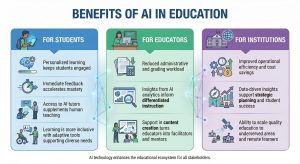
Benefits of AI in Education
For Students
- Personalized learning keeps students engaged
- Immediate feedback accelerates mastery
- Access to AI tutors supplements human teaching
- Learning is more inclusive with adaptive tools supporting diverse needs
For Educators
- Reduced administrative and grading workload
- Insights from AI analytics inform differentiated instruction
- Support in content creation turns educators into facilitators and mentors
For Institutions
- Improved operational efficiency and cost savings
- Data-driven insights support strategic planning and student success
- Ability to scale quality education to underserved areas and remote learners
Challenges and Ethical Considerations
Despite its potential, AI in education faces challenges:
- Data privacy: Protecting sensitive student data is paramount.
- Algorithmic bias: AI must be developed to avoid reinforcing inequalities.
- Teacher roles: Balancing AI automation with maintaining human interaction and pedagogy.
- Access disparities: Ensuring AI tools are available broadly and fairly.
Addressing these requires transparency, ethics frameworks, and inclusive design, which many leading companies and policymakers now prioritize.
Real-World Impact and Case Studies
Knewton’s Adaptive Learning Platform
Knewton has delivered over a billion personalized recommendations worldwide, improving student performance and engagement. The platform’s ability to tailor lessons has been shown to close achievement gaps significantly in under-resourced schools.
Carnegie Learning’s AI Tutor
Carnegie’s MATHia program offers real-time, personalized assistance and uses data analytics to guide instructional decisions, resulting in measurable improvements in math proficiency nationwide.
Gradescope’s AI Grading
Gradescope’s automated grading solutions reduce educator workload and standardize evaluation across thousands of students, speeding up feedback cycles while maintaining grading reliability.
Investing in AI for Education: Why Now?
Education is foundational to economic growth and social development. AI’s ability to revolutionize learning experiences, improve outcomes, and lower costs presents compelling investment opportunities, and you must focus on AI-powered education app development not just for ROI but also to make learning easy, fun, and accessible. Key driving factors include:
- Rapid AI tech advances and cloud accessibility
- Increased governmental and institutional funding
- Growing demand for lifelong learning and upskilling
- Expansion of remote and hybrid education models worldwide
Early investment in innovative startups and platforms poised to scale can capture significant market share and influence the future of education.
Advance AI-Driven Education with Red Apple Technologies
We are a leading app development company, and we have established ourselves as an innovator in AI-powered education solutions, dedicated to transforming how students learn and educators teach. Leveraging adaptive learning platforms, intelligent tutoring systems, and smart assessment tools, Red Apple Technologies partners with schools, universities, and education providers to deliver personalized, data-driven learning experiences. Our commitment to ethical AI, data privacy, and educator empowerment makes us a trusted partner for institutions seeking meaningful, scalable, and future-ready educational impact.
Conclusion
Artificial Intelligence offers an unprecedented opportunity to reshape education—making it personalized, efficient, and more accessible globally. AI tools are already demonstrating significant impacts on student success, teacher empowerment, and institutional operations.
For investors, the expanding AI education market presents a high-growth, socially impactful sector. Supporting ethical, innovative AI education technologies not only promises strong returns but also contributes to building a smarter, more equitable future.
To Have A Better Understanding On This Let us Answer The Following Questions
Answer:
- Personalized learning platforms that adapt to individual student needs
- Intelligent tutoring systems providing real-time feedback and support
- Automated grading and assessment tools improving efficiency
- AI-driven administrative automation reducing operational costs
- Content creation and curriculum development powered by AI
Answer: AI education startups stand out by leveraging machine learning and predictive analytics to personalize learning dynamically, rather than offering static content. They enable continuous adaptation to student progress, provide real-time insights for educators, and automate administrative tasks, thereby improving personalization, efficiency, and scalability far beyond traditional one-size-fits-all models.
Answer:
- Limited digital infrastructure and uneven access, especially in under-resourced areas
- Concerns over data privacy and regulatory compliance (FERPA, GDPR)
- Resistance from educators wary of technology replacing human roles
- High initial investment costs and integration challenges with legacy systems
- Need for ongoing training and support to maximize AI tool effectiveness
Answer: Regulatory requirements around student data privacy and security shape the design and deployment of AI education products. Compliance with laws like FERPA in the US and GDPR in Europe mandates strict data handling, consent management, and transparency, influencing both product features and market access strategies. Investors must consider companies’ ability to navigate these evolving regulations to mitigate legal and reputational risks.
Answer:
- Acquisition by major education companies or technology giants seeking AI capabilities
- Strategic partnerships and joint ventures expanding market reach and product integration
- Initial Public Offerings (IPOs) following significant scale and revenue growth
- Mergers with complementary edtech firms to broaden offerings and customer base

Related Blogs
Discover more stories & insights that inspire
Right now, finding an AI development company feels a little like walking into a crowded market where everyone is claiming to have the “next big thing.” Every agency talks about...
From science fiction to our daily assistant, artificial intelligence (AI) has become part of our lives faster than we imagined. A few years ago, businesses discussed AI cautiously. Today, it...

In the past few years, San Francisco has become the center of the modern AI economy, not just because major AI companies are headquartered there but because the city has...
Artificial Intelligence (AI) is literally the powerhouse in every market, including stocks. Today’s lightning-fast stock markets were in much need of innovation for trading activities. In just a few years,...
The real estate industry, once driven by intuition and manual processes, is now undergoing a powerful digital transformation, and Artificial Intelligence is at the heart of it. From predicting property...

Esports is the market. It is a multi-billion-dollar global industry, drawing millions of viewers and fostering an elite competitive talent pool across a wide variety of games. As esports matures,...
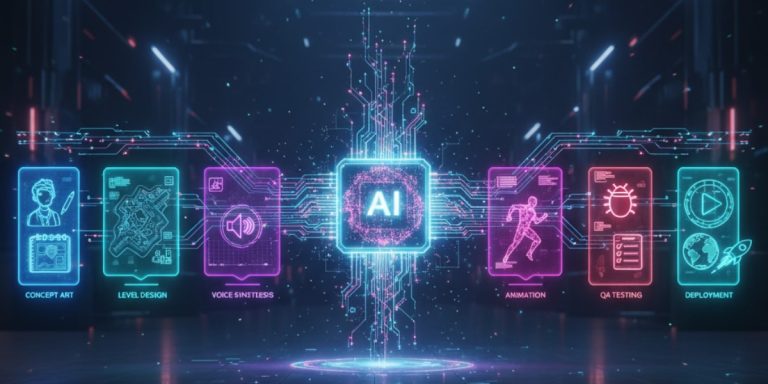
Artificial Intelligence (is becoming) has become the backbone of modern game development and player experience. If you don’t think so, you’re fighting a losing battle. Sure, AI has been in...

Do you remember Orkut, Myspace, and Friendster? Some of the most popular social platforms of the 2000s. It was all about adding friends, sending messages, and staying connected—ahh! The golden...

By now, we all know that AI is fundamentally transforming everything around us, and the retail and e-commerce landscape are among the primary ones to experience it, driving hyper-personalization, automation,...

Just like every other industry, the automotive market is experiencing a boom in AI-powered vehicles. From understanding the possibilities of automated driving to predictive maintenance, what was once science fiction...


 Book An Appointment
 WhatsApp