


- Blog
- >
- AI in Real Estate
- >
- AI in Real Estate:...
AI in Real Estate: Smarter Property Search and Investment Insights
The real estate industry, once driven by intuition and manual processes, is now undergoing a powerful digital transformation, and Artificial Intelligence is at the heart of it. From predicting property values with uncanny accuracy to personalizing buyer experiences and streamlining property management, AI is redefining how we buy, sell, and invest in real estate. What was once a paper-heavy, instinct-led business is rapidly becoming a data-powered ecosystem of smarter decisions and seamless automation.
Let’s check out how you can integrate AI in real estate industry value chain, dive into breakthrough technologies and startups, and also understand why this dynamic sector offers immense potential for investors today.
Real estate has traditionally relied on human intuition, market experience, and manual data analysis. However, AI is automating these processes by harnessing vast datasets and sophisticated machine learning models. AI algorithms analyze historical sales data, economic indicators, demographic trends, geospatial data, and consumer behavior to generate precise, real-time predictions and personalized experiences.
This data-driven approach is enhancing decision-making, reducing risk, and accelerating transactions, thereby increasing returns and expanding access to capital.
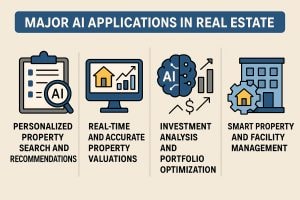
Major AI Applications in Real Estate
Personalized Property Search and Recommendations
Modern buyers and renters demand faster, more accurate matches to their unique preferences. AI-powered platforms learn from user behavior, location preferences, price sensitivity, and lifestyle choices to generate personalized property recommendations. This tailored approach shortens search cycles and boosts client satisfaction.
For instance, AI chatbots can engage users with conversational search experiences, ask clarifying questions, and quickly surface ideal listings, transforming the property discovery journey.
Real-Time and Accurate Property Valuations
Valuation has always been the cornerstone of real estate transactions. The use of AI in real estate integrates diverse data sources (from housing sales, neighborhood trends, renovation records, to macroeconomic factors) to calculate property values with remarkable accuracy. These valuations constantly update in real time as new data emerges, supporting transparency and trust.
Machine learning reduces human bias seen in traditional appraisals, providing investors with objective metrics crucial to pricing, acquisition, and refinancing decisions.
Investment Analysis and Portfolio Optimization
Investment in real estate demands sound risk assessment and opportunity identification. AI tools analyze complex variables, including local economic forecasts, zoning changes, infrastructure developments, and tenant analytics to identify undervalued properties or emerging hotspots.
Portfolio managers leverage AI forecasts to optimize asset mixes, rebalance holdings, and predict cash flow disruptions. This enables more strategic capital allocation and long-term value creation.
AI-Driven Marketing and Customer Engagement
AI transforms how properties are marketed. Hire AI expert for automation real estate to create virtual tours and 3D imaging that invites remote buyers into lifelike digital experiences. AI-powered virtual assistants field inquiries, prequalify leads, and schedule visits 24/7, enhancing engagement and conversion.
Sentiment analysis on social media and consumer reviews informs branding strategies, while predictive models tailor marketing campaigns to high-potential targets, maximizing ROI.
Smart Property and Facility Management
Operational efficiency is critical in property management. AI powers predictive maintenance by monitoring equipment health and usage patterns, reducing downtime and costs. Intelligent scheduling optimizes resource allocation for cleaning, repairs, and tenant services.
AI analytics on tenant behavior improve retention strategies and personalize services, boosting satisfaction and lifetime value.
Market Growth and Investment Opportunities
The AI in real estate market size is projected to exceed $300 billion in recent years, fueled by the rapid adoption of AI-driven analytics, virtual reality, and automation tools. PropTech firms integrating AI modules have attracted record venture funding rounds and strategic partnerships with traditional real estate players.
Emerging trends such as generative AI for deal structuring, robotic process automation for paperwork, and blockchain for smart contracts promise to further revolutionize the sector.
For investors, three areas hold particular promise:
- AI analytics platforms enabling smarter, scalable decisions
- AI-powered property management SaaS improving operational margins
- AI-enhanced marketing and customer engagement tools accelerating sales velocity
Leading Companies and Case Studies
Skyline AI
Skyline AI uses proprietary deep learning models to analyze billions of data points, forecasting real estate asset values and market trends with high accuracy. Its platform aids institutional investors in portfolio optimization, risk management, and identifying new investment opportunities.
Matterport
Matterport provides AI-driven 3D virtual tours and digital twin creation, enabling immersive property walkthroughs accessible from anywhere in the world. These virtual experiences increase buyer confidence and reduce time on market.
Redfin
Redfin adopts AI to personalize property recommendations, optimize search algorithms, and power virtual assistants. Their AI models predict market hotspots and timing, providing a competitive edge to agents and investors alike.
Pioneering AI Solutions in Real Estate
Red Apple Technologies is at the forefront of AI app development services that revolutionize real estate operations and investment strategies. With cutting-edge AI-powered platforms, we deliver advanced property analytics, automated valuation models, and intelligent portfolio management tools designed to empower investors, agents, and property managers.
Our solutions leverage big data, machine learning, and predictive analytics to create actionable insights that optimize acquisitions, improve asset management, and enhance customer experiences. Committed to transparency, data privacy, and innovation, we partner with leading real estate stakeholders to drive smarter decisions and sustainable growth in this rapidly evolving market.
Challenges and Considerations
Despite the benefits, AI adoption in real estate faces several challenges:
- Data Privacy and Security: Handling sensitive personal and financial data requires strong governance and compliance with regulations like GDPR and CCPA.
- Integration with Legacy Systems: Many real estate firms operate with outdated systems, making AI integration complex and costly.
- Bias and Transparency: Ensuring AI algorithms are free from bias and provide explainable results is critical to adoption.
- Talent and Expertise: There is a shortage of professionals skilled in real estate and AI, complicating solution development and deployment.
Addressing these challenges effectively determines the pace and success of AI adoption in real estate.
Conclusion: AI as a Catalyst for Real Estate Innovation
The integration of AI into real estate represents a paradigm shift that boosts transparency, agility, and profitability across the value chain. For investors who hire app developers specializing in this new technological advancement, you are at the forefront, as AI unlocks new ways to identify undervalued assets, optimize investment portfolios, engage buyers, and manage properties efficiently.
Embracing AI technology today positions stakeholders to capitalize on growing digital trends and industry modernization. The future of real estate is intelligent, data-driven, and profoundly interconnected with AI at its core.
To Have A Better Understanding On This Let us Answer The Following Questions
What sub-sectors within real estate show the highest ROI potential from AI adoption?
Answer:
- Lodging and resorts: Over 15% improvement in operating cash flows due to AI-driven labor automation and operational efficiencies.
- Brokers and services: Potential 34% increase in operating cash flows, leveraging generative AI tools for productivity and enhanced transactions.
- Healthcare REITs: Growing AI adoption for managing complex healthcare properties and optimizing services.
These sectors benefit from strong labor cost savings, revenue opportunities, and advanced data-driven decision-making.
Answer: AI automates around 37% of tasks in real estate, leading to significant operational efficiencies worth billions. This can lead to job transformation and some displacement, which creates risks such as potential decreases in demand for certain spaces like offices or lodging if unemployment rises. However, AI-driven productivity gains may also create new jobs and increase overall labor demand, balancing risks and opportunities.
Answer:
- Legacy systems and data silos are making AI integration complex and costly.
- Data quality and consistency issues are hindering accurate AI forecasting.
- Need for skilled professionals who understand both real estate and AI technologies.
- Organizational resistance to change and adopting new AI-enhanced workflows.
These factors can slow digital transformations and require careful governance and change management.
Answer: Predictive analytics use vast datasets and machine learning to forecast property values, market trends, and tenant behaviors with higher accuracy than traditional methods. This enables investors to optimize purchase timing, identify undervalued assets early, predict potential defaults, and structure portfolios to minimize risk exposure.
Answer:
- Acquisition by large real estate companies or tech firms expanding AI capabilities.
- Strategic partnerships allowing scaling and integration of AI tools into broader platforms.
- Initial Public Offerings (IPOs) after reaching sufficient market share and profitability.
Mergers with other PropTech firms to broaden product offerings and customer reach.
These exits provide multiple liquidity paths reflecting the industry’s consolidation and innovation trends.
Table of Contents

Related Blogs
Discover more stories & insights that inspire
Right now, finding an AI development company feels a little like walking into a crowded market where everyone is claiming to have the “next big thing.” Every agency talks about...
From science fiction to our daily assistant, artificial intelligence (AI) has become part of our lives faster than we imagined. A few years ago, businesses discussed AI cautiously. Today, it...

In the past few years, San Francisco has become the center of the modern AI economy, not just because major AI companies are headquartered there but because the city has...
Artificial Intelligence (AI) is literally the powerhouse in every market, including stocks. Today’s lightning-fast stock markets were in much need of innovation for trading activities. In just a few years,...

Artificial Intelligence (AI) is ushering in a new era of personalized learning, efficient administration, and empowered educators. By now, AI-powered tools have become essential in classrooms globally, from K-12 to...

Esports is the market. It is a multi-billion-dollar global industry, drawing millions of viewers and fostering an elite competitive talent pool across a wide variety of games. As esports matures,...

Artificial Intelligence (is becoming) has become the backbone of modern game development and player experience. If you don’t think so, you’re fighting a losing battle. Sure, AI has been in...

Do you remember Orkut, Myspace, and Friendster? Some of the most popular social platforms of the 2000s. It was all about adding friends, sending messages, and staying connected—ahh! The golden...

By now, we all know that AI is fundamentally transforming everything around us, and the retail and e-commerce landscape are among the primary ones to experience it, driving hyper-personalization, automation,...

Just like every other industry, the automotive market is experiencing a boom in AI-powered vehicles. From understanding the possibilities of automated driving to predictive maintenance, what was once science fiction...


 Book An Appointment
 WhatsApp