

- Blog
- >
- app development companies
- >
- How to Choose the...
How to Choose the Right AI Development Company
Right now, finding an AI development company feels a little like walking into a crowded market where everyone is claiming to have the “next big thing.”
Every agency talks about automation. Every company says they build intelligent systems. Every pitch deck sounds futuristic.
But once you move past the buzzwords, most businesses are really asking one simple question:
“Can this company actually help us solve a real business problem?”
Because that’s what matters.
Not flashy terminology. Not vague promises. Just results.
Don’t Start With AI. Start With the Problem.
This is where many businesses go wrong.
They begin by saying, “We need AI,” before clearly defining what they actually need help with.
Maybe customer support is becoming difficult to manage. Maybe forecasting is inconsistent. Maybe internal workflows are slowing the business down.
The best AI projects usually begin with an operational problem—not the technology itself.
A strong AI development agency for business will spend more time understanding your workflows and bottlenecks than trying to overwhelm you with technical language.
That’s usually a very good sign.
A Good AI Partner Should Make Things Simpler
One of the fastest ways to identify the wrong partner is this:
After speaking with them, do you feel more confused than before?
AI is complex, yes. But experienced companies know how to explain it clearly in business terms.
You should understand:
how the solution works, what problem it solves, and what kind of outcome is realistically possible.
If every conversation sounds like a research paper, communication may become a problem throughout the project, too.
And communication matters more than most businesses expect.
Industry Experience Makes a Huge Difference
AI implementation is never exactly the same across industries.
A retail company operates differently from a healthcare platform. A gaming business has very different requirements compared to a logistics company.
That’s why industry familiarity matters.
An experienced custom AI software company doesn’t just understand AI models. It understands the operational realities of your business environment—customer behavior, workflow structure, scalability concerns, and integration challenges.
That context often saves time, money, and unnecessary complexity later.
Be Careful With Generic AI Solutions
Some companies try to apply the same AI framework to every client.
That approach rarely works well long-term.
Every business has different systems, goals, and operational challenges. Your AI solution should fit naturally into your workflow rather than forcing your workflow to adapt around the software.
The best AI companies spend time understanding how your business actually operates before recommending tools or platforms.
That’s what makes customization valuable.
Scalability Should Be Discussed Early
A lot of AI systems perform well initially.
The real test comes later—when operations grow.
More customers. More data. More automation requirements.
Suddenly, the system that worked perfectly during the early stage begins slowing down or creating operational friction.
A strong AI technology partner plans for long-term scalability from the beginning. They think about infrastructure, future growth, performance optimization, and ongoing system refinement before deployment even starts.
Because AI is not really a short-term software installation anymore.
It becomes part of the business itself.
Ask Practical Questions
Some companies are excellent at talking about AI.
Fewer are excellent at implementing it inside real operational environments.
When evaluating an AI company, focus on practical experience:
Have they integrated AI into existing workflows before? How do they handle scaling? What happens after deployment? How do they optimize systems over time?
The strongest companies usually answer directly and clearly.
They don’t rely heavily on buzzwords to sound impressive.
Your Data Matters More Than Most Businesses Realize
This part often gets overlooked.
AI systems are only as effective as the data supporting them.
Even advanced AI models struggle when data is inconsistent, incomplete, or poorly integrated across systems.
A reliable best AI solutions provider will discuss your data infrastructure early in the process—not as a secondary consideration.
Because without a strong data foundation, the AI itself becomes far less useful.
Long-Term Support Is Extremely Important
One misconception businesses have is treating AI like traditional software that gets installed once and then left alone.
AI systems evolve continuously.
They improve through new data, usage patterns, optimization, and refinement.
That means the relationship with your development partner often continues well after launch.
This is one reason businesses work with experienced implementation-focused companies like Red Apple Technologies, which support organizations with scalable AI integration, workflow optimization, and long-term operational alignment.
The goal is not simply launching AI.
It’s making sure the system continues creating value over time.
Why Businesses Work With Red Apple Technologies for AI Development
Businesses adopting AI often face the same challenge: turning AI ideas into systems that actually improve operations.
That’s where Red Apple Technologies positions itself differently.
Instead of approaching AI as a standalone technology layer, the company focuses on integrating AI into real business workflows—helping organizations improve automation, operational efficiency, personalization, and long-term scalability.
Its expertise spans areas like:
AI-powered workflow automation, predictive analytics, intelligent engagement systems, operational optimization, and scalable software integration.
For businesses looking for a reliable AI technology partner, the focus is not just on building AI tools, but on ensuring those systems create measurable operational value over time.
The Cheapest Option Usually Costs More Later
AI development is one area where choosing solely based on cost often creates larger expenses later.
Poor implementation can lead to workflow inefficiencies, scalability problems, integration failures, and expensive redevelopment cycles.
A better question is not:
“Who is the cheapest?”
It’s:
“Who can help us build something sustainable?”
That’s usually where long-term value comes from.
You’re Choosing a Partner, Not Just a Vendor
This is probably the most important thing to remember.
When businesses adopt AI seriously, they’re not just purchasing software.
They’re choosing a long-term operational partner.
The right company should understand your business goals, operational challenges, growth plans, and customer expectations—not just the technical side of AI.
Because successful AI implementation is not only technical.
It’s strategic.
Final Thought
Choosing the right AI development company isn’t about finding the company using the most complicated technology.
It’s about finding a partner that understands how technology can improve your business in practical, scalable ways.
The best AI systems are often the ones that quietly make operations smoother, faster, and easier to grow over time.
And increasingly, those operational advantages are becoming difficult for competitors to catch up with.
To Have A Better Understanding On This Let us Answer The Following Questions
Answer: Start by evaluating whether the company understands your business goals—not just AI technology. A strong AI partner should have implementation experience, scalability expertise, and the ability to explain solutions clearly in operational terms.
Answer: An experienced AI development agency should help with strategy, workflow analysis, customization, system integration, scalability planning, and long-term optimization. The goal should be operational improvement, not simply software deployment.
Answer: Generic AI tools often fail to align with unique workflows, customer behavior, and operational requirements. Custom AI solutions allow businesses to build systems tailored specifically to their processes and long-term goals.
Answer: An AI technology partner helps businesses identify automation opportunities, integrate AI into existing systems, optimize workflows, and continuously improve performance as operations grow.
Answer: AI systems improve over time through data, optimization, and user behavior analysis. Long-term support ensures the system continues performing efficiently as business requirements evolve.
Answer: Yes. AI is no longer limited to large enterprises. Small and mid-sized businesses increasingly use AI to automate workflows, improve customer experiences, reduce operational inefficiencies, and scale more sustainably.

Published by
Arup Roy
Related Blogs
Discover more stories & insights that inspire
From science fiction to our daily assistant, artificial intelligence (AI) has become part of our lives faster than we imagined. A few years ago, businesses discussed AI cautiously. Today, it...

In the past few years, San Francisco has become the center of the modern AI economy, not just because major AI companies are headquartered there but because the city has...

Artificial Intelligence (AI) is literally the powerhouse in every market, including stocks. Today’s lightning-fast stock markets were in much need of innovation for trading activities. In just a few years,...

The real estate industry, once driven by intuition and manual processes, is now undergoing a powerful digital transformation, and Artificial Intelligence is at the heart of it. From predicting property...

Artificial Intelligence (AI) is ushering in a new era of personalized learning, efficient administration, and empowered educators. By now, AI-powered tools have become essential in classrooms globally, from K-12 to...

Esports is the market. It is a multi-billion-dollar global industry, drawing millions of viewers and fostering an elite competitive talent pool across a wide variety of games. As esports matures,...
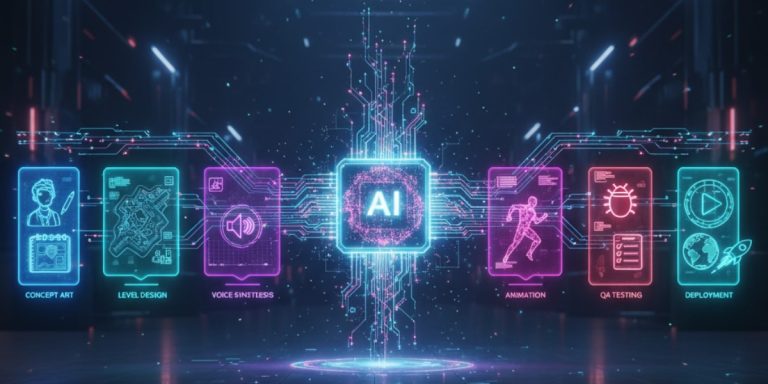
Artificial Intelligence (is becoming) has become the backbone of modern game development and player experience. If you don’t think so, you’re fighting a losing battle. Sure, AI has been in...

Do you remember Orkut, Myspace, and Friendster? Some of the most popular social platforms of the 2000s. It was all about adding friends, sending messages, and staying connected—ahh! The golden...

By now, we all know that AI is fundamentally transforming everything around us, and the retail and e-commerce landscape are among the primary ones to experience it, driving hyper-personalization, automation,...

Just like every other industry, the automotive market is experiencing a boom in AI-powered vehicles. From understanding the possibilities of automated driving to predictive maintenance, what was once science fiction...


 Book An Appointment
 WhatsApp