


- Blog
- >
- App development company
- >
- Why Businesses Are Investing...
Why Businesses Are Investing in AI Development Services
From science fiction to our daily assistant, artificial intelligence (AI) has become part of our lives faster than we imagined.
A few years ago, businesses discussed AI cautiously. Today, it is a catalyst for business transformation. Those who are embracing this technology are doing some of the most business-critical things better. Research is faster, routine tasks are now automated, operational efficiency is increased, and everything organizations need for growth, AI has improved. Is it because they suddenly took an interest in futuristic technology? No. The pressure to operate faster, reduce inefficiencies, and scale intelligently has become impossible to ignore.
Businesses today generate more data, manage more workflows, and serve customers with higher expectations than ever before. Traditional systems are struggling to keep pace with that complexity.
AI is increasingly becoming the solution businesses turn to when they need operations to move faster without sacrificing quality.
That’s why investment in AI development is accelerating across industries.
Businesses Are Under Pressure to Operate More Efficiently
Growth creates operational strain. As businesses scale, manual processes become harder to manage.
- Customer support volumes increase
- Reporting becomes more complex
- Decision-making slows down
- Teams spend more time on repetitive tasks
At some point, operational inefficiency starts affecting profitability. This is one reason companies are investing heavily in AI development services for enterprises. AI helps reduce repetitive work, improve workflow coordination, and support faster decision-making across departments.
Businesses are no longer viewing AI as optional innovation. They’re viewing it as operational infrastructure.
Automation Has Become a Business Priority
One of the biggest reasons companies invest in AI is automation. Many workflows still rely heavily on manual effort, like data processing, reporting, customer interactions, and document management. These tasks consume time without creating significant strategic value.
AI systems help automate these processes, allowing businesses to operate more efficiently while reducing operational bottlenecks. However, modern automation is no longer just rule-based software.
AI-driven systems can learn patterns, adapt to changing conditions, and improve performance over time. That flexibility makes automation far more valuable than traditional workflow systems.
Businesses Want Better Decision-Making
Most organizations already collect enormous amounts of data. The problem is turning that information into actionable insight quickly enough. AI helps businesses process and interpret data faster than manual analysis methods, improving demand forecasting, risk management, and customer retention analysis, among other things.
Instead of reacting after issues appear, businesses can identify patterns earlier and respond proactively. That predictive capability is becoming one of AI’s biggest operational advantages.
Customers Now Expect Personalized Experiences
Consumer expectations have changed dramatically. People expect businesses to understand preferences, behavior, and intent across the digital experience. Generic communication is becoming less effective. AI helps businesses personalize their:
- Product recommendations
- Marketing campaigns
- Customer support interactions
- User experiences
This level of personalization improves engagement because interactions feel more relevant and timely. That’s why many organizations invest in custom AI solutions for business rather than relying entirely on standardized software products. The goal is not simply automation but creating smarter customer experiences at scale.
Businesses Need Competitive Advantage
Competition is moving faster across nearly every industry. Companies are expected to respond quickly, operate efficiently, and scale without operational breakdowns. Businesses investing in AI are often doing so because they recognize that operational speed and adaptability are becoming competitive advantages.
AI helps organizations reduce delays, improve responsiveness, optimize workflows, and scale more sustainably. Over time, those advantages compound.
AI Helps Businesses Scale Without Matching Operational Costs
Traditionally, business growth required proportionally increasing operational teams. More customers meant more support staff, and more data meant larger analytics teams. Not anymore.
By automating repetitive tasks and improving workflow efficiency, businesses can scale operations without increasing complexity at the same pace. That scalability is one reason enterprise investment in AI continues growing.
Especially for businesses handling large volumes of customer interactions, transactions, or operational workflows, AI creates meaningful long-term efficiency gains.
Businesses Are Looking for Strategic AI Guidance
One reason companies partner with an external AI consulting agency is that implementing AI successfully requires more than software. Businesses need guidance around:
- Workflow integration
- Data infrastructure
- Scalability planning
- Long-term optimization
- Responsible AI implementation
Without a strategy, AI projects often become disconnected experiments that fail to create measurable operational value. This is why businesses increasingly seek long-term partnerships instead of one-time deployments.
AI Systems Improve Over Time
One of the most important differences between AI systems and traditional software is adaptability. AI systems improve as they process more information.
Recommendations become smarter. Forecasting becomes more accurate. Automation becomes more efficient. That means businesses investing in AI today are often building capabilities that strengthen over time.
This long-term improvement potential is one reason organizations increasingly view AI as a strategic investment rather than a short-term technology upgrade.
Why Businesses Work With Red Apple Technologies
Building AI infrastructure internally can be expensive and time-consuming. It requires data engineering expertise, model development, infrastructure scaling, workflow integration, and ongoing optimization.
For many businesses, partnering with an experienced AI development company or AI innovation partner is more practical than building everything internally. Companies like Red Apple Technologies help organizations implement AI-powered systems focused on automation, operational efficiency, analytics, and scalable digital experiences tailored to business objectives.
The advantage of working with experienced partners is not just technical capability. It’s implementation clarity.
Businesses Are Moving From Curiosity to Commitment
The conversation around AI is changing. A few years ago, companies were asking if they should explore AI. Now the question is how quickly they can integrate AI effectively. That shift reflects how important AI has become in modern operational strategy. Businesses are investing because they see AI not as a temporary trend, but as infrastructure for future growth.
Final Thought
Businesses are investing in AI development services because operational complexity is increasing faster than traditional systems can handle.
AI helps organizations automate workflows, improve decision-making, personalize experiences, and scale more efficiently. But the companies are seeing that the strongest results are not simply adopting AI tools; they’re integrating AI strategically into how the business operates.
And increasingly, that strategic integration is becoming a major competitive advantage.
To Have A Better Understanding On This Let us Answer The Following Questions
Answer: Businesses invest in AI to improve efficiency, automate workflows, personalize customer experiences, and scale operations more effectively.
Answer: They are enterprise-focused AI solutions designed to optimize operations, automate tasks, and improve data-driven decision-making.
Answer: Custom AI solutions are tailored AI systems built around a company’s specific workflows, operational challenges, and growth objectives.
Answer: An AI consulting agency helps businesses plan, implement, and optimize AI systems strategically across operations.
Answer: An AI innovation partner supports businesses with long-term AI strategy, development, integration, and operational optimization.

Published by
Arup Roy
Related Blogs
Discover more stories & insights that inspire
Right now, finding an AI development company feels a little like walking into a crowded market where everyone is claiming to have the “next big thing.” Every agency talks about...

In the past few years, San Francisco has become the center of the modern AI economy, not just because major AI companies are headquartered there but because the city has...
Artificial Intelligence (AI) is literally the powerhouse in every market, including stocks. Today’s lightning-fast stock markets were in much need of innovation for trading activities. In just a few years,...
The real estate industry, once driven by intuition and manual processes, is now undergoing a powerful digital transformation, and Artificial Intelligence is at the heart of it. From predicting property...

Artificial Intelligence (AI) is ushering in a new era of personalized learning, efficient administration, and empowered educators. By now, AI-powered tools have become essential in classrooms globally, from K-12 to...

Esports is the market. It is a multi-billion-dollar global industry, drawing millions of viewers and fostering an elite competitive talent pool across a wide variety of games. As esports matures,...
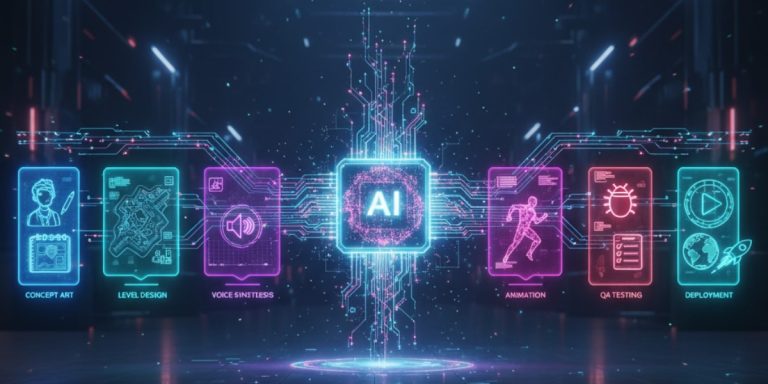
Artificial Intelligence (is becoming) has become the backbone of modern game development and player experience. If you don’t think so, you’re fighting a losing battle. Sure, AI has been in...

Do you remember Orkut, Myspace, and Friendster? Some of the most popular social platforms of the 2000s. It was all about adding friends, sending messages, and staying connected—ahh! The golden...

By now, we all know that AI is fundamentally transforming everything around us, and the retail and e-commerce landscape are among the primary ones to experience it, driving hyper-personalization, automation,...

Just like every other industry, the automotive market is experiencing a boom in AI-powered vehicles. From understanding the possibilities of automated driving to predictive maintenance, what was once science fiction...


 Book An Appointment
 WhatsApp