


Online Poker Game Security: How to Protect Gameplay Integrity
A fair shuffle doesn’t necessarily mean a fair poker table.
Your game might use encrypted connections, a tested random number generator (RNG), and secure payment integrations. That’s a good start, but it won’t stop players from colluding, manipulating betting actions, or exploiting information they were never supposed to receive.
This is where online poker security becomes more complicated than conventional application security. You’re not only protecting accounts and financial information. You’re protecting the rules of the game, the confidentiality of each player’s cards, and the integrity of every decision that changes the outcome of a hand.
And those protections can’t be left until the final QA cycle. Once the multiplayer architecture is established, changing who controls the game state or how transactions are processed becomes considerably more disruptive.
We recommend treating game integrity as an architectural requirement from day one. The goal isn’t to promise that nobody will ever cheat. It’s to make exploitation difficult, identify suspicious behavior, and ensure the operator can reconstruct what happened when something goes wrong.
Don’t Give the Client More Information Than the Player Needs
One of the simplest rules in poker development is also one of the easiest to get wrong: the client shouldn’t be trusted to enforce the game.
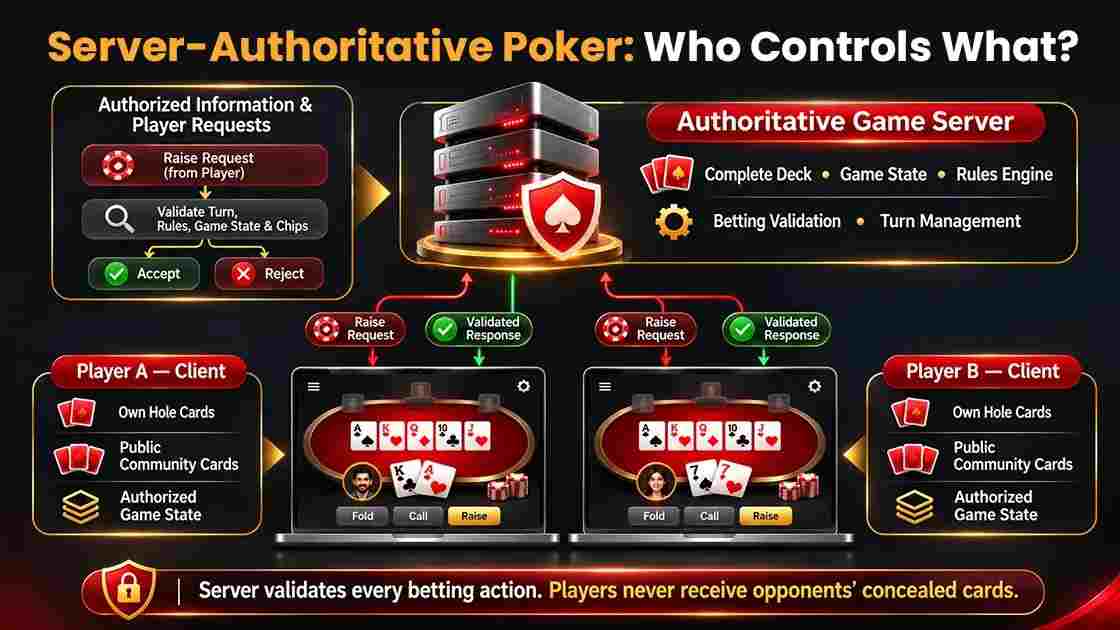
Your frontend is responsible for presenting cards, displaying chip balances, collecting player actions, and keeping the experience responsive. The server has a different job. It maintains the authoritative state of the hand, determines which actions are legal, and controls the information each participant receives.
In Texas Hold’em, the server knows the complete deck, the cards dealt to each player, the community cards, and the current betting state. Individual players don’t need access to all that information. They need their own cards and whatever public information the game rules allow them to see.
If your backend sends every player’s private cards to every connected client and relies on the interface to hide them, you’ve already lost control of that information. Someone using a modified client could inspect data that should never have reached their device.
Adding another layer of visual obfuscation won’t solve the underlying problem. Keep concealed information on the server, and authorize every piece of data before delivering it to the client.
A Player’s Request Isn’t Automatically a Legal Move
The same principle applies to betting actions. When a player selects “Raise,” the request tells the server what they want to do. It doesn’t establish that the action is allowed.
The server needs to check whose turn it is, whether the hand remains active, whether the raise follows the applicable betting rules, and whether the player has enough chips. It also needs to handle requests that arrive late, out of order, or more than once.
That last point matters more than it initially appears. A delayed action can arrive after the betting round has closed, while a repeated request might be generated by a network retry rather than another intentional player action. Neither should alter a hand that has already moved forward.
We’d build those checks directly into the gameplay logic and test them independently of the interface. A button being disabled in the frontend is useful for the player experience, but it isn’t a security control. Someone can bypass the interface; they shouldn’t be able to bypass the rules.
Fair Shuffling Is Essential, but RNG Isn’t an Anti-Cheat System
Random card distribution is fundamental to online poker. If players can predict the shuffle or influence which cards appear, the game’s competitive integrity is compromised before betting even begins.
An RNG provides the randomness used to shuffle the deck. For security-sensitive poker applications, use a suitable cryptographically secure random number generator rather than a predictable general-purpose random function. The shuffle must also preserve the expected probabilities, without introducing bias through incorrect random-number mapping or implementation errors.
Consider Fisher–Yates, a widely used shuffling algorithm. When implemented correctly with uniform random selections, it produces an unbiased permutation. But even a sound algorithm becomes vulnerable when developers use predictable seeds, repeat random sequences, or inadvertently expose internal generator state.
And once the deck is shuffled, you still have to protect it. The server must control concealed card information throughout the hand, releasing only the cards each participant is authorized to see.
What Does RNG Testing Actually Establish?
A statistically plausible card distribution isn’t enough to establish that your shuffle is secure. You also need to know whether someone could predict or manipulate future outcomes.
Statistical tests examine whether results follow the expected probabilities. Security and implementation reviews examine the randomness source, seeding, internal state, shuffle logic, and how random values are translated into card positions.
Both forms of evaluation matter. A generator can produce distributions that look perfectly reasonable while remaining predictable to someone who knows its seed.
The UK Gambling Commission’s RTS 7 establishes requirements for acceptably random outcomes in applicable gambling products. Gaming Laboratories International also publishes relevant technical standards, including GLI-19, for evaluating interactive gaming systems.
These references help teams understand what must be demonstrated during testing. They don’t mean every poker game follows identical certification requirements, and an RNG certificate doesn’t establish worldwide regulatory compliance.
There’s another distinction we wouldn’t overlook: an RNG can establish fairness in card distribution, but it can’t tell you whether two players are secretly cooperating. That’s a different security problem requiring different controls.
Collusion and Bots Won’t Care How Strong Your Encryption Is
You can secure every connection and authenticate every account, yet still have players cheating at the table.
Collusion exploits the interaction between players rather than a weakness in the encryption. Participants might share concealed information outside the game, coordinate betting decisions, or deliberately move chips between accounts. Multi-accounting adds another complication when one person controls several seats or uses multiple identities to gain an advantage.
Bots and unauthorized real-time assistance present different challenges. A bot might automate decisions, while an assistance tool could recommend actions during live play in violation of the operator’s rules. Neither necessarily depends on compromising the server.
This is why conventional cybersecurity and poker game-integrity monitoring need to work together. One protects systems and information. The other helps identify behavior that undermines fair competition.
Detect Suspicious Play Without Accusing Everyone Who Plays Differently
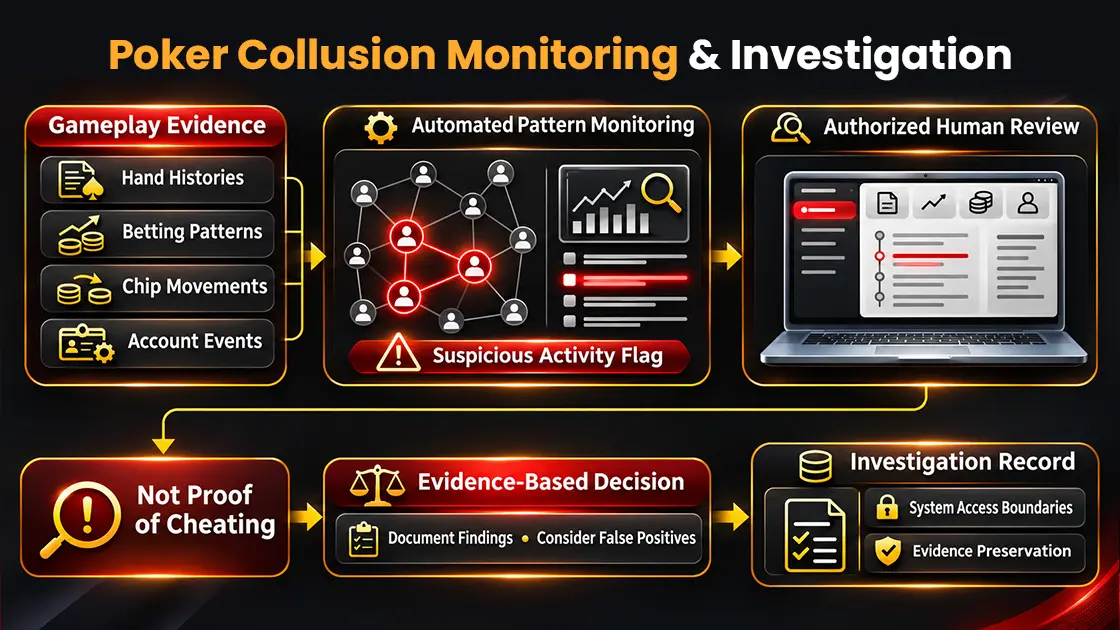
Poker platforms already generate valuable behavioral information. Hand histories show who played together, how betting unfolded, when players folded, and where chips moved.
Those records can reveal patterns worth investigating. Repeatedly unusual chip transfers between related accounts, coordinated betting behavior, or suspicious interactions across numerous hands deserve attention.
But don’t turn a suspicious statistic into an automatic cheating verdict.
Strong players make unconventional decisions. Legitimate users share networks or devices. Some patterns that appear suspicious over a small number of hands disappear when examined against a larger sample.
Our preference is to use automated monitoring to identify cases requiring investigation, not to replace the investigation itself. If a detection system flags an account, an authorized reviewer needs enough context to understand why it was flagged and what evidence supports further action.
False positives deserve serious attention, particularly when the consequences include account suspension or restrictions on player funds. A system that detects suspicious behavior but repeatedly misclassifies legitimate players creates another operational problem.
Build the Investigation Tools Before You Need Them
When an operator suspects collusion, a screenshot and a player’s complaint aren’t enough. They need to reconstruct the relevant gameplay: who joined the table, how the betting unfolded, which accounts interacted, and where chips moved.
That requires reliable hand histories, timestamps, account-event records, and controlled access to the supporting information. The records also need to be protected against unauthorized changes, particularly when they’re used to investigate disputes.
We’d include investigation workflows in the platform’s requirements rather than leaving the operations team to piece together evidence manually after launch.
The UK Gambling Commission’s RTS 11 reinforces the importance of measures against collusion and cheating, relevant activity records, and appropriate controls over accounts and sessions for applicable peer-to-peer gambling systems.
The precise requirements depend on the jurisdiction. The engineering lesson doesn’t: if your platform can’t reconstruct what happened at a poker table, your operator has a serious blind spot.
Treat Betting and Settlement Like Accounting, Not Just Gameplay
A poker game has to do more than calculate who won. It needs to account for every wager, every contribution to the pot, and every settlement without losing or duplicating value.
During a hand, the server tracks each player’s contribution, the current bet, folded and all-in states, pot eligibility, and the actions permitted by the rules. Those values change throughout the hand, often while network conditions are less than ideal.
This is where seemingly minor implementation mistakes become expensive. An outdated action might be accepted after betting closes. A side pot might be calculated incorrectly. A settlement request might be processed twice after a timeout.
In a real-money game, those failures can have direct financial consequences. In a virtual-currency poker game, they can still undermine the economy and the reliability of player balances.
We recommend keeping the game-state rules and financial accounting responsibilities clearly defined while ensuring their outcomes remain consistent. The gameplay system determines the valid result; the wallet or ledger records the resulting movements.
What Happens When a Settlement Request Runs Twice?
Duplicate requests are a normal reality of networked applications. They shouldn’t produce duplicate payouts.
Use transaction designs that recognize repeated operations and prevent them from being applied more than once. Idempotency keys, durable transaction records, and controlled recovery mechanisms are useful tools, depending on the system architecture.
The important question isn’t whether an API request succeeded on its first attempt. It’s whether the game and the financial records reach the correct state after retries, failures, or interruptions.
For systems where game-state updates and wallet transactions happen in different services, that consistency needs deliberate engineering. Don’t assume two independent operations will always succeed or fail together.
Side Pots Are Where Weak Settlement Logic Gets Exposed
Side pots deserve particular attention because multiple all-in players create different eligibility rules.
The system must know how much each participant contributed, which pots they’re eligible to win, and how the winnings are distributed. Folded players, split pots, ties, and odd-chip rules introduce additional cases that ordinary winner-takes-all testing won’t cover.
We’d build deterministic tests around these scenarios before trusting the settlement system with live gameplay. Record the initial state, apply a defined sequence of player actions, and compare the calculated outcome against the expected result.
Those tests also need to survive future code changes. If a developer updates the betting logic, existing regression tests should reveal whether a previously correct settlement now behaves differently.
The UK Gambling Commission’s RTS 5 provides a relevant regulatory reference for processing and settling bets according to published terms and game rules.
For poker developers, the practical standard is straightforward: don’t assume the math is right because a few ordinary hands settled correctly. Prove it across the situations your game allows.

A Dropped Connection Shouldn’t Become a Gameplay Exploit
Disconnections are inevitable. What matters is whether your poker architecture handles them consistently.
When someone disconnects during a hand, the rest of the table doesn’t necessarily stop playing. The server must retain the current state, apply the established timing and action rules, and determine what the returning player is entitled to do.
The application also needs to distinguish between an action that reached the server before the connection failed and one that never arrived. If the player reconnects and resubmits a request that was already accepted, the system must not apply it again.
That isn’t something we’d leave for the frontend team to resolve with a loading screen and a reconnect button.
Define the recovery rules alongside the betting logic. Decide what happens if a player disconnects before their turn, during an action request, or after betting has closed. Tournament and cash-game rules may require different treatment, so the implementation must follow the operator’s documented policies.
The UK Gambling Commission’s RTS 10 addresses the fair handling of interrupted gambling, including appropriate recovery of stateful games.
From an engineering perspective, that means maintaining reliable game-state records and ensuring reconnects cannot create conflicting versions of the same hand. The user experience matters, but the server’s record of what happened must remain authoritative.
Account and API Security Still Have a Job to Do
Poker-specific controls don’t replace authentication, secure sessions, authorization, or ordinary application-security testing.
A player shouldn’t be able to retrieve someone else’s private cards through an exposed endpoint. An authenticated account shouldn’t gain access to table administration merely because it can send requests to the relevant service. Support personnel shouldn’t receive unrestricted access to sensitive player or financial information.
These are authorization problems, not simply login problems.
We’d examine permissions at the API and service level, then test whether requests remain properly restricted when they’re modified, repeated, or sent outside the intended interface.
The OWASP Application Security Verification Standard provides a useful framework for defining and testing those controls. Its guidance can inform how teams approach authentication, authorization, session management, and related application-security requirements.
Real-money poker also introduces regulatory and financial obligations. Player verification, payment handling, monitoring, and data retention requirements vary by operating market, so they need to be established through the operator’s applicable legal and compliance framework.
The principle is to connect those controls to the actual platform architecture rather than treating security as a separate checklist completed after development.
Test What Players and Systems Aren’t Supposed to Do
A normal poker QA cycle confirms that players can join tables, place bets, complete hands, and receive payouts. That’s necessary, but it won’t tell you whether your game can withstand deliberate manipulation.
Security testing has to challenge the rules.
Try submitting a raise when it’s another player’s turn. Repeat a previously accepted betting request. Examine whether a modified client can retrieve private-card information. Interrupt a transaction and check whether the wallet and game state recover consistently.
We’d also test side-pot combinations, multiple all-in players, interrupted settlements, and account permissions across different roles. These aren’t exotic edge cases. They’re the situations where poorly defined state management and authorization rules tend to reveal themselves.
Anti-cheat monitoring deserves separate testing. A detection system needs to identify relevant suspicious patterns while giving reviewers the evidence to assess them. Teams should also measure false positives and confirm that legitimate gameplay isn’t routinely classified as misconduct.
A Practical Poker Security Review
| Security Risk | Engineering Response | What QA Needs to Establish |
|---|---|---|
| Hidden-card exposure | Server-controlled information access | Unauthorized clients cannot retrieve concealed cards |
| Predictable or biased shuffling | Secure RNG and validated shuffle implementation | Card distribution meets intended randomness and unpredictability requirements |
| Collusion and chip dumping | Behavioral monitoring and investigation records | Suspicious behavior can be identified and reviewed |
| Bots and unauthorized assistance | Anti-cheat monitoring and account controls | Detection supports investigation without treating every anomaly as proof |
| Invalid or duplicate betting | Authoritative action validation and duplicate-request protection | Illegal or repeated actions cannot corrupt the hand |
| Incorrect pot settlement | Deterministic settlement logic and consistent accounting | Side pots, ties, and payouts produce correct results without duplicate credits |
| Interrupted gameplay | Persistent state and defined recovery behavior | Reconnects and failures preserve consistent game and financial states |
Don’t stop at testing each control individually. Combine failure conditions wherever they interact. A disconnect during a betting request, followed by a retry and a settlement, tells you more about system reliability than three isolated successful tests.
Security testing also continues after launch. Changes to gameplay logic, account systems, third-party integrations, and backend infrastructure can introduce vulnerabilities that weren’t present in the original release.
Regression testing, monitoring, and a defined response process are therefore part of maintaining a secure poker platform, not optional work after deployment.
What Should You Expect From Your Poker Development Partner?
If you’re evaluating a company to build your poker game, don’t settle for broad promises about encryption, secure coding, or fraud prevention.
Ask how the team intends to protect private cards, validate player actions, handle disconnections, and keep financial records consistent with the game state. These questions reveal far more about the proposed architecture than a list of security technologies.
We’d also want to understand how RNG behavior will be tested, how side-pot calculations will be verified, and what information the operator will have available when investigating suspicious gameplay.
The answers should influence architecture, development estimates, and QA planning before implementation begins. Retrofitting those controls into an established multiplayer platform introduces avoidable complexity.
For regulated real-money products, licensing and compliance advisers should establish the applicable obligations. The development team then needs to translate those requirements into technical specifications, integrations, and testable acceptance criteria.
Red Apple Technologies’ iGaming gameplay engineering services cover gameplay logic, player interactions, state management, backend events, and related engineering work. Those capabilities support the technical foundations needed to implement poker-specific security and integrity controls.
A good development partner should be able to explain not just which protections will be included, but how those protections will be tested and maintained as the game evolves.
Final Thoughts
Poker security is about protecting the integrity of the game, not just the systems surrounding it.
A fair shuffle won’t help if players can access concealed cards. Strong authentication won’t stop legitimate accounts from colluding. Accurate betting rules won’t protect a platform if repeated requests can corrupt settlements.
These problems require different controls, but those controls have to work together.
Our recommendation is to make security part of the architecture before the first real-money transaction or competitive hand is processed. Challenge the assumptions behind the gameplay logic, test what happens when requests fail, and make sure the operator can reconstruct events when a hand is disputed.
That’s how you build a poker platform whose fairness can be examined and supported by evidence, rather than relying on assurances that the game is secure.
Building a Secure Online Poker Game?
Red Apple Technologies develops custom gaming and iGaming solutions, including gameplay engineering, backend systems, integrations, and QA.
If you’re planning a multiplayer poker game or evaluating the technical requirements of an existing platform, explore our iGaming development capabilities and discuss your project with our team.

Published by
Pradip Banerjee
Related Blogs
Discover more stories & insights that inspire

Two game studios can show equally polished portfolios and still create very different production risk. The difference often becomes visible only after you look beyond the showreel: who will actually...

A game can have a strong core loop and still run into trouble if two business decisions are left until the end: how it will make money and how it...

An AR prototype built around one core interaction and a multiplayer VR game designed for several headsets should not receive anything close to the same estimate. Both may fall under...

A good-looking game can still fail to hold a player’s attention if its mechanics are unclear, progression feels unrewarding, or levels become frustrating for the wrong reasons. Game design goes...

Despite occupying second position after China, the USA still manages to be a superpower in the global game industry. Whether game development or game publishing, the USA continues to shine...

Italy has quietly developed into one of Europe’s most creative mobile game development ecosystems. While the country may not match the scale of mobile gaming markets like the United States...

The UAE — particularly Dubai and Abu Dhabi — has rapidly evolved into one of the Middle East’s most ambitious gaming hubs. Backed by government-led initiatives, global investment, and major...

Turkey has become one of the fastest-growing mobile gaming ecosystems in Europe. Over the past decade, mobile game developers in Turkey have produced globally successful casual and hyper-casual titles, attracted...

Spain has established itself as one of Europe’s most active mobile game development markets. With internationally successful studios, experienced live-operations teams, and competitive production structures, the country continues to attract...

Game development followed a familiar pattern for decades: build everything in-house or outsource isolated tasks when schedules slipped. That model has been quietly changing. It’s 2026, and while a section...


 Book An Appointment
 WhatsApp