


- Blog
- >
- Game Development
- >
- The Rise of Unity...
The Rise of Unity 3D: Dominating Game and VR Development in 2026
The Evolution of Unity: From Indie Favorite to Industry Titan
Unity and VR Development
Key Features Driving Unity’s 2026 Success
1. Unity AI (formerly Muse & Sentis)
2. DOTS (Data-Oriented Technology Stack)
3. URP and HDRP
- URP (Universal Render Pipeline) is tailored for performance across mobile, web, and standalone devices.
- HDRP (High Definition Render Pipeline) delivers cinematic fidelity for high-end PCs and consoles. Developers must choose upfront, as switching pipelines mid-project is not seamless, but this choice allows for optimized visual performance across all platforms.
4. Build Profiles & Multiplatform Excellence
Use Cases Beyond Gaming
- Automotive: Used for AR-based maintenance, driving simulations, and design validation environments.
- Architecture, Engineering & Construction (AEC): Enables real-time walkthroughs, safety training modules, and digital twins to streamline planning.
- Healthcare: Supports surgical simulations, VR therapy, and cognitive rehabilitation tools.
- Film & Animation: With its advanced real-time rendering, Unity powers virtual production workflows used in modern filmmaking. ILM’s StageCraft was built on Unreal Engine. Virtual-production films like The Jungle Book and The Lion King used Unity.
GDC 2026 Announcements: A Glimpse Into Unity’s Future
- Enhanced DevOps Tools: Unity DevOps (formerly part of Unity Cloud) now includes version control and automated build pipelines. Unity DevOps provides CI/CD in the cloud (build automation) and analytics dashboards for live game operations.
- Spatial Creator Toolkit: An all-in-one third-party platform (developed by Spatial Systems) powered by Unity to build persistent, networked spatial experiences with minimal coding. Spatial.io’s Spatial Creator Toolkit lets developers build and publish multiplayer VR/AR experiences with Unity/C#.
Why Unity Reigns Supreme in 2026
Conclusion
To Have A Better Understanding On This Let us Answer The Following Questions
How is Unity used in VR game development?
Answer: Unity is widely used in VR development for its low-latency rendering, OpenXR support, spatial interaction toolkits, and compatibility with headsets like Meta Quest, PS VR2, and Apple Vision Pro. We use Unity to build immersive VR games, enterprise training apps, and simulations.
Is Unity better than Unreal Engine?
Answer: Unity offers fast prototyping, real-time rendering, broad device compatibility, and an extensive asset store. With Unity, businesses can quickly build and deploy immersive VR solutions for gaming, training, education, and more.
Why should businesses choose Unity for their next VR project?
Answer: Unity offers fast prototyping, real-time rendering, broad device compatibility, and an extensive asset store. With Unity, businesses can quickly build and deploy immersive VR solutions for gaming, training, education, and more.

Related Blogs
Discover more stories & insights that inspire
Two game studios can show equally polished portfolios and still create very different production risk. The difference often becomes visible only after you look beyond the showreel: who will actually...

A game can have a strong core loop and still run into trouble if two business decisions are left until the end: how it will make money and how it...
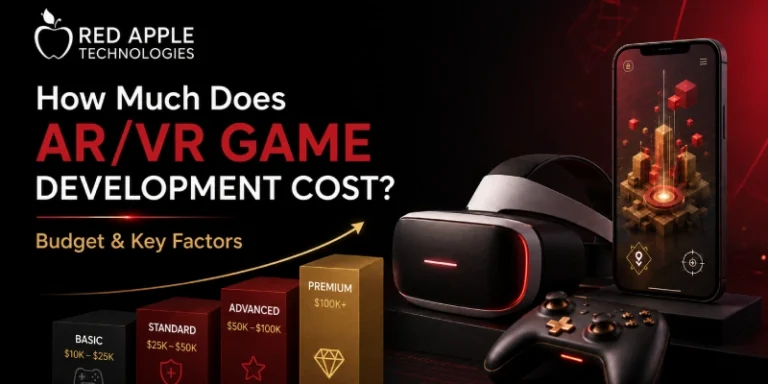
An AR prototype built around one core interaction and a multiplayer VR game designed for several headsets should not receive anything close to the same estimate. Both may fall under...
A good-looking game can still fail to hold a player’s attention if its mechanics are unclear, progression feels unrewarding, or levels become frustrating for the wrong reasons. Game design goes...
Despite occupying second position after China, the USA still manages to be a superpower in the global game industry. Whether game development or game publishing, the USA continues to shine...
Italy has quietly developed into one of Europe’s most creative mobile game development ecosystems. While the country may not match the scale of mobile gaming markets like the United States...

The UAE — particularly Dubai and Abu Dhabi — has rapidly evolved into one of the Middle East’s most ambitious gaming hubs. Backed by government-led initiatives, global investment, and major...
Turkey has become one of the fastest-growing mobile gaming ecosystems in Europe. Over the past decade, mobile game developers in Turkey have produced globally successful casual and hyper-casual titles, attracted...

Spain has established itself as one of Europe’s most active mobile game development markets. With internationally successful studios, experienced live-operations teams, and competitive production structures, the country continues to attract...

Game development followed a familiar pattern for decades: build everything in-house or outsource isolated tasks when schedules slipped. That model has been quietly changing. It’s 2026, and while a section...


 Book An Appointment
 WhatsApp