


Simulation in VR: Building Scientifically Accurate Collaborative Physics Experiments
Transforming Customer Experience with AI-Driven Insights.

Simulation in VR
Product Name

Virtual Reality
Platform

Education / EdTech
Industry
Project Details
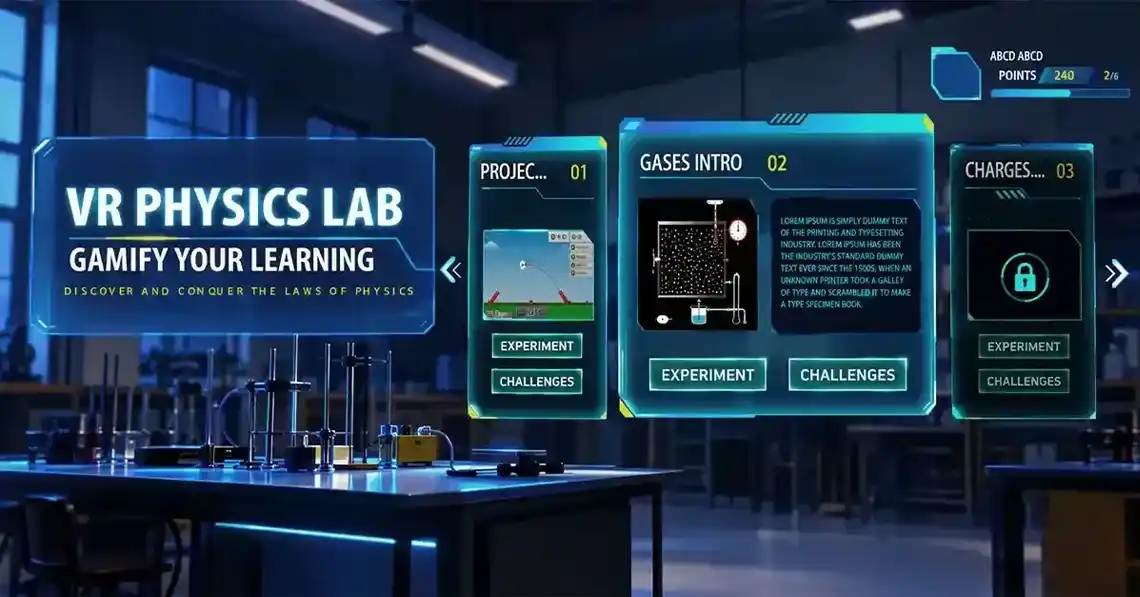
The project was developed for the Pontifical Catholic University of Puerto Rico, College of Sciences. The goal was to create an interactive Physics education platform where university students can explore complex concepts through 3D simulations, virtual experiments, and collaborative learning. Students can manipulate variables, observe simulated behavior, and take measurements through hands-on practice.
Scoping Out the Project
The scope included:
- Develop six interactive physics experiments in Unity
- Enable individual practice and collaborative experiments for up to five students
- Implement a host/lead student role to validate experimental activities
- Create educational mini-games to reinforce concepts through interactive challenges
Facing Challenges Head-On

Maintaining Scientific Accuracy
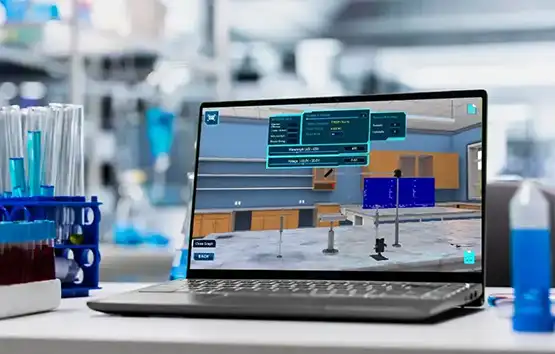
The client provided the Physics calculation codebase for the simulations. Integrating that logic into an interactive 3D environment required the team to ensure that calculated results and observed physical behavior remained consistent.

Ensuring Real-Time Data Transmission
When a student used the experimental equipment or changed a setting, the data had to reach other connected participants. Transmitting this information reliably was essential to keeping the shared experiment consistent.

Synchronizing Multiplayer Experiments
With up to five students sharing a virtual laboratory, changes made by one participant needed to be represented consistently for the others. Keeping experimental states aligned during simultaneous interactions added complexity to the multiplayer experience.

Preserving Interactive Responsiveness
Experimental parameters, object movements, and measurements had to be transmitted and synchronized without making interactions feel delayed. The challenge was to maintain consistent results across connected users while preserving responsiveness.
Solution
The development process followed repeated cycles of: Calculation → Transmission → Synchronization → Validation → Testing → Optimization
- Integrated the client's Physics calculation codebase into interactive Unity simulations
- Identified and synchronized critical experiment data across connected users through real-time communication
- Validated calculations and experimental behavior against expected Physics results
- Enabled shared equipment interactions, participant visibility, and host-led experiment sessions for up to five students
- Structured each experiment around individual practice, multiplayer collaboration, and concept-based mini-games
Technologies

Unity

Node.js

MongoDB

Socket.io
Key Features

Six Interactive Physics Experiments
The platform covers Projectile Motion, Gases Intro, Charges and Fields, Faraday's Electromagnetic Lab, Photoelectric Effect, and Models of the Hydrogen Atom.

Individual Experiment Practice
Students can explore the virtual lab and configure experiments.They can adjust settings, take measurements, and familiarize themselves with the required steps.

Multiplayer Virtual Laboratory
Each shared experiment room supports up to five participants. Students can interact with the equipment, observe other participants' actions, and work through the experiment together.

Educational Mini-Games
Each Physics module includes a single-player mini-game based on its experiment. These are designed to reinforce the concepts students have already explored through the simulation.
Result & Achievement:
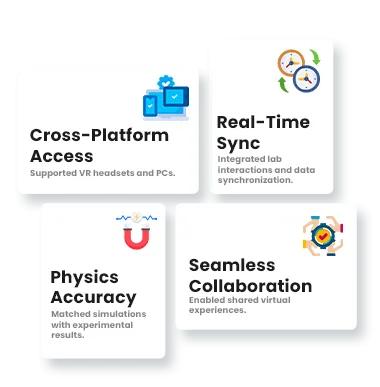
Ensuring that simulated physical behavior and experimental measurements remained consistent was a key achievement, particularly in a shared environment. The platform also delivers a seamless collaborative experience for users joining through different devices, including VR headsets and PCs. By bringing physics calculations, lab interactions, data sync, and cross-platform participation together, the team created a cohesive virtual learning environment.
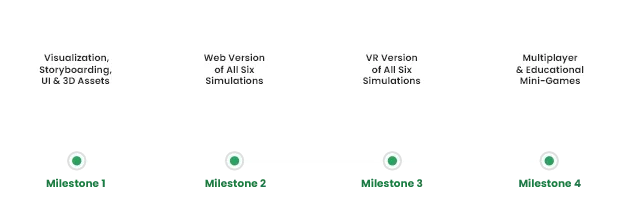
Timeline


 Book An Appointment
 WhatsApp