


- Blog
- >
- AI in Healthcare
- >
- AI in Healthcare: Smarter...
AI in Healthcare: Smarter Care with Faster, Data-Driven Decisions
Artificial Intelligence (AI) is promising a future where medical care is more precise, accessible, and efficient. The benefits of artificial intelligence in healthcare have been proven across medical imaging accuracy, personalized treatment, and administrative streamlining, making it an invaluable asset in modern medicine. AI’s unmatched ability to analyze vast datasets accelerates diagnostics, improves clinical decision-making, and allows healthcare providers to deliver focused, effective treatments.
Our expertise as a mobile app development company extends to AI-powered healthcare applications, as we embed intelligent algorithms into interactive apps to automate symptom checking, appointment scheduling, and health monitoring. These apps harness natural language processing and real-time data analysis, providing users with seamless, accessible digital health experiences while aiding providers in delivering personalized care.
For those seeking robust AI healthcare applications development, this comprehensive blog provides an insightful, data-driven overview of AI’s pivotal role in modern medicine, blending informative content with actionable value. We believe your understanding of AI-powered apps in healthcare is essential for your innovation, so—
Let’s Start with the Benefits
AI’s capabilities to process and analyze vast healthcare data sets have introduced revolutionary benefits. Enhanced diagnostic accuracy is one of the foremost advantages, with AI-powered imaging tools reaching up to 95% accuracy in detecting anomalies such as cancers, brain lesions, and chronic diseases. This early detection significantly improves patient outcomes by enabling timely intervention.
AI also powers personalized patient care by considering an individual’s genetics, lifestyle, and medical history, crafting tailored treatment plans. This customization boosts treatment effectiveness and patient satisfaction. Additionally, healthcare providers benefit from AI streamlining administrative tasks, freeing clinicians to focus on patient care while reducing operational costs.
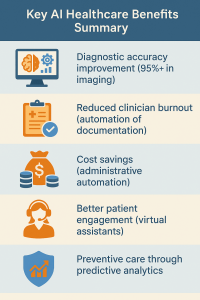
Key AI Healthcare Benefits Summary
Visualize key benefits such as:
- Diagnostic accuracy improvement (95%+ in imaging)
- Reduced clinician burnout (automation of documentation)
- Cost savings (administrative automation)
- Better patient engagement (virtual assistants)
- Preventive care through predictive analytics
AI’s Transformative Power in Healthcare
AI technologies are now part of various healthcare domains, each providing unique value. Diagnostic imaging leads adoption, leveraging deep learning for high-precision detection of diseases such cancer and neurological disorders. Virtual health assistants powered by natural language processing enhance patient interactions by providing symptom checking, appointment scheduling, and health advice. Predictive analytics identify patients at risk of complications or readmission, enabling preventive care. Automation of clinical documentation through ambient listening reduces physician burnout, streamlining workflows. Personalized treatment apps analyze genetic and behavioral data to tailor therapy plans.
See the distribution in the chart below:
| AI Healthcare Application | Percentage Usage | Key Benefit |
|---|---|---|
| Diagnostic Imaging | 30 | Improves accuracy and speed of disease detection |
| Virtual Health Assistants | 25 | Enhances patient engagement and accessibility |
| Predictive Analytics | 20 | Enables early intervention and reduces hospital stays |
| Clinical Documentation Automation | 15 | Frees clinicians from administrative burdens |
| Personalized Treatment Apps | 10 | Provides tailored therapies |
How AI Fulfills Healthcare Needs Today
The scale and scope of AI healthcare applications development have surged to meet rising medical needs. Diagnostic tools employing image recognition technologies can identify tumors faster, reducing misdiagnosis and improving treatment timelines. Virtual assistants use conversational AI to provide 24/7 patient support, guiding triage and medication adherence, essential for enhanced patient engagement. Predictive models analyze patient data in real-time, flagging at-risk individuals earlier than traditional methods.
Healthcare app development enriched with AI also increases efficiency by automating routine tasks such as appointment management and claims processing. This operational uplift translates into cost savings and allows medical staff to focus on care quality.
Market Growth and Future Outlook
The healthcare AI market, valued at nearly $36 billion in 2025, is exponentially growing, projected to exceed $355 billion by 2032 with a CAGR of 37.66%. This growth reflects widespread AI adoption, with over 80% of healthcare organizations embedding AI solutions across clinical and administrative settings. Remote patient monitoring, robotic-assisted surgeries, and AI-driven drug discovery will be critical growth areas in the near future.
| Year | Market Size (Billion USD) | CAGR (%) |
|---|---|---|
| 2025 | 35.95 | – |
| 2027 | 70.2 | 37.66 |
| 2030 | 180.0 | 37.66 |
| 2032 | 355.78 | 37.66 |
The future of healthcare with AI promises more personalized, accessible, and preventive medicine, reshaping patient experiences and health outcomes globally.
Why Partner with Us for AI Healthcare App Development
Choosing the right AI app development company to navigate the complexity of artificial intelligence is crucial. Red Apple Technologies offers specialized AI app development services, including:
- Full-cycle design and development of HIPAA- and GDPR-compliant AI healthcare apps.
- Integration with electronic health records, wearables, and telemedicine platforms to amplify AI’s impact.
- Continuous AI model tuning based on real-world clinical data to ensure accuracy and reliability.
- Cross-platform mobile and web applications engineered for scalability and user engagement.
Our expertise combines deep AI capabilities with medical domain knowledge, helping healthcare providers innovate effectively while prioritizing patient safety and data security.
Artificial Intelligence is empowering healthcare with smarter diagnostic tools, personalized care, and operational excellence. For healthcare organizations and innovators seeking AI healthcare applications development, partnering with experienced developers offering cutting-edge AI services is key to success in this evolving landscape. Embrace the coming of better healthcare experiences, optimize expenses, and pioneer medical innovation.
To Have A Better Understanding On This Let us Answer The Following Questions
Answer: Key areas attracting investments include:
- AI-powered diagnostics: Advanced imaging tools that enhance detection accuracy.
- Predictive analytics: Tools that forecast patient risks and optimize care plans.
- Virtual health assistants: Conversational AI improving patient engagement and reducing provider workload.
- Drug discovery acceleration: Generative AI models speeding up clinical trials.
- Infrastructure support: Cloud computing and cybersecurity services critical for AI deployments.
The market is expected to grow from ~$21 billion in 2025 to over $110 billion by 2030, driven by increasing adoption in both developed and emerging markets.
Answer: Investors benefit from reduced risk profiles due to:
- Established regulatory frameworks (HIPAA, GDPR) ensuring compliance.
- Collaborations between tech firms and clinical institutions validating real-world effectiveness.
- Increasing demand for AI solutions amid global healthcare workforce shortages.
- Growing evidence of improved patient outcomes and operational cost savings.
However, risks include technological complexity, data privacy challenges, and evolving regulations that require adaptive strategies.
Answer: Return timelines vary by use case but generally:
- Many providers see ROI in 6 months to 2 years post-deployment.
- Efficiency gains from automation and reduced hospital readmissions drive early cost savings.
- Enhanced patient retention and improved diagnostics contribute to long-term revenue growth.
- Scalability of AI applications enables rapid expansion once initial validation is complete.
Answer: AI apps are customized to meet local healthcare demands by:
- Supporting telemedicine and remote diagnostics in underserved/rural areas.
- Adapting to local regulatory and data environments.
- Integrating with region-specific health infrastructure and digital public health initiatives.
India’s example: Collaborations under government digital missions foster accessible AI-driven care that mitigates critical resource gaps.
Answer: Important trends creating investment momentum include:
- Generative AI’s rise for clinical documentation and drug discovery.
- Enhanced integration of AI with IoT wearables and cloud platforms.
- Growing focus on chronic diseases, mental health, and personalized medicine.
- Increased strategic mergers, acquisitions, and partnerships in healthcare startups.
- Expansion of AI applications beyond diagnostics into patient engagement and health system management.

Related Blogs
Discover more stories & insights that inspire
Right now, finding an AI development company feels a little like walking into a crowded market where everyone is claiming to have the “next big thing.” Every agency talks about...
From science fiction to our daily assistant, artificial intelligence (AI) has become part of our lives faster than we imagined. A few years ago, businesses discussed AI cautiously. Today, it...

In the past few years, San Francisco has become the center of the modern AI economy, not just because major AI companies are headquartered there but because the city has...
Artificial Intelligence (AI) is literally the powerhouse in every market, including stocks. Today’s lightning-fast stock markets were in much need of innovation for trading activities. In just a few years,...
The real estate industry, once driven by intuition and manual processes, is now undergoing a powerful digital transformation, and Artificial Intelligence is at the heart of it. From predicting property...

Artificial Intelligence (AI) is ushering in a new era of personalized learning, efficient administration, and empowered educators. By now, AI-powered tools have become essential in classrooms globally, from K-12 to...

Esports is the market. It is a multi-billion-dollar global industry, drawing millions of viewers and fostering an elite competitive talent pool across a wide variety of games. As esports matures,...
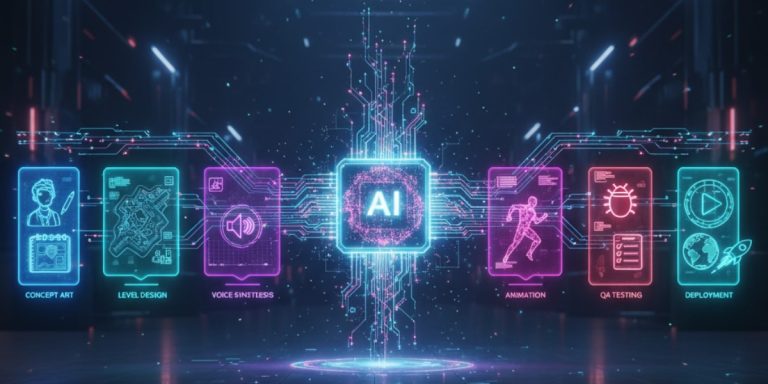
Artificial Intelligence (is becoming) has become the backbone of modern game development and player experience. If you don’t think so, you’re fighting a losing battle. Sure, AI has been in...
Do you remember Orkut, Myspace, and Friendster? Some of the most popular social platforms of the 2000s. It was all about adding friends, sending messages, and staying connected—ahh! The golden...

By now, we all know that AI is fundamentally transforming everything around us, and the retail and e-commerce landscape are among the primary ones to experience it, driving hyper-personalization, automation,...


 Book An Appointment
 WhatsApp