


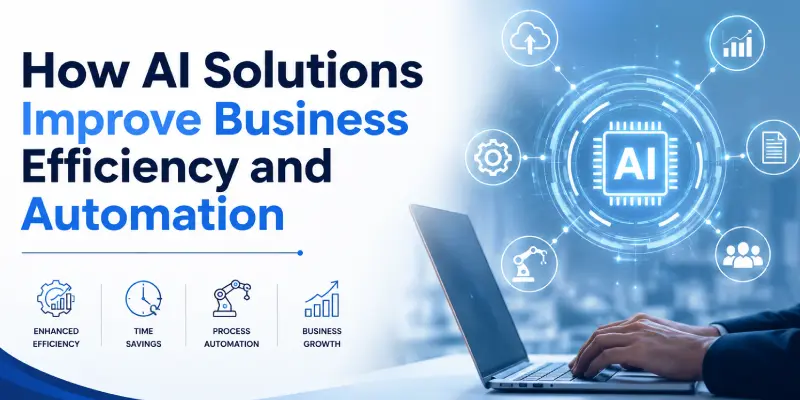
How AI Solutions Improve Business Efficiency and Automation
Inefficiency is not noticed immediately. It builds slowly, and most businesses notice it late.
A few extra hours spent on reporting. Delays in customer support responses. Teams are manually repeating tasks that software should already be handling. Decision-making slows as operations grow more complicated.
At first, these issues seem manageable. However, as businesses scale, small inefficiencies begin to affect productivity, customer experience, and profitability in ways difficult to ignore.
This is why every industry is quickly adopting AI; not because businesses prefer automation over manual labor, but because they need more efficient systems to handle complexity.
Efficiency Is Important
Speed matters in highly competitive industries. Businesses are expected to respond quickly, personalize experiences, and operate without delays. Manual processes struggle to meet that expectation.
AI helps businesses improve efficiency by reducing repetitive work and accelerating operational workflows. That includes areas like customer support, data processing, inventory forecasting, and scheduling and coordination.
According to McKinsey & Company, companies implementing AI-driven operational systems increasingly report measurable improvements in productivity and efficiency.
So, the key advantage is not simply doing tasks faster but reducing operational friction across the business.
Removing Repetition with Automation
Automation is clearly one of the biggest benefits of AI. Many business workflows still depend heavily on repetitive manual tasks like data entry, processing documents, responding to customer requests, and updating reports, which consume time without creating much strategic value.
AI automation solutions for businesses help reduce that burden by handling repetitive workflows consistently without manual input. The result is not only improved speed but enhanced focus. Teams can spend more time on problem-solving, strategy, and customer relationships rather than routine operational work.
Faster Business Decisions with AI
Modern businesses generate enormous amounts of data, but there’s a problem: humans can’t process it quickly enough.
AI systems help analyze large datasets in real time, identifying patterns and generating insights that support faster decision-making. This can improve:
- Demand forecasting
- Risk assessment
- Customer retention strategies
- Marketing performance analysis
- Operational planning
Instead of waiting for monthly reports or delayed analysis, businesses can respond much more quickly to changing conditions. That responsiveness becomes increasingly important as markets move faster.
Customer Support Becomes More Manageable
Customer expectations have changed significantly. People expect faster responses and more personalized interactions. AI-powered systems now help businesses automate many aspects of customer support without sacrificing responsiveness. This includes intelligent chat systems, automated ticket routing, AI-assisted response generation, and customer behavior analysis.
A strong AI automation agency helps businesses implement these systems in ways that improve support quality rather than simply cutting down costs, and that distinction matters. Poor automation frustrates customers. Good automation improves the overall experience.
Improved Operational Accuracy with AI
Efficiency is not only about speed, but also about reducing errors. Manual workflows often create inconsistencies, especially as businesses grow and operations become more complex. AI systems help improve accuracy by standardizing processes and identifying anomalies earlier.
For example:
- Financial systems can detect unusual transactions
- Logistics platforms can optimize delivery patterns
- Retail systems can forecast inventory demand more accurately
These improvements reduce operational waste and improve reliability across the organization.
Sustainably Scaling Businesses
Growth often creates operational pressure. More customers usually mean more support requests, data, coordination, and administrative workload. Scaling, without automation, typically requires continuously expanding operational teams. But AI changes that model.
By automating repetitive processes and improving workflow coordination, businesses can scale more efficiently without increasing operational complexity at the same pace. That scalability is one reason working with an experienced AI software development company is essential for businesses, as there’s a growing need for custom operational systems.
AI Personalization Improves Efficiency Too
Personalization is often discussed as a marketing advantage, but it also improves efficiency. AI systems help businesses deliver more relevant recommendations, communication, and customer experiences automatically. Instead of broad, generic campaigns, businesses can target users based on behavior and preferences. This will improve conversion rates, customer engagement, marketing efficiency, and retention performance. It also reduces wasted effort across marketing and customer outreach strategies.
Rapid Expansion of AI Adoption
AI is no longer limited to technology companies. Businesses across industries continue to increase AI adoption to improve operational efficiency and automation capabilities. Here are a few examples:
- Healthcare organizations use AI for diagnostic support.
- Retailers use it for forecasting and personalization
- Financial firms use it to detect fraud.
- Game studios use it for player analytics and engagement optimization.
So, the pattern is clear: AI is becoming part of standard operational infrastructure.
AI Works Best When Integrated Properly
One reason some AI initiatives fail is poor implementation. Adding AI tools without integrating them into existing workflows often creates more complexity instead of less. Successful AI implementation requires workflow alignment, clean data systems, scalable infrastructure, and continuous optimization.
That’s why businesses often work with an experienced AI implementation partner rather than relying only on standalone software tools. The goal is not simply to introduce AI — it is to make operations genuinely more efficient.
Companies like Red Apple Technologies help businesses implement AI-driven operational systems designed around automation, analytics, and scalable workflow optimization.
How Red Apple Technologies Supports AI-Driven Business Efficiency
As businesses adopt AI more aggressively, one challenge becomes increasingly common: integrating AI into real operational workflows without disrupting existing systems. That’s where Red Apple Technologies comes into play.
We help businesses move beyond experimentation and toward practical implementation. We focus on building AI-powered systems that improve operational efficiency, automate repetitive workflows, and support data-driven decision-making across industries. Instead of offering generic automation tools, the focus is placed on developing scalable solutions aligned with specific business goals and processes.
Our capabilities include:
- AI-powered workflow automation
- Intelligent analytics systems
- Personalized user engagement solutions
- AI-assisted operational optimization
- Scalable software integration support
For businesses looking to improve efficiency without adding unnecessary operational complexity, working with an experienced AI implementation partner can significantly accelerate adoption and long-term results.
Small Efficiency Gains Compound Over Time
One of the most underestimated aspects of AI is compounding efficiency. Saving a few minutes per process may seem minor initially. But across hundreds or thousands of daily operations, those improvements become significant: faster workflows improve responsiveness, better forecasting reduces waste, and smarter automation lowers operational pressure. Over time, these improvements create measurable competitive advantages.
Businesses Are Moving From Experimentation to Integration
A few years ago, many companies viewed AI as experimental technology. Now, businesses are increasingly integrating AI into everyday operations. There is nearly no room for us to ask if we should use AI. Instead, the question is, “How do we use AI effectively?”
That change reflects how important operational efficiency has become in modern business environments.
What We Think
AI solutions improve business efficiency not by replacing entire operations, but by reducing friction inside them. Automation, predictive analysis, workflow optimization, and personalization all help businesses operate faster and more intelligently.
As operational complexity continues increasing across industries, AI is becoming less of an optional innovation and more of a practical requirement for sustainable growth.
To Have A Better Understanding On This Let us Answer The Following Questions
Answer: They are AI-powered systems designed to automate workflows, improve efficiency, and reduce repetitive manual tasks.
Answer: They streamline operations, improve decision-making, reduce errors, and increase overall productivity.
Answer: An experienced AI software development company helps businesses build scalable systems aligned with operational goals.
Answer: An AI automation agency develops and integrates AI-powered automation systems for business operations and workflows.
Answer: An AI implementation partner helps businesses integrate, optimize, and scale AI systems effectively within existing operations.
Get Started
- End-to-End Game & App Development Services
- Flexible Business Models – Project Based or Dedicated Hiring
- 13+ Years of Industry Experience with Global Clientele
- Globally Recognized by Clutch, GoodFirms & DesignRush
Related Blogs
Discover more stories & insights that inspire
Right now, finding an AI development company feels a little like walking into a crowded market where everyone is claiming to have the “next big thing.” Every agency talks about...
From science fiction to our daily assistant, artificial intelligence (AI) has become part of our lives faster than we imagined. A few years ago, businesses discussed AI cautiously. Today, it...
Lacking ideas is one of the reasons behind businesses struggling to grow, but for most, the struggle comes from difficulty in managing operations as they become complex. More customers create...
Most businesses already know AI matters. The problem is that many still don’t know where it actually fits. Some assume AI is only for large tech companies. Others think it’s...

In the past few years, San Francisco has become the center of the modern AI economy, not just because major AI companies are headquartered there but because the city has...
A lot of businesses are talking about AI right now. Far fewer are using it in ways that actually improve operations, reduce costs, or create measurable growth. That gap matters....
Artificial Intelligence (AI) is literally the powerhouse in every market, including stocks. Today’s lightning-fast stock markets were in much need of innovation for trading activities. In just a few years,...
The real estate industry, once driven by intuition and manual processes, is now undergoing a powerful digital transformation, and Artificial Intelligence is at the heart of it. From predicting property...

Artificial Intelligence (AI) is ushering in a new era of personalized learning, efficient administration, and empowered educators. By now, AI-powered tools have become essential in classrooms globally, from K-12 to...

Esports is the market. It is a multi-billion-dollar global industry, drawing millions of viewers and fostering an elite competitive talent pool across a wide variety of games. As esports matures,...


 Book An Appointment
 WhatsApp