


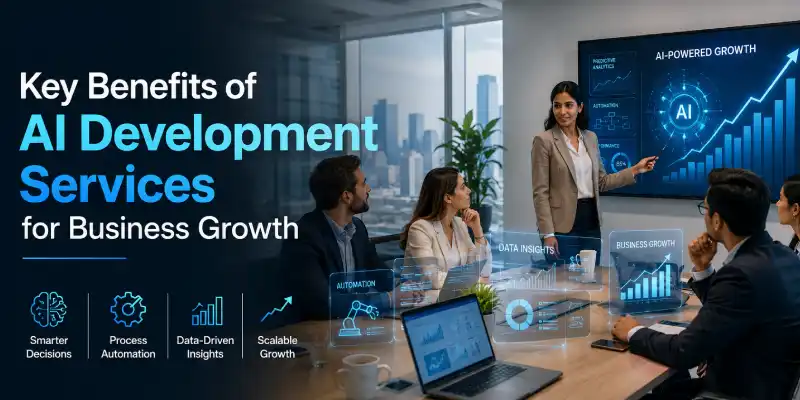
Key Benefits of AI Development Services for Business Growth
Lacking ideas is one of the reasons behind businesses struggling to grow, but for most, the struggle comes from difficulty in managing operations as they become complex.
More customers create more support requests. More transactions generate more data. More scaling usually means more manual processes, more inefficiencies, and slower decision-making.
At some point, traditional workflows stop scaling efficiently. That’s where AI starts becoming valuable, not as a futuristic experiment, but as a practical business tool.
The companies seeing the biggest impact from AI right now are using it to remove operational friction, improve responsiveness, and make growth more sustainable.
AI Changes How Businesses Scale
Growth used to depend heavily on adding more people to handle more work. That model becomes expensive quickly. AI introduces a different approach.
Instead of scaling primarily through headcount, businesses can scale through automation, predictive systems, and smarter operational workflows. This is one reason demand for AI development services for business growth has accelerated so rapidly across industries.
The goal is no longer just efficiency — it’s efficiency that can be scaled.
Automation Reduces Operational Pressure
One of the most immediate benefits of AI is automation. But the real advantage isn’t simply reducing repetitive work; it’s freeing teams to focus on higher-value tasks.
AI business automation solutions are now commonly used for:
- Customer support workflows
- Data processing
- Internal reporting
- Document analysis
- Scheduling and operational coordination
These systems reduce delays and improve consistency without requiring constant manual oversight. McKinsey & Company says that businesses adopting AI-driven automation are increasingly reporting measurable productivity gains and operational improvements.
Faster Decision-Making Creates Competitive Advantage
Many businesses already collect large amounts of data. The challenge is interpreting that information quickly enough to act on it. AI helps businesses process and analyze data in real time, allowing teams to make faster and more informed decisions.
This can improve:
- Demand forecasting
- Customer retention strategies
- Inventory planning
- Marketing optimization
- Financial risk assessment
Instead of reacting after problems occur, businesses can identify patterns earlier and respond proactively. Over time, that responsiveness becomes a major competitive advantage.
Customer Experiences Become More Personalized
Consumers increasingly expect businesses to understand their preferences. Generic communication performs worse than it used to. AI allows companies to personalize experiences at scale by analyzing customer behavior and adapting interactions accordingly. This includes:
- Product recommendations
- Personalized offers
- Dynamic content experiences
- Customer support interactions
Businesses that personalize effectively often see stronger engagement and higher retention rates because interactions feel more relevant. That’s why many organizations work with an experienced AI transformation agency to build scalable personalization systems.
AI Helps Businesses Operate More Efficiently
Operational inefficiency becomes more expensive as businesses grow. Manual processes that seem manageable early on often become bottlenecks later. AI helps streamline operations by reducing repetitive decision-making and improving workflow coordination. For example:
- Logistics companies use AI for route optimization
- Retailers use it for demand forecasting
- Financial firms use it for fraud detection
- Gaming companies use it for player behavior analysis
These improvements may seem incremental individually, but they compound significantly over time.
AI Improves Responsiveness
Modern markets move quickly. Customer expectations shift fast. Trends change rapidly. Delayed responses often lead to lost opportunities.
AI systems help businesses react more quickly because they can monitor activity continuously and generate insights in real time. This allows companies to:
- Identify emerging trends earlier
- Detect operational issues faster
- Respond to customer behavior more effectively
In highly competitive industries, responsiveness often matters as much as innovation itself.
Growth Becomes Predictable
One underrated benefit of AI is predictability. Businesses often struggle with uncertainty around:
- Customer churn
- Revenue fluctuations
- Demand changes
- Operational bottlenecks
AI systems help reduce uncertainty by identifying patterns humans may overlook. Predictive analytics models can estimate future outcomes based on historical and real-time data, helping businesses plan more confidently.
This is particularly valuable for scaling businesses trying to manage growth without losing operational control.
AI Adoption Is Expanding Across Industries
AI is no longer concentrated within large technology firms. Businesses across industries continue increasing AI adoption to improve efficiency and automation capabilities.
- Healthcare organizations use AI for diagnostics support
- Retailers use it for personalization and inventory forecasting
- Financial companies use it for fraud prevention
- Gaming businesses use it for engagement optimization
Businesses Need More Than AI Tools
One reason AI projects fail is that businesses often focus too heavily on tools instead of an implementation strategy. Technology alone rarely creates results. Successful adoption depends on:
- Workflow integration
- Data quality
- Scalability planning
- Long-term optimization
That’s why businesses increasingly work with an experienced AI development company or AI growth partner rather than trying to manage AI implementation entirely internally.
The right partner helps ensure AI systems solve real operational problems instead of becoming disconnected experiments. Red Apple Technologies is committed to supporting businesses with AI-driven systems designed around operational efficiency, automation, and scalable growth objectives.
AI Creates Long-Term Operational Advantages
One of the biggest misconceptions about AI is that its value comes from short-term productivity gains. The larger impact usually appears gradually.
Better forecasting improves planning.
Automation reduces operational strain.
Personalization improves retention.
Faster insights improve responsiveness.
Over time, these advantages compound. Businesses become more efficient, more adaptive, and more scalable than competitors relying heavily on manual systems.
The Companies Moving Early Are Building Stronger Foundations
AI adoption is still uneven across industries. Some businesses are already deeply integrating AI into operations, while others are still evaluating where it fits. That gap creates opportunity.
Companies implementing AI strategically today are building operational systems that may become difficult for slower competitors to match later. Since AI systems improve over time through continuous learning and optimization, early implementation often creates long-term advantages.
Final Thought
AI development services are not just about automation. They’re about building businesses that can grow more efficiently, make better decisions, and adapt faster as markets evolve.
The companies benefiting most from AI right now are not simply using more technology; they’re using it more intelligently. And increasingly, that difference is becoming a major driver of long-term business growth.
To Have A Better Understanding On This Let us Answer The Following Questions
Answer: They are AI-powered solutions designed to improve automation, decision-making, operational efficiency, and scalability for businesses.
Answer: They reduce repetitive manual work, improve workflow efficiency, and allow teams to focus on higher-value tasks.
Answer: An experienced AI development company helps businesses implement scalable AI systems aligned with operational and growth objectives.
Answer: An AI transformation agency helps businesses integrate AI into workflows, operations, analytics, and customer experiences.
Answer: An AI growth partner supports businesses with AI-driven strategies that improve scalability, efficiency, and long-term operational performance.
Get Started
- End-to-End Game & App Development Services
- Flexible Business Models – Project Based or Dedicated Hiring
- 13+ Years of Industry Experience with Global Clientele
- Globally Recognized by Clutch, GoodFirms & DesignRush
Related Blogs
Discover more stories & insights that inspire
Right now, finding an AI development company feels a little like walking into a crowded market where everyone is claiming to have the “next big thing.” Every agency talks about...
From science fiction to our daily assistant, artificial intelligence (AI) has become part of our lives faster than we imagined. A few years ago, businesses discussed AI cautiously. Today, it...
Inefficiency is not noticed immediately. It builds slowly, and most businesses notice it late. A few extra hours spent on reporting. Delays in customer support responses. Teams are manually repeating...
Most businesses already know AI matters. The problem is that many still don’t know where it actually fits. Some assume AI is only for large tech companies. Others think it’s...

In the past few years, San Francisco has become the center of the modern AI economy, not just because major AI companies are headquartered there but because the city has...
A lot of businesses are talking about AI right now. Far fewer are using it in ways that actually improve operations, reduce costs, or create measurable growth. That gap matters....
Artificial Intelligence (AI) is literally the powerhouse in every market, including stocks. Today’s lightning-fast stock markets were in much need of innovation for trading activities. In just a few years,...
The real estate industry, once driven by intuition and manual processes, is now undergoing a powerful digital transformation, and Artificial Intelligence is at the heart of it. From predicting property...

Artificial Intelligence (AI) is ushering in a new era of personalized learning, efficient administration, and empowered educators. By now, AI-powered tools have become essential in classrooms globally, from K-12 to...

Esports is the market. It is a multi-billion-dollar global industry, drawing millions of viewers and fostering an elite competitive talent pool across a wide variety of games. As esports matures,...


 Book An Appointment
 WhatsApp