


- Blog
- >
- AI in Banking
- >
- AI in Banking: AI...
AI in Banking: AI Powers Secure, Personalized Banking Experiences
AI is giving the banking sector a significant boost, powering the front, middle, and back-end, and improving both internal operations and customer-centric applications. Whether it is about regulatory compliance, managing wealth, detecting potential fraud, or providing remarkable customer service, AI in banking and finance has been enhancing various functions at all angles.
All kinds of financial service providers are embracing digital transformation to stay in the fintech trend loop. Artificial intelligence has come beyond being a choice. Its steady evolution has turned it into a must-have component of the banking sector. But how does it help, and what potential does it promise?
What Made AI Part of Banking?
Financial services have hardly been known to innovate. According to McKinsey, Legacy banks lag 40% behind digital natives in productivity. Generative AI in banking could add between $200 billion and $340 billion annually, mainly through automation and productivity boost.
For a long time, bankers have been using natural language processing (NLP) to analyze vast data. Analytics tools help them acquire insights that help them make informed decisions, be it in terms of wealth management or investments.
Now, banks have embraced AI technologies to give them a fair advantage in the modern era. Users desire smooth banking experiences, and in the digital world, apps must anticipate what they need. If they run into problems, they want to interact with virtual/real-world assistants who can help them find a solution.
If you want customers to be happy, you have to improve their user experience, and you can do that seamlessly with generative AI and efficient data management.
At Red Apple Technologies, we believe that the banking sector can leverage the maximum potential of AI by fusing it with automation. By doing this, you get AI-fueled automation that is the best of both worlds: advanced artificial intelligence and effective automation.
Although AI in banking sector gained popularity in just a few years, the technology has come a long way. AI agents can make decisions autonomously. They can verify documents, guide a loan application fill-up, interact with customers, check creditworthiness, and detect compliance failures. One of the biggest advantages is that AI can adapt to information updates and make decisions without following predetermined rules; result: real-time decision making with minimal human intervention.
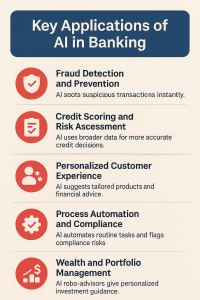
Key Applications of AI in Banking
AI is streamlining financial operations and heightening customer experiences across multiple domains. Its integration is not limited to chatbots or fraud detection but extends to predictive analysis, risk modeling, and hyper-personalization.
Fraud Detection and Prevention
AI models analyze millions of transactions in real time, identifying irregular patterns and potential fraud before they become severe. Advanced anomaly detection algorithms continuously learn from new data, enhancing fraud prevention accuracy without compromising customer experience.
Credit Scoring and Risk Assessment
Traditional credit checks often overlook valuable data points. AI, however, analyzes alternative data such as spending behavior, social signals, and digital footprints to offer a more holistic assessment of creditworthiness, expanding financial inclusion.
Personalized Customer Experience
Generative AI allows banks to tailor financial advice and product recommendations to individual customers. Virtual assistants proactively suggest optimal credit cards, savings plans, or loan offers based on behavioral insights.
Process Automation and Compliance
Routine back-office tasks, like KYC verification, documentation, and claim processing, are automated using intelligent document processing (IDP). AI also helps ensure adherence to fast-changing regulatory frameworks by analyzing compliance reports and identifying risks early.
Wealth and Portfolio Management
Robo-advisors powered by generative AI provide personalized investment insights, enabling even small-scale investors to access wealth management services once reserved for high-net-worth individuals.
Use Cases of AI in Banking
The use of generative AI in banking is broad and transformative. Here are some use cases that demonstrate its powerful applications:
Loan Processing Automation: AI-powered systems can evaluate loan applications by verifying identity, analyzing credit histories, and assessing risk, all within minutes. This reduces turnaround times drastically and improves customer satisfaction.
Chatbots and Virtual Assistants: Banks use AI chatbots to provide 24/7 customer support, handling routine inquiries such as balance checks, transaction histories, and FAQs. This frees up human agents to focus on more complex tasks.
Anti-Money Laundering (AML): Machine learning models scan thousands of transactions to detect suspicious activity patterns that may indicate money laundering. These models adapt to evolving tactics, enhancing regulatory compliance.
Predictive Analytics for Customer Retention: AI analyzes customer behavior to predict churn, enabling banks to proactively engage customers with personalized offers or interventions.
Sentiment Analysis on Customer Feedback: Natural language processing tools analyze customer reviews, social media comments, and call transcripts to gauge sentiment and inform service improvement.
The Future Potential: Generative AI and Automation Fusion
The real power of AI in banking lies in integrating automation with advanced language and reasoning models. When generative AI collaborates with robotic process automation (RPA), banks can build truly cognitive systems, ones that understand, reason, and act faster than any human team.
This synergy drives:
- Continuous process optimization
- Instant customer query resolution
- Enhanced risk forecasting and mitigation
- Personalized, compliant, and proactive customer engagement
Important Steps Banks Should Take to Adopt AI
Looking for AI app development companies to build an AI app for your organization? There are many things to consider when approaching AI, but these should be your primary focus:
Modify Your Business Model
If you are new to the world of AI or your bank is yet to adopt it, you need to revamp your business strategies. It will change how you serve clients; you are going to get off the conventional grid and enable them to bank with you anywhere, anytime. Use AI to expand advisory services and unlock new fee opportunities across retail, businesses, and investment banking. Remember, payments aren’t just transactions; they are a gateway to better AI risk intelligence.
Fine-Tune Your Risk Management Culture
Drive software development with AI while ensuring that complexity does not increase. With accelerating innovation, managing compliance and security across the platform is crucial. Improve data governance to safeguard confidentiality and integrity, making sure that the AI models stand on robust frameworks to reduce the chances of legal problems and data breaches.
Increase Operational Efficiency
Identify high-impact workloads to make them digital-friendly with enhanced offerings. With the adoption of AI, you can make your processes 360°, which will contribute to increased efficiency.
Train Your Employees
Introducing something that is heavily technology-forward out of the blue can cause more hindrances than it can help; that is, unless your bankers are ready. Provide education programs and training on using artificial intelligence to streamline workflow. Teach bankers to embrace the digital transformation without delaying reskilling.
Challenges to Implementing AI in Banking
Data Governance
Data is the lifeblood of AI, but it also presents a major hurdle. While banks sit on vast troves of information, much of it is siloed, unstructured, or riddled with quality issues. Moreover, strict privacy regulations and internal governance policies often restrict access to the very data that could power smarter models. Without clean, accessible, and well-governed data, AI initiatives struggle to get off the ground.
Lack of Control
AI models are not capable of reasoning—they do not understand their outputs. They read patterns in the input data and produce results. So, you cannot expect your AI app to tell you if the data is inaccurate. In a highly regulated sector like banking, it can be complex, so bankers must understand how an AI model made its decision.
Cybersecurity
Although AI fraud detection banking has become easier, there are possible security risks. In the present world, AI models are probably the most viable malicious targets. This is why AI governance is critical to risk management.
Regulatory Complexity
This is another layer of difficulty. Financial institutions must ensure that AI systems are explainable, auditable, and compliant with evolving legal standards. This is especially critical in areas like credit scoring, anti-money laundering, and algorithmic trading, where opaque models can lead to legal exposure or reputational damage.
Red Apple Technologies Empowers Banks with Innovative AI Tech
We are passionate about pushing the boundaries of AI and automation in financial services. Our mission is to empower banks and fintech companies to harness the full potential of AI, helping them stay competitive in a rapidly evolving landscape.
Tailored AI Solutions: We design and deploy customized AI models that seamlessly integrate with existing banking infrastructures, ensuring minimal disruption and maximum impact.
End-to-End Automation: By blending advanced AI with process automation, we deliver solutions that transform tedious manual workflows into agile, efficient operations.
Customer-Centric Innovations: Our AI-powered chatbots and virtual assistants provide human-like interactions, enabling banks to deliver exceptional customer experiences round the clock.
Compliance and Security Focus: Understanding the critical nature of regulatory compliance, we provide AI app development services that keep data secure and help banks stay ahead of regulatory requirements.
Teaming up with us means equipping your bank with the latest AI innovations, future-proofing your services, and delivering unmatched value to your customers.
Conclusion: Why Should Financial Service Providing Organizations Adopt AI?
The future of banking belongs to intelligent ecosystems that merge data-driven insights with empathetic user experiences. With generative AI evolving rapidly, financial institutions have the opportunity to redefine trust, efficiency, and inclusivity in every customer interaction. At Red Apple Technologies, we help banks embrace this transformation by creating scalable, AI-powered solutions that ensure success in a digital-first era.
To Have A Better Understanding On This Let us Answer The Following Questions
Answer: AI systems handle vast amounts of sensitive financial data, raising concerns about privacy and security. Banks must implement strong data governance, encryption, and compliance frameworks to protect customer information while leveraging AI capabilities. Ensuring transparency and adherence to regulations like GDPR or equivalent is critical for maintaining trust.
Answer:
Use diverse and representative data sets to train AI models, reducing the risk of bias from skewed data.
- Continuously monitor AI outputs for signs of bias or unfair treatment and adjust models accordingly.
- Implement explainability tools that provide clear reasoning behind AI decisions to promote transparency.
- Regularly conduct audits and impact assessments to identify, measure, and mitigate potential discriminatory effects.
- Involve multidisciplinary teams, including ethicists, data scientists, and legal experts, to oversee AI governance.
- Adopt ethical AI frameworks and compliance standards tailored to the financial industry to align with regulatory demands.
Answer: Implement hybrid approaches that allow AI modules to operate alongside legacy infrastructure. Gradually modernize systems instead of complete overhauls to avoid operational disruptions. Use APIs and middleware to connect new AI solutions with existing legacy applications seamlessly.
Answer: Though AI enables automation and real-time decisions, human oversight remains essential. Bank professionals validate AI recommendations, handle exceptions, and ensure compliance with legal and ethical standards. This hybrid approach balances efficiency with accountability.
Answer: Partner with AI vendors or fintech firms that offer AI-as-a-service solutions. Utilize cloud-based AI platforms, which require less upfront investment and infrastructure. Focus on high-impact areas like fraud detection or customer support initially, gradually scaling AI use.

Related Blogs
Discover more stories & insights that inspire
Right now, finding an AI development company feels a little like walking into a crowded market where everyone is claiming to have the “next big thing.” Every agency talks about...
From science fiction to our daily assistant, artificial intelligence (AI) has become part of our lives faster than we imagined. A few years ago, businesses discussed AI cautiously. Today, it...

In the past few years, San Francisco has become the center of the modern AI economy, not just because major AI companies are headquartered there but because the city has...

Artificial Intelligence (AI) is literally the powerhouse in every market, including stocks. Today’s lightning-fast stock markets were in much need of innovation for trading activities. In just a few years,...

The real estate industry, once driven by intuition and manual processes, is now undergoing a powerful digital transformation, and Artificial Intelligence is at the heart of it. From predicting property...

Artificial Intelligence (AI) is ushering in a new era of personalized learning, efficient administration, and empowered educators. By now, AI-powered tools have become essential in classrooms globally, from K-12 to...

Esports is the market. It is a multi-billion-dollar global industry, drawing millions of viewers and fostering an elite competitive talent pool across a wide variety of games. As esports matures,...

Artificial Intelligence (is becoming) has become the backbone of modern game development and player experience. If you don’t think so, you’re fighting a losing battle. Sure, AI has been in...

Do you remember Orkut, Myspace, and Friendster? Some of the most popular social platforms of the 2000s. It was all about adding friends, sending messages, and staying connected—ahh! The golden...

By now, we all know that AI is fundamentally transforming everything around us, and the retail and e-commerce landscape are among the primary ones to experience it, driving hyper-personalization, automation,...


 Book An Appointment
 WhatsApp